Turn the Page into a Small Math Map
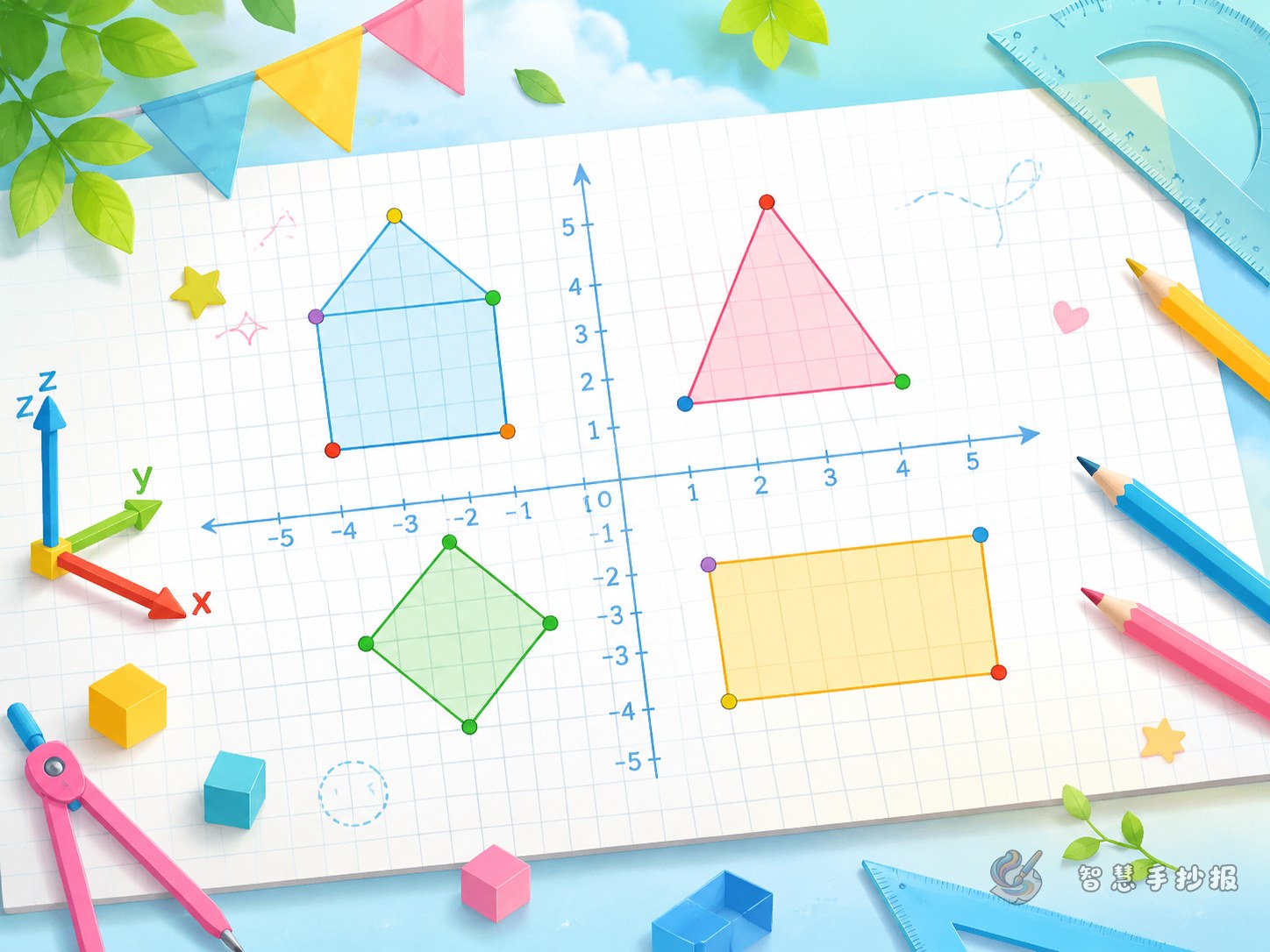
The charm of a coordinate grid poster is that it places geometry inside a world of positions and directions. Instead of only drawing triangles and rectangles, students can show where shapes are, how points connect, and how routes move across the grid.
Use a pencil to draw light grid lines first. A pale blue or light gray grid works well because it keeps the poster neat while leaving enough space for writing and coloring.
Useful Sections to Include
- Grid Basics: Rows go across, columns go up and down. A position can be found by checking both.
- Connect the Points: Mark several points on the grid and connect them to form triangles, rectangles, or trapezoids.
- Direction Route: Start from one point, move three squares right and two squares up, then mark the new place.
- Count the Squares: Count how many small squares a shape covers to get an early sense of area.
Each section should be short and visual. Three to five sentences are enough for a clear handwritten poster.
Ready-to-Use Writing Material
A coordinate grid is like a map with rules. Every square helps us find a position more accurately. When we mark points and connect them, different geometric shapes appear. By counting the squares inside a shape, we can also compare size and understand area. The grid shows us that math is not only about calculating, but also about observing, locating, and creating.
Layout Ideas That Add Spatial Depth
Place the Title in One Corner
Put the title in the upper left corner and use block-style letters. A small challenge box can be placed in the lower right corner, such as “Can you find the treasure?”
Use Color for Points, Lines, and Surfaces
Red dots can mark points, blue lines can show connections, and light yellow or orange can fill the shapes. This makes point-line-surface relationships easier to see.
Keep the Grid Clean
A grid poster can easily become too busy. Leave one or two grid spaces between sections so the page looks organized and readable.
Add a Hands-on Challenge
- Draw an 8 by 8 or 10 by 10 grid.
- Mark a starting point, an ending point, and several key points.
- Use a ruler to connect points into simple shapes.
- Write route instructions using up, down, left, and right.
- Add light colors and check whether the text is easy to read.
If you want to organize the title, columns, borders, and writing materials more quickly, you can continue making your poster in the 智慧手抄报 WeChat mini program.