Why a Round Shape Is the Easiest Hero for a Tulou Page
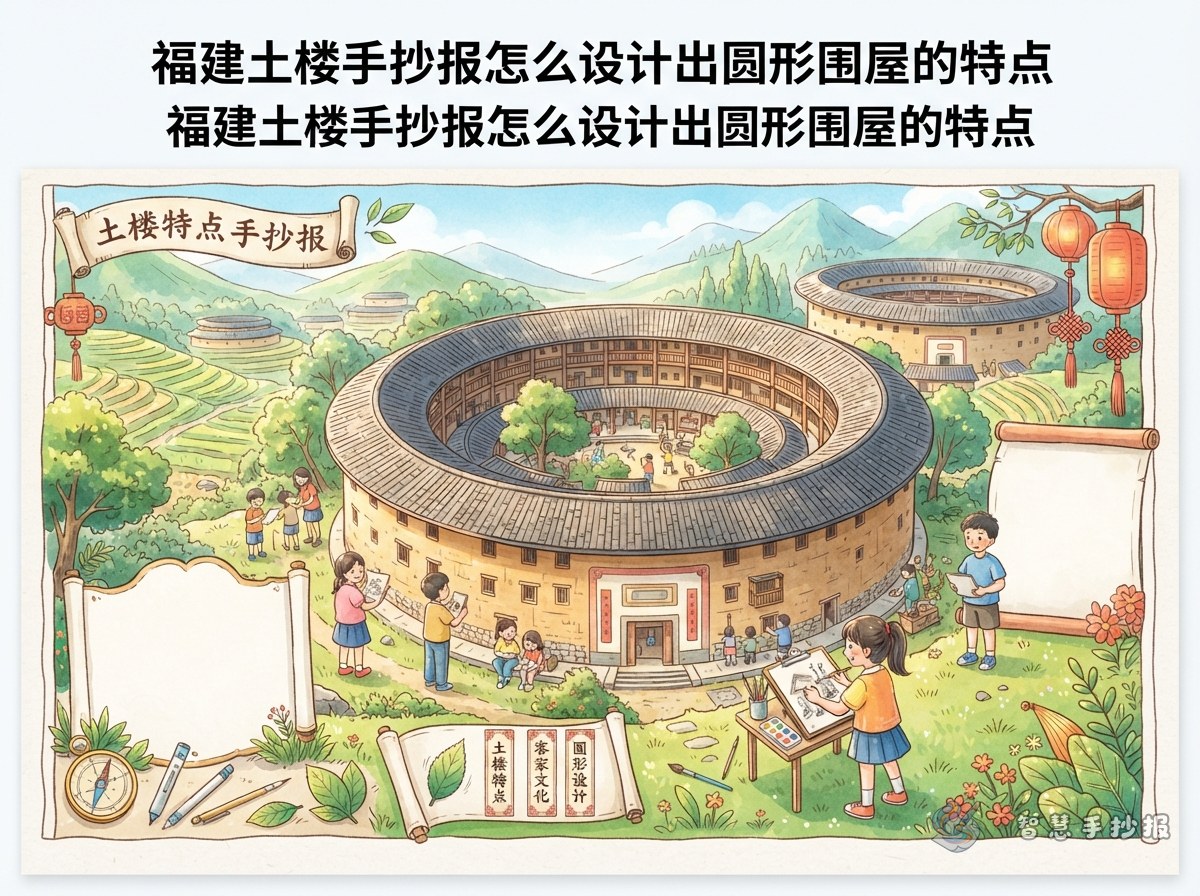
When students hear the words traditional Chinese architecture, they usually think of the Great Wall or the Forbidden City first. Fujian tulou can feel harder to start, until you notice one thing: the whole building is a circle. A round outer wall, a shared courtyard, ring after ring of tiled roofs. Build the page around that shape and the topic becomes instantly recognisable.
- A circle is a complete shape on its own, so the middle of the page never looks empty.
- It divides the paper into an inside and an outside, which makes placing text boxes much easier.
- Roof tiles, small windows and red lanterns under the eaves are simple, pretty details to draw.
Remember what the page is for: it introduces the Fujian tulou, it is not an architectural drawing. So the circle can be a little bolder or cuter than the real thing, and nobody expects exact proportions.
Two Layout Plans That Turn the Circle Into a Frame
Plan A: One Big Circle in the Middle
Draw a large circle in the centre of the sheet. Put your main title, or a sketch of the tulou front, inside it. Then leave a long text box in each of the four corners. This is the safest plan and a good choice for a first tulou project.
Plan B: A Bird's-Eye Tulou as a Reading Path
Draw a set of rings to show the tulou seen from above. Readers move inward: the outer ring explains what a tulou is, the middle ring explains why it was built round, and the centre describes daily life inside the building. The whole layout reads as one image.
- Sketch the circle lightly in pencil and check that it does not touch the paper edge.
- Mark out three or four text boxes with a ruler or by hand.
- Add the title lettering last, at the top of the circle or just inside its upper edge, where it stands out most.
Whatever plan you pick, follow one rule: lay out first, write later. The most common reason for redoing a page is running out of room for drawings after the writing is already done.
Notes You Can Copy Straight Into the Boxes
You do not need much text. Each box only has to explain one idea clearly. These directions all work well for primary school students:
- What a tulou is: a large family home built from rammed earth and timber, usually round or square.
- Why it is round: houses stand in a full circle so relatives live close together, share a central courtyard and can look after one another.
- Walls and roofs: thick earth walls, wooden beams and columns, and layer upon layer of tiled roof are the three parts that make a tulou easy to recognise.
- Famous groups: Chengqi Lou in Yongding, Fujian, is often called the king of tulou, and the Tianluokeng cluster in Nanjing County is remembered for several buildings standing together.
- World heritage: Fujian tulou are listed as a UNESCO World Heritage site, which is a strong reason to include them in your page.
If a corner is still empty, add one short personal line, such as life inside a round house means the whole family meets every day. It is easy to write and gives the page a warm touch.
Colour, Lettering, and Small Decorations
- Main colours: earth yellow and light brown for the rammed earth walls, dark grey or blue grey for the roofs.
- Accents: a little green for hills and trees, a little red for lanterns and paper cut windows, and the page brightens up.
- Title lettering: use block letters or a slightly thick cartoon style, one shade darker than the body text, and keep the whole sheet to about three main colours.
- Borders: tile patterns, meander patterns or simple leaves around the text boxes are enough.
White space matters too. Leave a little room between the circle and the boxes, and near the edges of the paper, so nothing looks crowded.
Quick Check Before You Hand It In
- The title is big enough that anyone can tell the topic is the Fujian tulou.
- Every box has content, with no empty frames left behind.
- Writing sits on straight lines, helped by faint pencil guides.
- Colours are consistent and neatly filled without going over the lines.
- Your name and class are written, and the page is free of stray pencil marks.
If you want a more polished round layout, open the ZhiHui ShouChaoBao WeChat mini program, choose the traditional Chinese architecture theme, pick a layout and note set that fits, then adjust it to your own idea. It saves a lot of time compared with starting from a blank sheet.