Why “one bucket, many uses” suits a water-saving poster
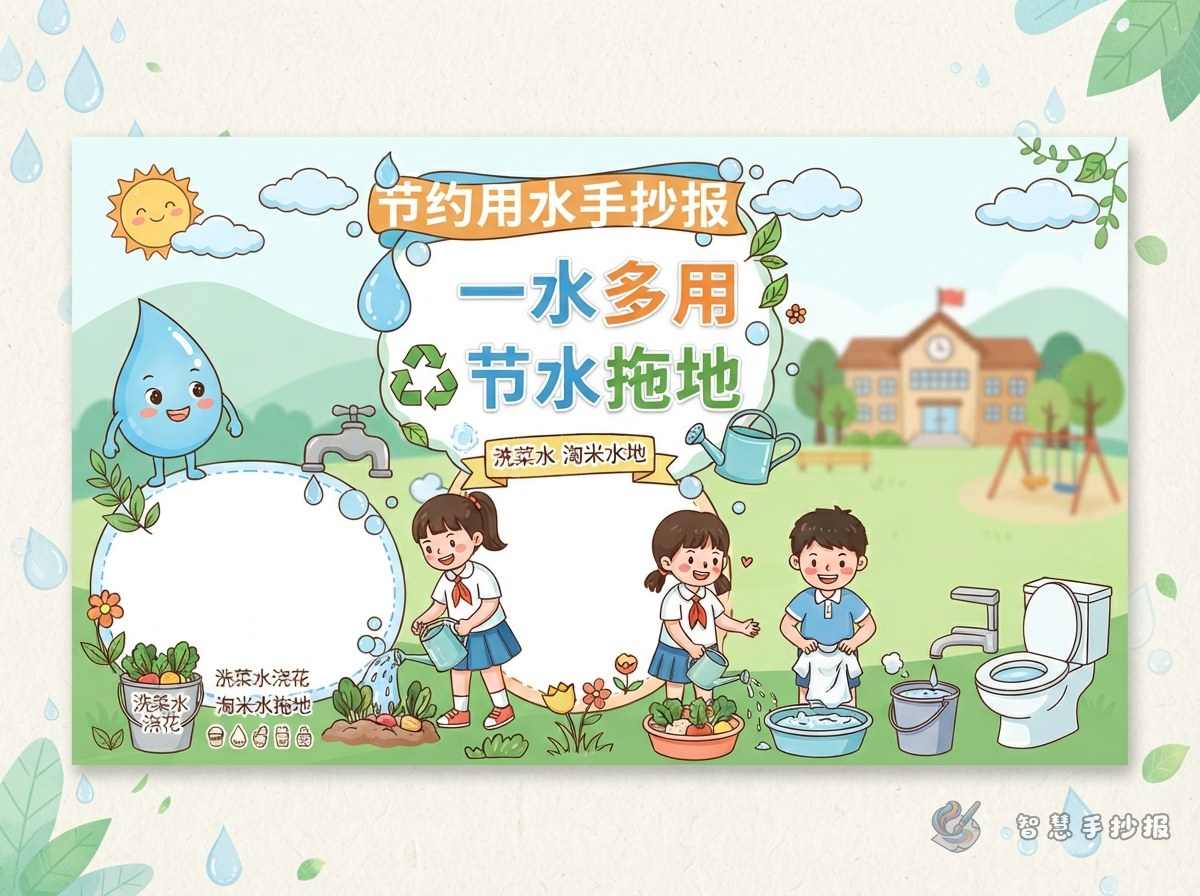
There are many things you can write about saving water, but a page full of “turn off the tap” lines can look thin. Multi-use water is different: it is visible and doable. One basin of water can rinse vegetables, wipe the table, and then flush the toilet, and that single route can carry the whole poster with a few arrows and small icons.
Pick three talking points before you draw
A short water route
For example, “rice water - plants”, “vegetable water - toilet”, or “cold shower water - mopping”. Keep it to three steps at most, or the page starts to read like a manual.
A simple before-and-after
Use two small drawings of basins or cups to show water being used once and water being used twice. A simple picture explains the difference faster than a paragraph.
One sentence in your own voice
Save a small corner for “My promise” and write something your family actually does, such as “I carry the rice water to the flower pot”.
Sentences you can copy or rewrite
- Don't pour rice water away - it is just right for plants.
- Water from washing vegetables or fruit is fairly clean, so save it for the toilet or the floor.
- Laundry water can stay in the basin for mopping or flushing.
- On a rainy day, catch a little rainwater in a bucket for plants or the mop.
- Catch the cold water before a shower and use it for rags or the toilet.
- Water is not finished after one job - it can still work somewhere else.
Feel free to change these lines so they sound like your own home.
Layout: let a water route run through the page
- Draw a curved water-drop path in the middle or slightly left of the page, linked with arrows.
- At each bend, draw a small circle or box and write one use inside.
- Keep two text blocks on either side: one for “Why use water twice?” and one for “What my family can do”.
- Leave the top right corner for the title, such as “A Drop's Journey” or “Let Water Work Twice”.
- Add water drops, taps, buckets or small clouds along the border, but do not fill every space.
The advantage is simple: a reader who follows the route once understands the whole page without hunting for the main idea.
Colors and small details that keep it clean
- Use blue, light blue and teal as the main colors, with a little yellow or pale orange as an accent.
- A light blue background behind text is fine, but write in dark blue or black so it stays readable.
- Make the water drops different sizes instead of repeating one shape.
- Leave a strip of white space between columns so the words do not crowd together.
- Keep the title one or two sizes larger than the body text; bigger is not always better.
A quick way to finish the poster
Sketch the route and column positions on scrap paper first to check that your sentences fit, then copy everything neatly onto the final sheet. If time is short, you can also open the Smart Handwritten Newspaper mini program in WeChat, choose a water-saving layout, and swap in your own multi-use examples. Print it or copy it by hand, and the page still belongs to you.