Choosing a Focus for Your India Handwritten Newspaper
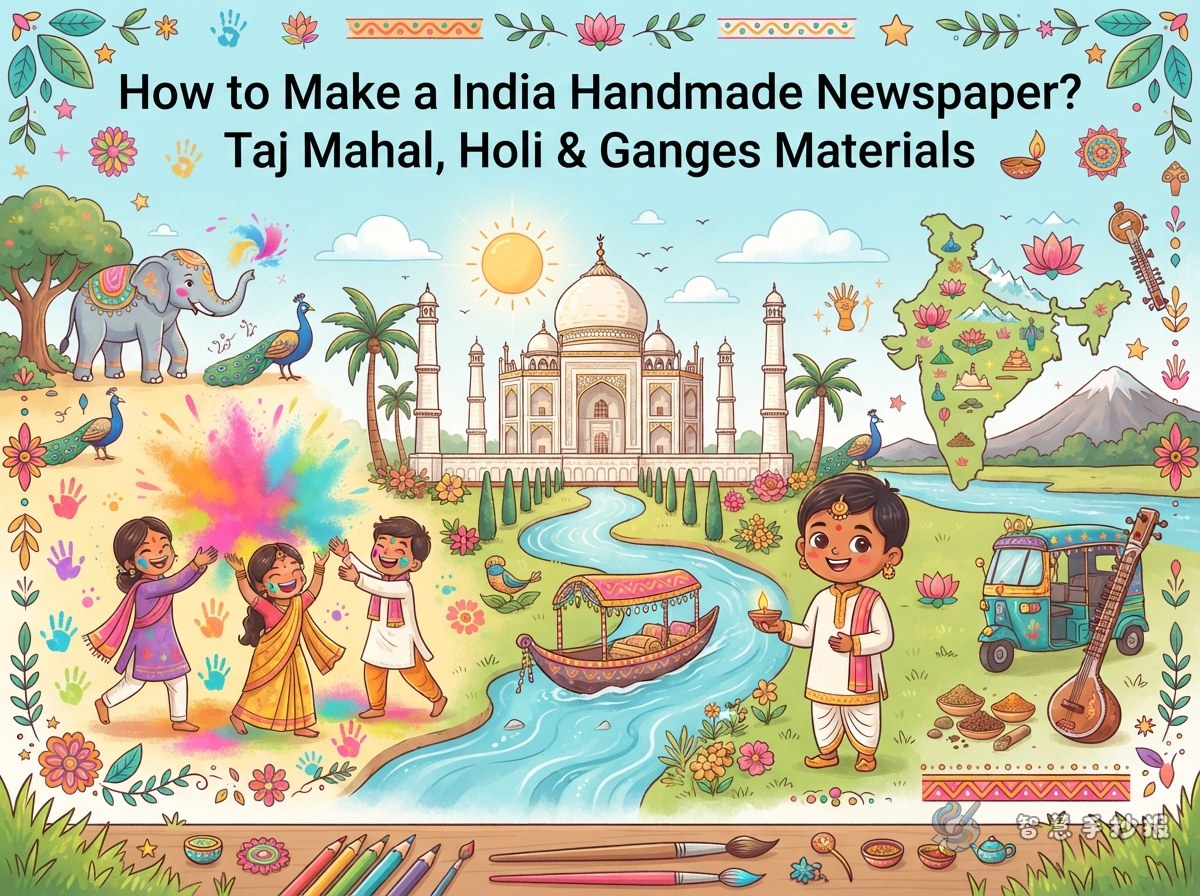
India has so many possible topics that the page can easily become a list of unrelated facts. A simple approach for primary school students is to pick three or four things you can actually picture: one building, one festival, one river and one everyday detail. The Taj Mahal can be the building, Holi the festival, the Ganges the river, and yoga or spices the everyday detail. This gives the handwritten newspaper both geography and culture.
After choosing the focus, decide on a main title. Short titles such as "A Country of Color and Belief", "From the Taj Mahal to the Ganges" or "Incredible India" work well. Keep it to a few words so it stands out.
Facts and Details You Can Put on the Page
The Taj Mahal: A White Marble Memory
The Taj Mahal stands in Agra, in the northern state of Uttar Pradesh. It is a tomb built from white marble. At sunrise and sunset the stone seems to change color, and the long reflecting pool makes it look as if the building is floating. On your page you can mention three easy details: the large central dome, the small domes on both sides, and the reflection in the water. You do not need to memorize dates; the picture words are enough.
Holi: A Festival of Flying Color
Holi is a spring festival in India. People throw colored powder at each other and the streets fill with clouds of color. When you write about Holi, use three key words: color, laughter and spring. For the drawing, simple figures holding small bags of powder, surrounded by colored dots, will capture the mood.
The Ganges and Varanasi: Steps by the River
The Ganges is a sacred river for many Indians, and Varanasi is an ancient city on its banks. In the early morning, people gather on the stone steps to pray, bathe and float small lamps. For a school handwritten newspaper, there is no need to discuss religion in depth. Focus on the images: morning light, stone steps, small lamps and the wide river.
Yoga, Spices and Everyday Life
- Yoga began in India and focuses on breathing, balance and stretching.
- Spices such as turmeric, cardamom and cinnamon are common in Indian kitchens.
- Curry is not one single dish; every region has its own style.
- Greeting: people often press their palms together and say "Namaste".
Layout: One Map, Three Columns
Divide the page into three areas. On the left third, draw a simple outline map of India and mark the Taj Mahal in the north and the Ganges in the northeast. In the middle and on the right, make three columns for building, festival and everyday life. The map does not need to be exact; it only needs to look like the diamond shape of India.
- Lightly sketch the map and the column borders in pencil.
- Add the main title across the top or down the left side.
- Write the small heading for each column first, then add two or three sentences.
- Finish with simple decorations: a Taj Mahal silhouette, colored powder, river steps and a yoga figure.
Use orange, green and blue as your main colors. Orange echoes Holi, green and blue echo spices and the river. Try to keep the palette to three or four colors so the page looks tidy.
Column Titles You Can Use
- Building column: Tears of White Marble, The Taj Mahal Reflected
- Festival column: Spring in the Air, The Festival of Color
- River column: Morning on the Ganges, Lamps on the Steps
- Everyday column: Yoga and Spices, Secrets of an Indian Kitchen
If your teacher asks for a geography fact box, add a small frame in the corner with the capital, location, neighboring countries and main languages. Keep each line short.
Simple Version and Detailed Version
For younger students, keep only the Taj Mahal and Holi, use larger drawings and one or two sentences per section. The map can be a simple outline with a few dots. Older students can add the Ganges, yoga and spices, plus a geography fact box and a "What I Found Interesting" section.
If you want to save time on layout, you can open the World Countries and Culture theme in the 智慧手抄报 WeChat mini program, replace the text and colors, and then copy the arrangement by hand.