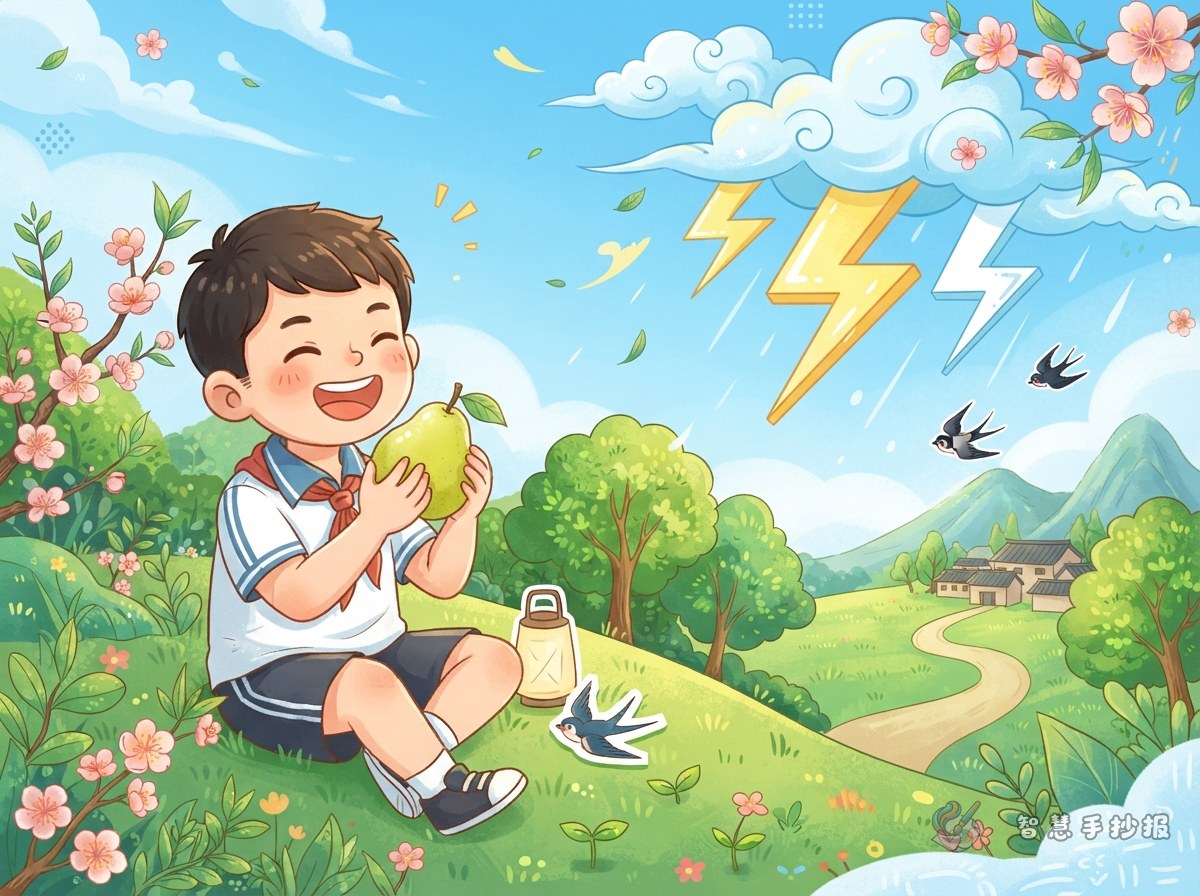
Start With One Image: Spring Thunder Over the Fields
Jingzhe is easy to recognise because of one moment: thunder rolls and the sleeping insects wake up. Give that moment the centre of your page, and let everything else support it.
- A lightning bolt cutting through low clouds, with slanted rain lines.
- A small crack in the soil with a ladybird or earthworm peeking out.
- Willow twigs with new buds, and a field that has just been ploughed.
Once these three elements are fixed, the rest of the layout becomes much easier to plan.
Folk Customs You Can Actually Write About
Eating pears
In many places people eat pears at Jingzhe. Spring air is dry, and pears are full of water; the word for pear also sounds like 'parting', so it carries a wish to stay away from illness. Write two or three sentences and draw a pear cut in half beside them.
Shooing away the 'villain'
Some regions have an old custom of symbolically driving away bad luck. For a school project, a small box with one clear sentence is enough. You can turn the idea into something positive, such as driving away bad habits.
Small details worth one line
Customs like offering sacrifices to the white tiger are less familiar, so mention them briefly in a 'did you know' corner instead of giving them a whole section.
Words, Sayings and Short Lines for the Text Boxes
If you have three text boxes, try this mix so the lengths vary and the page reads comfortably.
- The three Jingzhe phases: peach trees bloom, orioles sing, hawks change into doves. Add a tiny icon for each.
- Farming proverbs: 'If you do not plough at Jingzhe, you will not wait more than a few days.'
- Short lines: 'One roll of thunder, and the whole world wakes.'
Write the line you care about most in colour, keep the rest in black, and leave a little extra space between characters.
Layout Plan: Let the Thunder Run Down the Page
A top-to-bottom layout suits Jingzhe well. Use the upper third for clouds and lightning, keep a large open area in the middle for the main picture, and place two or three text boxes along the bottom.
- A tall narrow box on the left for customs, a round box on the right for the three phases.
- The title sits beside the storm clouds, in the largest letters on the page.
- Add insects, sprouts and raindrops in the corners, but do not fill every gap.
Borders do not need to be perfectly straight. Cloud shapes and wavy lines fit the mood of Jingzhe nicely.
Quick Checklist Before You Start Writing
- Can the title be read at a glance without fighting the illustration?
- Is the text split into at least three blocks, without any long paragraphs?
- Are you using four colours or fewer, with green as the main tone?
- Is there space at the bottom for your name and class?
If you would rather not begin with a blank sheet, open the 智慧手抄报 WeChat mini program, choose a Jingzhe layout, drop in the customs and proverbs above, then add a few drawings of your own before printing.