Decide the Four Questions Your Hail Poster Will Answer
Weather posters often turn into one long, unfocused paragraph. Before you start, split the topic into four questions and give each one its own box, so readers understand your point at a glance.
- What is hail? Chunks of ice falling from a cloud, from pea size to egg size.
- Why in summer? The hotter the ground, the faster air rises and the stronger the storm cloud.
- How harmful is it? It can damage crops, knock fruit off trees, and hurt people or animals.
- What should we do? Go indoors, stay away from windows, trees, and billboards.
Turn the four questions into four small headings and your poster already has a backbone.
Draw the Storm Cloud in Cross-Section
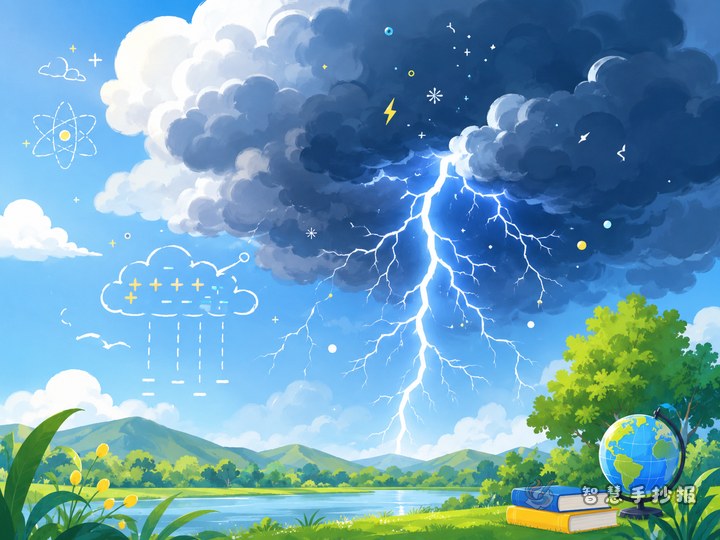
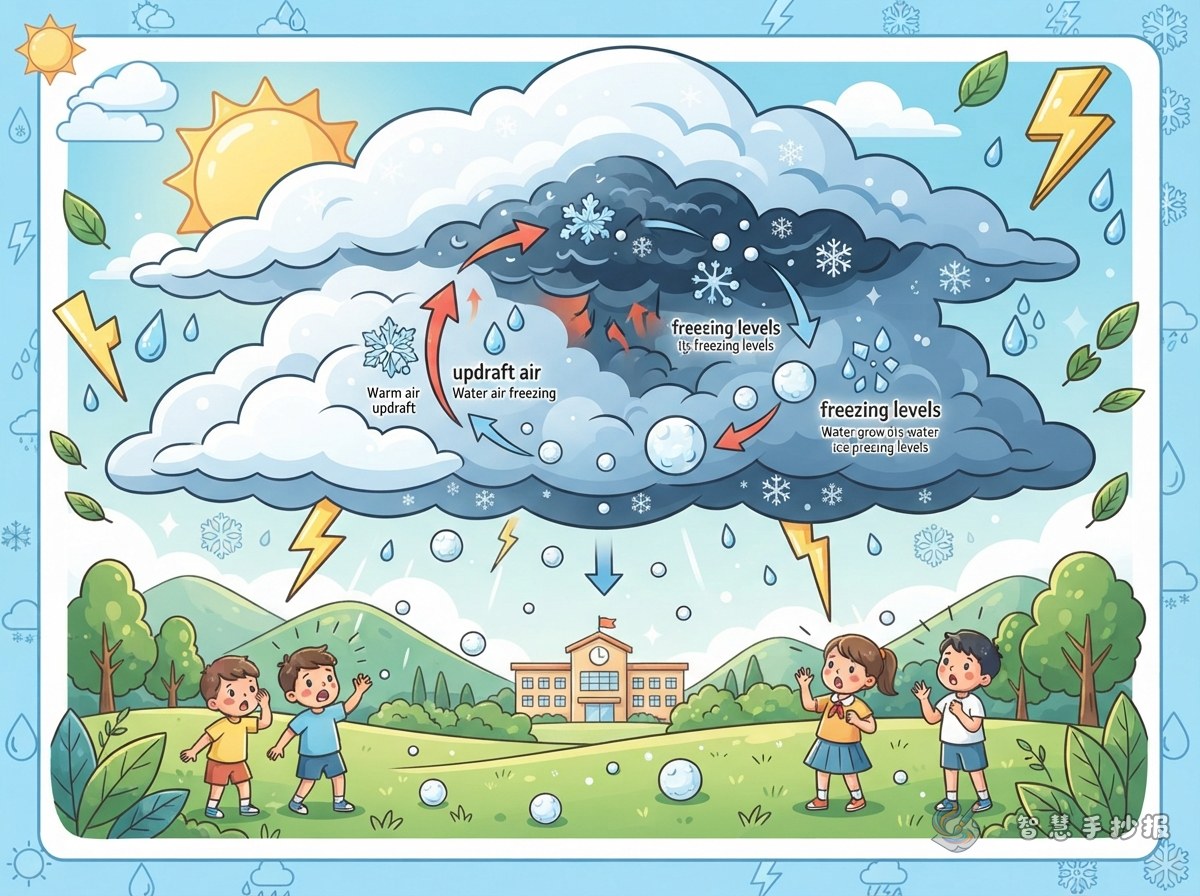
Hail formation is easy to show with arrows and numbers. Sketch one tall, thick thunderstorm cloud and label the steps beside it instead of writing a long paragraph.
- The summer sun heats the ground and moist air rises quickly.
- Several kilometers up, the air is below freezing, so droplets become tiny ice pellets.
- Updrafts toss the pellets up and down, coating them with supercooled water layer by layer.
- The ice grows heavier than the updraft can hold, and it falls as hail.
Add dots of different sizes inside the cloud to stand for ice pellets, and use curved arrows to show the up-down-up path. Then write one summary line: strong updraft, cold cloud layer, and repeated tumbling are the three key words of hail.
Science Snippets You Can Copy Onto the Page
How big can hail get?
Skip complicated numbers and compare it with everyday objects: pea size, bean size, ping-pong ball size, egg size. The bigger it is, the more dangerous. Draw a row of circles growing from small to large and make a simple hail size chart.
What weather comes with hail?
- Thunder and lightning
- Short bursts of heavy rain
- Gusty wind
- A clear drop in temperature before and after
Write safety reminders as tips
- When the sky darkens and thunder gets frequent, head indoors early.
- Never shelter under big trees, billboards, or flimsy sheds.
- If there is no shelter outdoors, cover your head with a bag, face away from the wind, and crouch down.
- After hail, the ground is slippery, so walk and ride slowly.
Layout Ideas That Make the Topic Obvious
Hail belongs to severe convective weather, so go for cool colors and a sense of motion instead of the usual sun and rainbow look.
- Title lettering: make the strokes thick, or use white letters with a blue outline to suggest blocks of ice.
- Main illustration: a thunderstorm cloud that is wide at the top and narrow at the bottom, with slanted rain lines and ice pellets below.
- Section shapes: a cloud-shaped frame on the left for the forming process, a rounded box on the right for safety tips, and a horizontal strip at the bottom for observations.
- Color choices: deep blue, lake blue, and gray-white as the base, with a touch of bright yellow for lightning. Keep enough white space.
- Border idea: link small ice crystals or tiny clouds into a border instead of using plain straight lines.
Quick Check Before You Hand It In
- Spell-check the title, headings, and body text.
- Make sure the science is consistent, not one place saying winter and another saying summer.
- Check that text and drawings are not crowded, and leave gaps between sections.
- Write your name, class, and date clearly.
If you want a tidier layout or a different set of borders and fonts, open the WeChat mini program and drop your finished text into a template to keep building. A clean weather science poster can be done in just a few minutes.