Start With the Seesaw Everyone Has Played On
When an adult slides closer to the middle of a seesaw, a child sitting on the far end can lift them easily. Nothing got lighter—a lever is at work. A lever is a rigid bar that turns around a fixed point, and with the right distances it lets a small force move a big load. Opening your poster with this familiar scene gives readers an instant reason to keep reading.
What to Write in the Main Sections
Five words cover the science: fulcrum, effort, load, effort arm and load arm. The fulcrum is the point the lever turns around, the effort is the force you apply, the load is what you are trying to move, and the two arms are the distances from the fulcrum to each force.
- Effort-saving levers: the effort arm is longer, so less force is needed—crowbar, bottle opener, claw hammer.
- Effort-wasting levers: the effort arm is shorter, so you push harder but gain speed and reach—tweezers, chopsticks, fishing rod.
- Balanced levers: both arms are equal, so no force is gained or lost—a balance scale, or a seesaw with both riders the same distance from the middle.
Add one everyday observation: your own arm is a lever too, with the elbow acting as the fulcrum, which is why carrying something with an outstretched arm feels so tiring.
Three Columns That Explain Levers Clearly
Column 1: The Big Question
Open with a question such as “How can a child lift a grown-up?” and answer it in two or three lines about balance on the seesaw.
Column 2: Lever Words
Show the five key words as small cards, each with a one-line meaning and a real-life example.
Column 3: Spot the Lever
Draw a row of simple icons—scissors, chopsticks, nail clippers, bottle opener, fishing rod, balance scale—and let readers label which type of lever each one is.
Layout and Drawing Tips
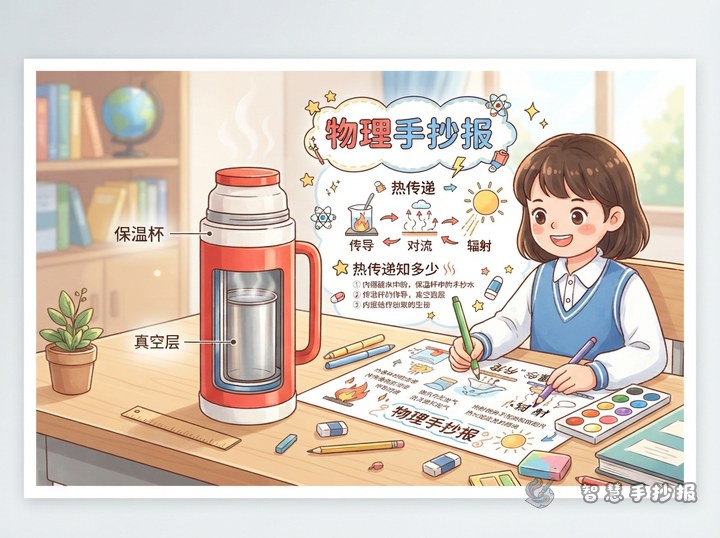
Put the seesaw in the centre of the page. Draw a straight board, a small triangle underneath as the fulcrum, two stick figures at the ends, and arrows for the effort arm and load arm. Leave the left and right sides for your text columns. A blue-and-yellow colour scheme with red arrows keeps the diagram easy to read, and an arched title across the top adds energy.
Small Extras That Make the Poster Stand Out
- Try a quick test with a ruler and an eraser as the fulcrum, then note how the push feels different at different spots.
- Add a safety line: sit firmly and hold on while playing on a seesaw.
- Write “simple machines” in a corner and mention that the lever is just one member of that family.
Plan your column boxes on scrap paper before writing, and you will avoid crowded edges. If you want ready-made frames and borders, the ZhiHui Handwritten Newspaper WeChat mini program offers layout templates you can fill with the notes you have already prepared.