Turn insulation into a race against escaping heat
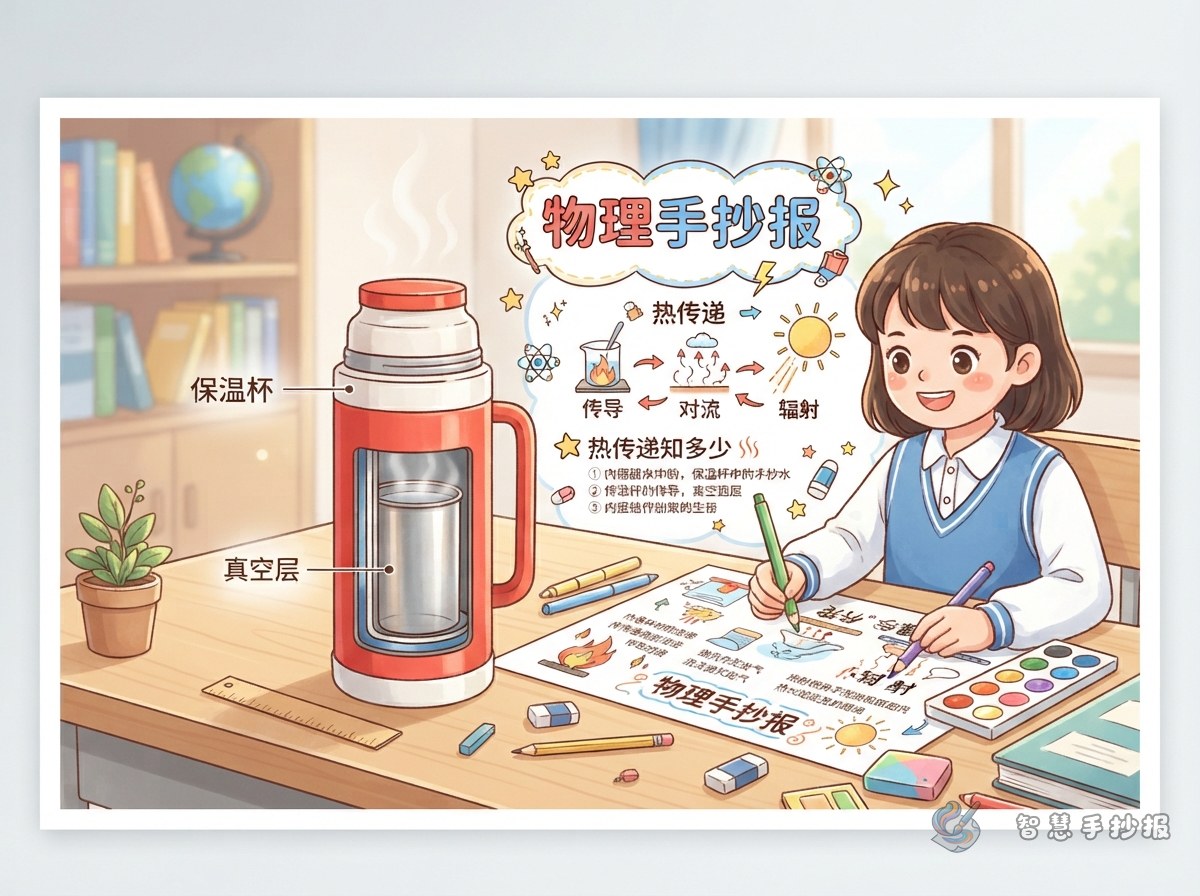
An insulated cup is a familiar object and a lively starting point for an elementary science poster. Draw the heat in the warm water as tiny runners trying to escape. The double walls, vacuum layer, and lid can become a team of barriers slowing them down. This idea makes the science easy to understand and gives the poster a clear visual story.
The science behind the cup
Warm water gradually cools because heat moves from the warmer water to the cooler surroundings. In an ordinary cup, heat can travel through the cup wall, move with circulating air, and spread outward as thermal radiation.
Double walls slow conduction
Many insulated cups have two walls with a vacuum or insulating space between them. With little or no air in this space, heat has a harder time traveling from the inner wall to the outside.
A lid limits air exchange
When the lid is closed, warm air near the opening is less likely to escape and cool air is less likely to enter. The lid also reduces the amount of heat carried away by evaporation.
The inner surface can reduce radiation
Some insulated cups have a smooth inner surface that helps reduce heat loss through radiation. On the poster, curved arrows can show heat being slowed down or reflected back toward the inside.
Four useful poster sections
- Everyday observation: Compare a covered insulated cup with an uncovered ordinary cup and record how they feel after the same amount of time.
- Science in simple words: Introduce conduction, convection, radiation, and evaporation with short explanations.
- Inside the cup: Draw the opening, inner container, double walls, vacuum layer, and outer shell, then label each function.
- Safety note: An insulated cup is not a heater. Ask an adult for help with hot water and check the temperature before drinking.
Text you can copy into the poster
Why can an insulated cup keep water warm? Warm water cools because it gives heat to the surroundings. An insulated cup uses double walls, a vacuum or insulating layer, and a tightly closed lid to slow conduction, convection, radiation, and heat loss from evaporation. As a result, the water can keep its temperature for longer. However, an insulated cup only slows cooling; it cannot keep hot water warm forever.
Design the page like an opened insulated cup
A landscape layout works well. Draw a cutaway cup on the left and use orange and red arrows to show heat inside. Place three short explanations about heat loss in the center. On the right, add a small “cup structure file” and a safety reminder. A title such as “Where Does the Heat in an Insulated Cup Go?” creates curiosity. Orange can represent warm water, while blue can represent the cooler air outside.
After planning the sections, you can continue arranging the title, decorations, and page layout in the 智慧手抄报 WeChat mini program for a cleaner final design.
A safe observation activity
- Prepare two similar cups and fill them with warm water at nearly the same temperature.
- Cover one cup and leave the other open. Put both in the same place.
- After some time, ask an adult to help check the temperature or compare how warm they feel.
- Draw a simple bar chart and write the conclusion: reducing air movement and covering the opening can slow heat loss.
Use warm water rather than boiling water. Do not touch very hot containers or liquids. A safe, clear observation is more valuable than a complicated experiment.