Start with a Small Science Surprise
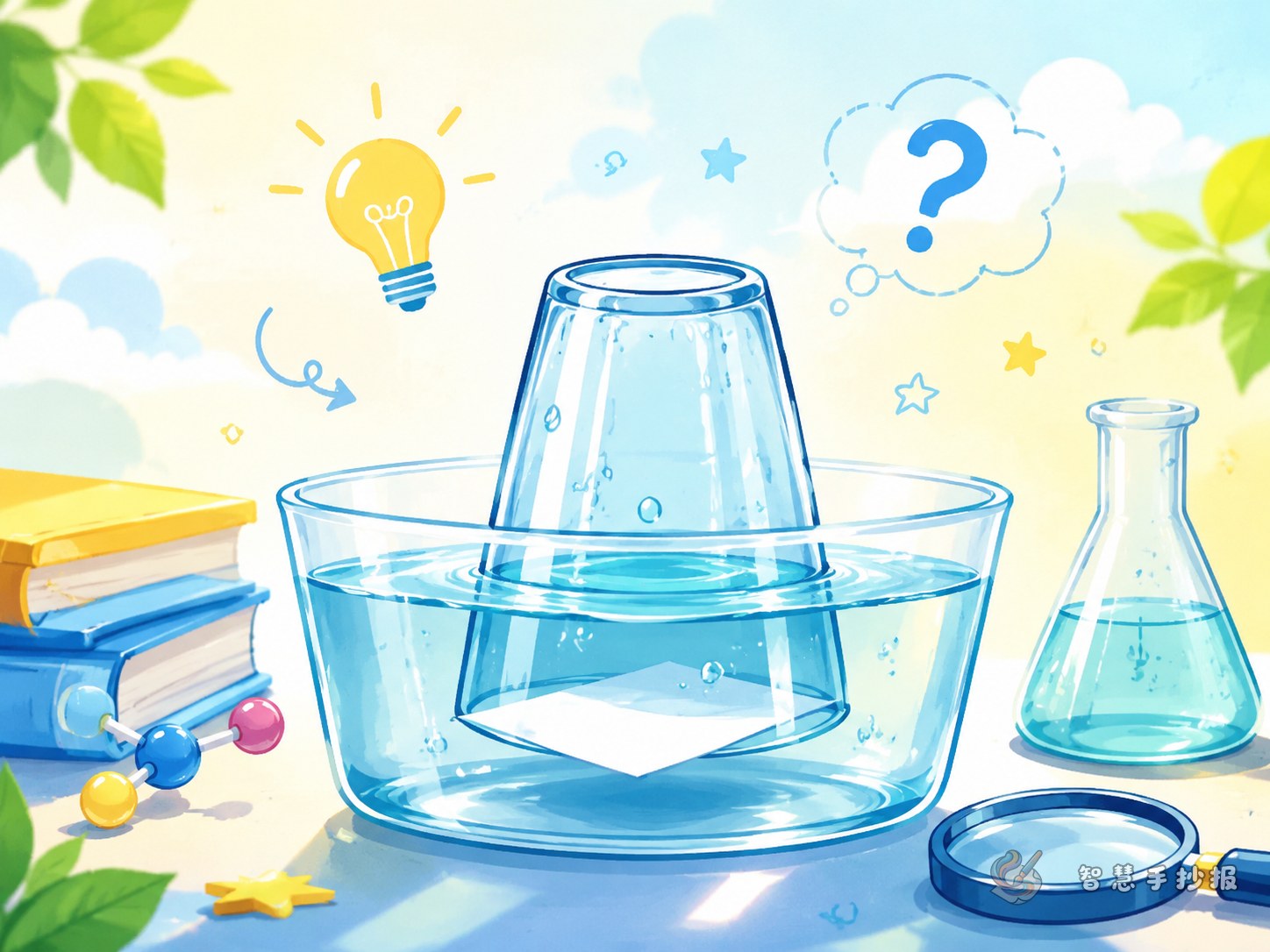
The question “Why does paper stay dry inside an upside-down cup?” is perfect for a physics-themed handwritten newspaper. It feels like a magic trick, but the answer comes from a simple science idea: air is real and it takes up space.
A good title can be The Invisible Air That Blocks Water or The Dry Paper Experiment. Place the title near a large drawing of a cup, water, and a small paper ball to catch attention quickly.
Turn the Experiment into a Clear Story
- Prepare a clear cup, a small piece of paper, and a basin of water.
- Press the paper into the bottom of the cup.
- Turn the cup upside down and push it straight into the water.
- Take the cup out and check whether the paper is wet.
This section can look like an experiment record card. Use one box for materials, one for steps, and one for observations such as “the paper is still dry” or “bubbles appear when the cup tilts.”
Explain the Science in Kid-Friendly Words
The cup is not empty before it enters the water. It contains air. When the cup goes straight down, the trapped air stays inside and keeps the water away from the paper. That is why the paper can remain dry.
If the cup tilts, some air may escape and water may enter. This makes a useful comparison for the newspaper: straight cup, dry paper; tilted cup, wet paper.
Short Text Materials for the Page
- Science idea: Air is invisible, but it takes up space.
- Observation: The paper at the bottom of the cup stays dry when the cup goes straight down.
- Daily link: Balloons, swimming rings, and bubbles all remind us that air exists.
- Thinking question: What will happen if there is a small hole in the cup?
These short lines are suitable for bubbles, side notes, or a “science question corner” on the handwritten newspaper.
Design It Like an Underwater Observation Board
Use light blue, white, and soft green as the main colors. Put the experiment drawing in the center, then arrange four areas around it: steps, explanation, daily examples, and my discovery.
Wave lines can divide the page, and bubble shapes can hold keywords. If you want more page structures, column names, or decoration ideas, you can continue creating the handwritten newspaper in the 智慧手抄报 WeChat mini program.