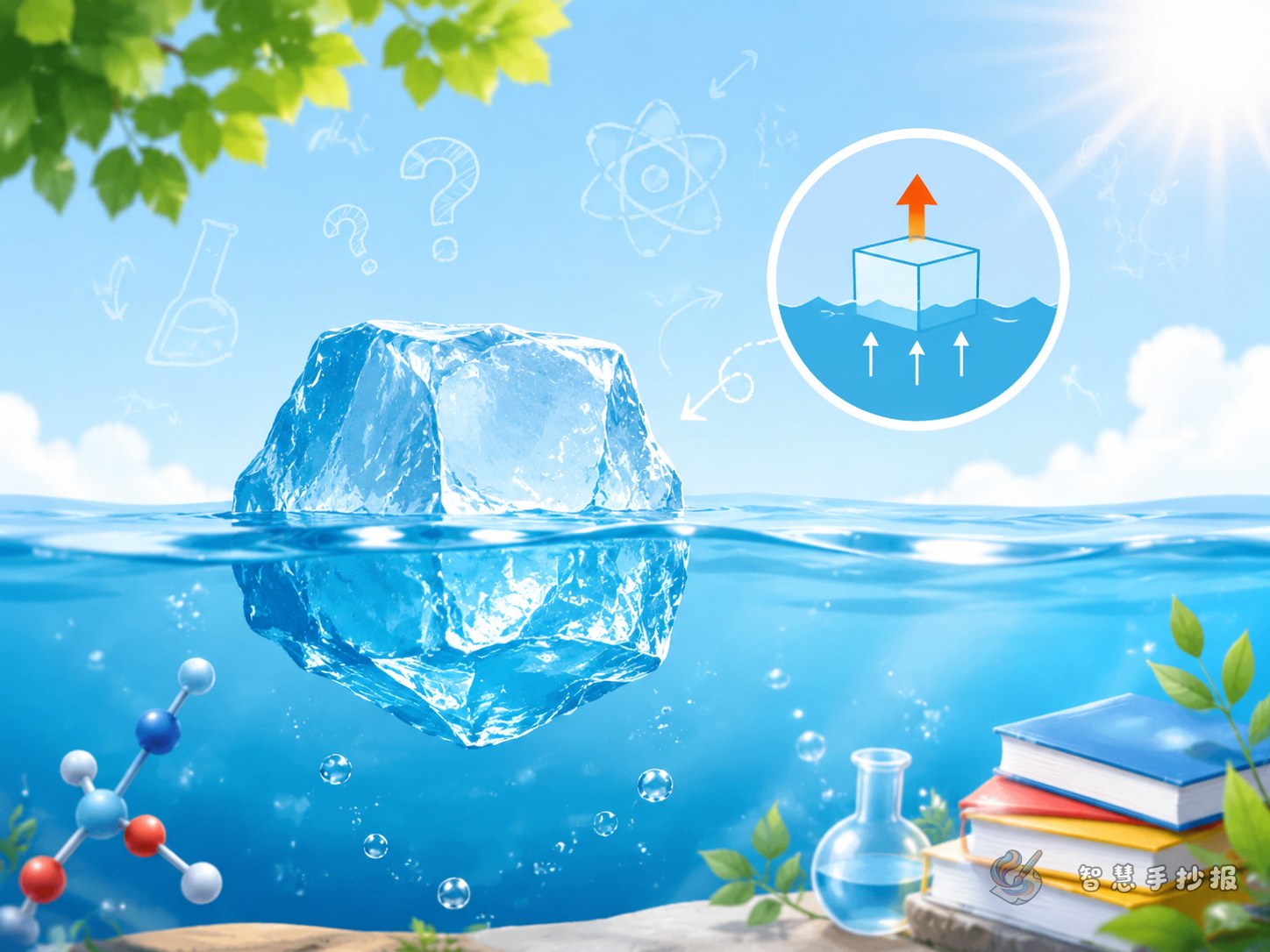
Turn a Floating Ice Cube into a Simple Science Page
This handwritten newspaper can begin with a familiar scene: a glass of water with ice cubes floating near the top. Draw a clear cup, a blue water line, and shiny white ice cubes beside the title so readers can understand the topic at a glance.
Opening text idea: When we drink iced water, we often see ice cubes floating instead of sinking. This everyday scene introduces two useful physics words: buoyancy and density. By looking carefully at a cup of ice water, students can discover that physics is part of daily life.
Explain the Key Idea in Three Easy Points
- Buoyancy: Water gives an upward push to objects placed in it.
- Density: If the same amount of space contains more matter, the object is denser; if it contains less, it is less dense.
- Why ice floats: Ice is less dense than liquid water, so the upward push of water can hold it near the surface.
For the page design, add a small force diagram. Draw gravity pointing downward and buoyancy pointing upward. This helps students show the science clearly without using difficult formulas.
Short Writing Materials for the Newspaper
Science paragraph
When water freezes into ice, it expands and becomes less tightly packed. That means ice has a lower density than liquid water. When an ice cube is placed in water, it pushes some water aside, and the water pushes back upward. Because ice is less dense than water, it floats with only part of the cube above the surface. This simple scene shows that interesting science can hide in ordinary life.
Everyday observation list
- Ice cubes float in drinks, and the water level changes very little after they melt.
- Wood often floats, while stones usually sink.
- A life ring helps a person stay afloat because of buoyancy.
- A boat can float even when it is heavy because its shape helps it push aside a large amount of water.
A Clear Layout Plan for Students
- Top left: Write the title “Why Does Ice Float on Water?” and draw a cup with ice cubes.
- Top right: Create a “What Is Buoyancy?” box with an upward arrow.
- Center: Show a mini comparison experiment with ice, wood, a stone, and water.
- Bottom left: Add a “Density Dictionary” using simple words and examples.
- Bottom right: List daily examples such as boats, life rings, and foam boards.
Use blue, light cyan, and white as the main colors. Add a little orange or yellow to highlight important words. Water waves, bubbles, and small ice crystals can be used as borders.
Add a Safe Mini Experiment
Prepare a cup of water, an ice cube, a small piece of wood, and a small stone. Put them into the water one by one and record which objects float and which sink. Students can draw the results as a small table on the page. Avoid sharp objects or hot water, and younger children should do the experiment with an adult.
A good closing sentence could be: “Curious eyes can find physics in a simple glass of ice water.” If you want to organize the title, sections, and layout more quickly, you can continue making the handwritten newspaper in the WeChat mini program “智慧手抄报”.