Why These Two Details Make a Strong Poster
When people think about old Chinese buildings, they often name famous places. Look a little closer, though, and the real cleverness sits under the eaves and between the timbers. Dougong is the stack of wooden brackets that carries the roof, and the mortise-and-tenon joint is how two pieces of wood lock together without a single nail. Both are easy to draw and easy to explain, which makes them a good spine for a handwritten newspaper.
Talking About Dougong in Plain Words
What it is
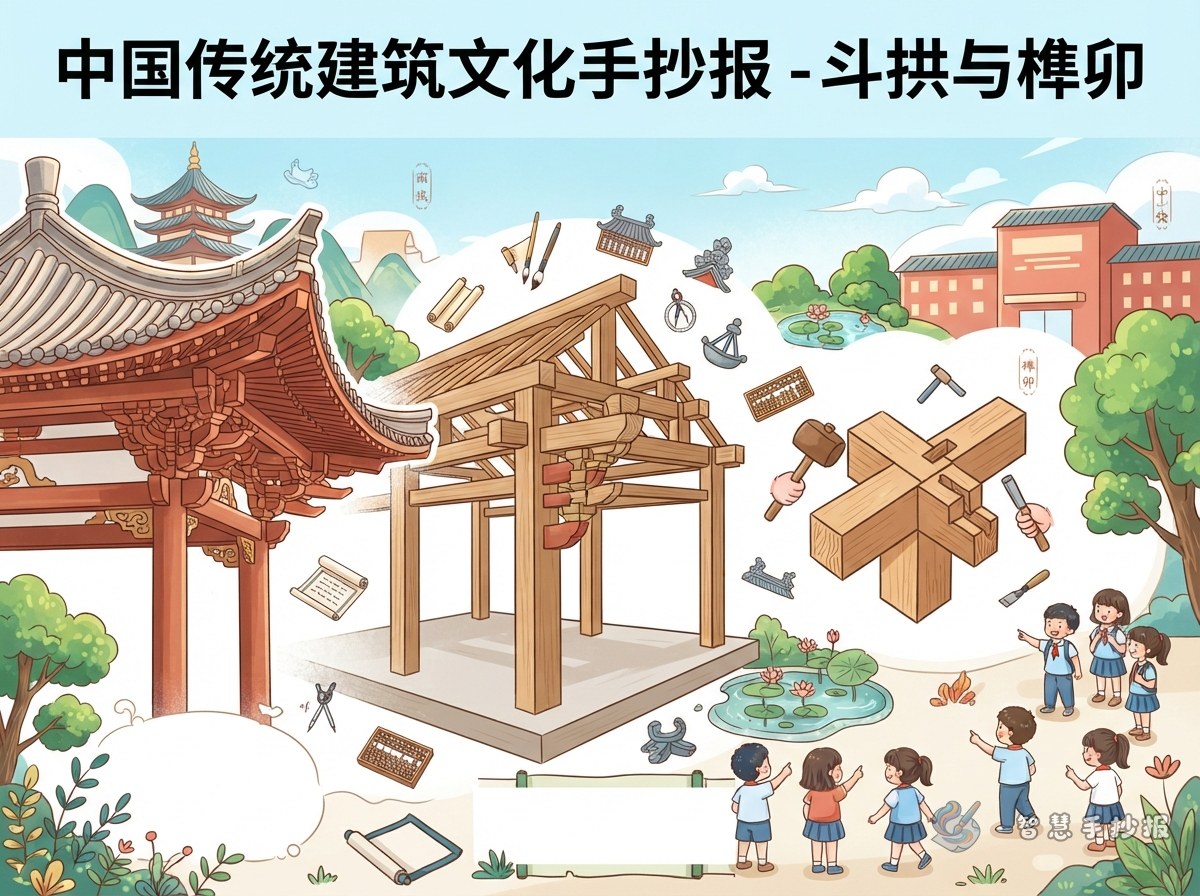
Dougong sits between the column and the roof. Small block-shaped pieces and curved arm-shaped pieces stack outward, step by step, until they support the overhanging eaves.
What it does
- Spread the weight of a heavy roof down onto the columns
- Let the eaves reach further out, so rain drips away from the wall
- Allow slight movement between layers when the ground shakes
- Look neat and rhythmic, so they became a main decoration
A sentence pupils can remember: dougong is a pair of hands under the eaves, holding the roof steady.
Mortise and Tenon: Wood That Holds Without Nails
A mortise-and-tenon joint is a way of connecting timber. The raised part is the tenon, the cut slot is the mortise, and the two fit together so their shapes stop each other from pulling apart. Straight joints, dovetail joints and shouldered joints all follow this idea, and you can find them in furniture, doors, windows and roof frames.
A helpful comparison for the page: it works like two building bricks that click, staying tight while keeping a little room to move. There is an old saying that the wall may fall but the house will not, because the timber frame can stand on its own.
Text You Can Copy Straight Onto the Page
- An idiom: the phrase for scheming against each other first described interlocking building parts and meeting eaves
- A saying: the wall may fall, the house stands; wood locks into wood without a nail
- A craft legend: Lu Ban, traditionally honoured as the patron of carpenters, for a small knowledge box
- A closing line: wood grows old, cleverness does not
- An observation note: look at nearby pavilions, old furniture or temples and see whether you can spot these details
Split these into three boxes, such as words explained, a short note and what I noticed, with three or four lines in each.
Arranging the Page
- Draw one simplified dougong in the header, using trapezoids and curved lines, keeping it symmetrical
- Divide the middle into two columns, one for dougong and one for the joint, so readers can compare
- Keep a strip along the bottom for sayings and a closing thought, framed with a simple repeating pattern
- Use timber brown, slate blue and cream as the main colours, with a touch of seal red on the title
- Leave enough white space and keep all subheadings in one colour
Before You Start Drawing
Sketch the header and columns lightly in pencil first, write the text next, and colour last, or your writing will smudge. If you are short on time, choose a layout from the topic library and fill in your dougong and joint notes. For more layouts and ready-made text, search for the WeChat mini program and pick a theme to start your own page.