Why Coins Make a Great "History You Can See" Theme
Coins in a museum case are small, yet they tie thousands of years together: cowrie shells, knife money and spade money, the Qin ban liang, the Han wu zhu, the Tang kai yuan tong bao, and the paper money of the Song dynasty. A coins poster does not need to be a history essay. Follow one idea, that every coin is a slice of daily life, and you get both content and pictures.
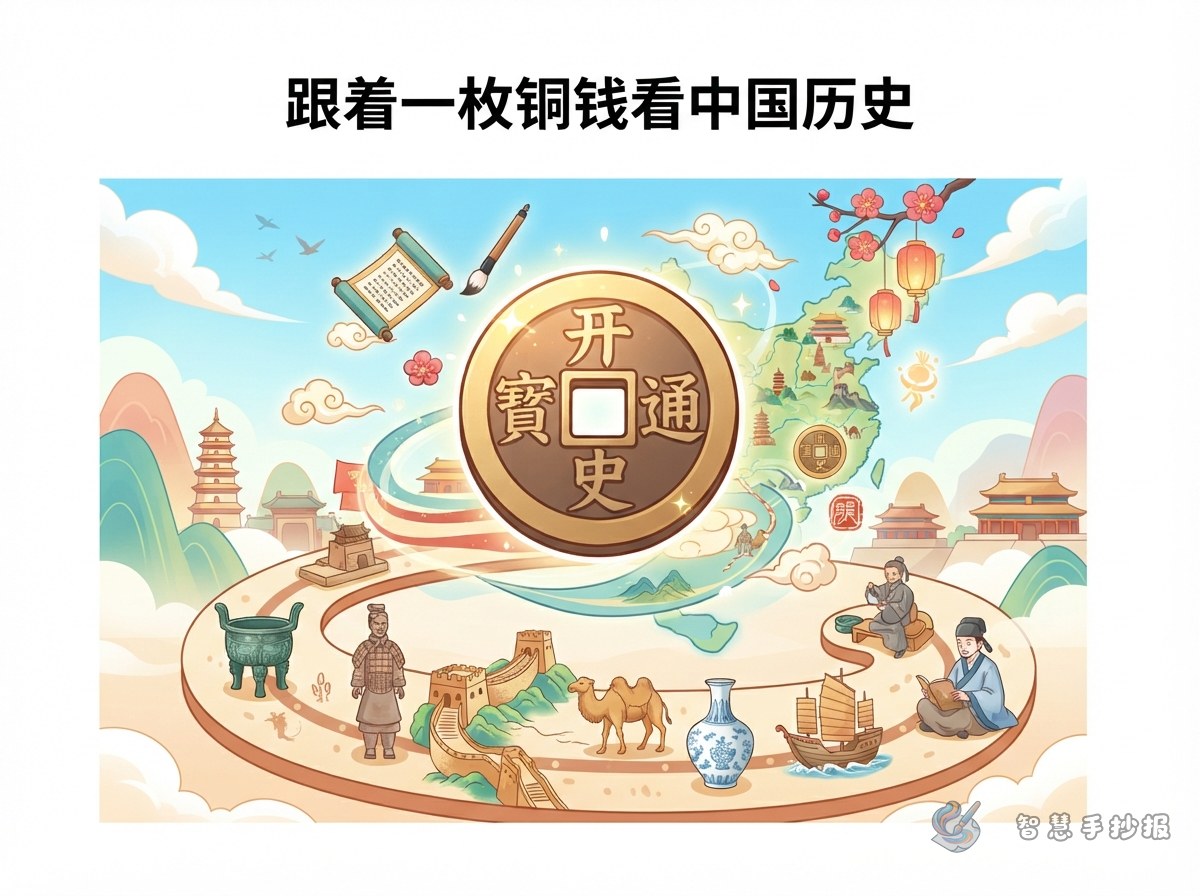
Coins are also easy to draw. A round coin with a square hole already looks like a design element, so it can become a title frame, a year marker or a small fact box, and it feels far more historical than a plain rectangle.
Choose One Thread, Then Five Coins
Pages get messy when you try to fit in every dynasty. Pick one thread first, for example "how money became easier to carry," then choose about five coins and write three sentences for each.
- Cowrie shells: the earliest money was actually sea shells, which is why so many Chinese characters about money contain the shell part, such as those for wealth and goods.
- Knife and spade money: during the Spring and Autumn and Warring States periods, different states used different shapes. Knife money looked like a small blade and spade money like a farm tool, showing that money grew out of daily work.
- The Qin ban liang: after the Qin unified the currency, the round coin with a square hole became the standard shape and stayed in use for a very long time.
- The Han wu zhu: used for centuries, with neat lettering. You can also explain that the zhu was an ancient unit of weight.
- The Tang kai yuan tong bao: the writing on this coin is especially handsome, which makes it a good subject for a "calligraphy on coins" column.
- Song paper money: its appearance shows that once trade grew busy, strings of copper coins were simply too heavy to carry.
Three Side Columns You Can Copy Straight Onto the Page
Words on the Coins
Coin inscriptions were written in different scripts, such as seal, clerical and regular script. Compare two or three of them and you have a mini calligraphy lesson on one coin.
Sayings About Money
Idioms and old sayings about money are easy to find. Choose two or three, put each on a small card, and the page looks far livelier than a block of explanation.
My Museum Notes
If you have visited a museum, keep a small space for "the one coin I saw in the case." Describe its shape, colour and any characters you could recognise, and you have honest, personal material.
Use the Round Coin with a Square Hole as a Layout Tool
A good structure is one timeline plus three small boxes. Draw a horizontal or diagonal timeline across the middle and place the five coins on it in chronological order. Divide the remaining space into three parts: the origin of coins on the upper left, words on coins on the upper right, and a large area at the bottom for "my favourite coin."
- Sketch the timeline and coin positions first, then write, so you never run out of room halfway through.
- Use one oversized round coin with a square hole as the frame for the main title, with the words inside the hole or around the rim.
- Limit the palette to three colours, such as earth yellow, ochre and dark brown. This feels closer to real artifacts than a rainbow.
- Borders do not have to be straight lines. Rope lines, bamboo slip stripes or meander patterns suit the theme better.
Small Reminders Before You Start Writing
- Keep each paragraph to four or five lines. A solid wall of text is the fastest way to ruin a poster.
- Write the characters on the coins clearly. If you cannot read one, write "too worn to read, but I can make out the character for treasure." That shows careful observation.
- Do not draw every coin the same size. Give the important ones more room so the page has rhythm.
- Short on time? Choose a coins or history theme in the Smart Handwritten Newspaper mini program, fill in the facts you have gathered, then copy the layout by hand onto paper. It saves a lot of arranging time.