Start with one clear angle: what did poets see from the wall?
A Great Wall poster does not have to be about battles and dates. Poems written about the frontier give you a gentler, more personal way in. The angle for this poster can be a single question: what did people see and feel when they stood on the wall? Keep that question on your draft paper, and it will guide every column you draw.
Before writing, note down three small answers: which pass or stretch of wall appears in the poem, what the poet was doing at the time, and what a soldier on night watch might have heard. These notes become your best text material.
Four frontier poems that suit younger students
Choose two or three poems, and copy only one or two famous lines from each. Long poems are hard to fit and easy to smudge.
"On the Frontier" by Wang Changling
- Famous line: the moon of Qin times, the pass of Han times; the long march goes on and no one returns.
- Picture it: bright moon, a lonely gate, soldiers far from home.
"A Song of Liangzhou" by Wang Zhihuan
- Famous line: the Yellow River rises into white clouds; a single lonely town among towering mountains.
- Picture it: high peaks, a small fort, the sound of a flute.
"Army Life on the Frontier" by Wang Changling
- Famous line: long clouds over the blue sea darken the snow mountains; from the lonely town we look toward Yumen Pass.
- Picture it: snow peaks, a distant gate, heavy clouds.
"Frontier Song" by Lu Lun
- Famous line: on a moonless night the wild geese fly high; the enemy chief slips away in the dark.
- Picture it: black night, geese, an army camp.
If there is still space, add the well-known line "One who has never been to the Great Wall is no true hero," and note that it comes from Mao Zedong's poem "Qingping Yue: Liupan Mountain." It makes a strong title or closing sentence.
A simple three-line pattern for each poem
Under every poem, leave three short rows: the verse itself, a note on one or two difficult words, and a sentence describing the picture you see. For example, beside "On the Frontier" you could write, "I can almost see a bright moon hanging over the wall, with wind blowing through the pass." This keeps every column consistent without writing too much.
- Verse: copy only the famous lines, in slightly larger letters.
- Notes: explain words such as pass, return or lonely town in one sentence each.
- Response: one sentence is enough, and try to include a colour and a sound.
Layout idea: write the lines inside wall bricks
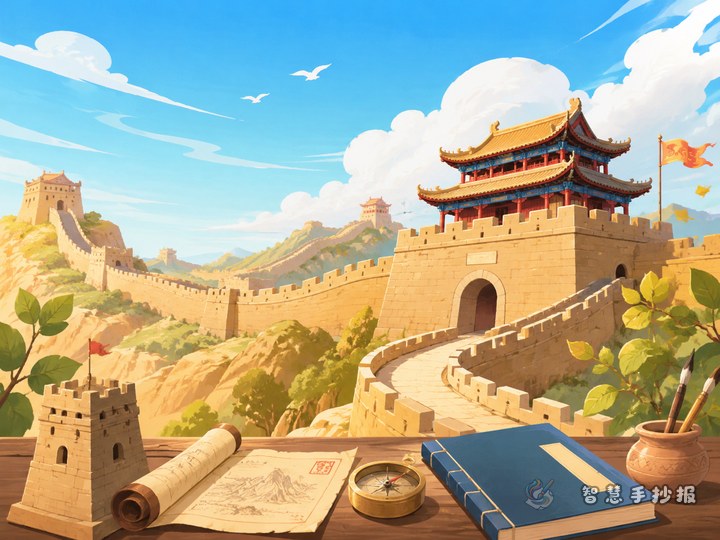
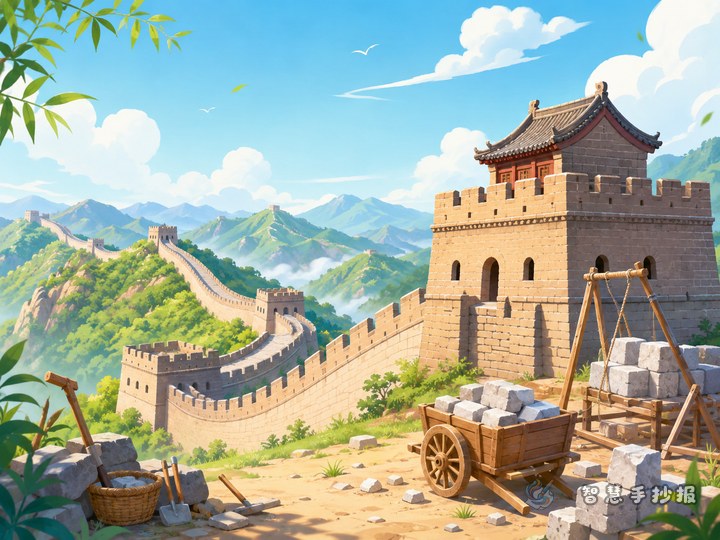
Draw a wall running from the left side of the page to the right, made of individual bricks. Put one line of poetry in each brick, with a thin grey line between them. Above the wall, leave open sky for a moon, stars or flying geese; below it, draw a slope and a few trees. The page then looks orderly and has a sense of depth.
- Sketch the wall lightly in pencil, letting it rise and fall a little instead of running perfectly straight.
- Mark four to six large bricks in the middle of the wall to hold the verses.
- Use the remaining space for a short poet profile and a personal response column.
- Finish with dark grey outlines, then colour with earth yellow, ochre and pale blue. Try not to use more than four colours.
Small mistakes to avoid
- Do not fill every line with text. Leave space between lines, or the poster looks like a solid block from a distance.
- Write the poet and dynasty together, such as "Tang dynasty, Wang Changling", not just the name.
- Do not copy notes word for word from a reference book. Explaining in your own words helps you remember.
- Keep the drawings simple. A large moon, gate tower or goose is more striking than many tiny details.
When you want a ready-made layout, open the Smart Handwritten Newspaper mini program in WeChat, search for "Great Wall" or "poetry", choose a design you like, and adjust the borders and columns to fit your own verses.