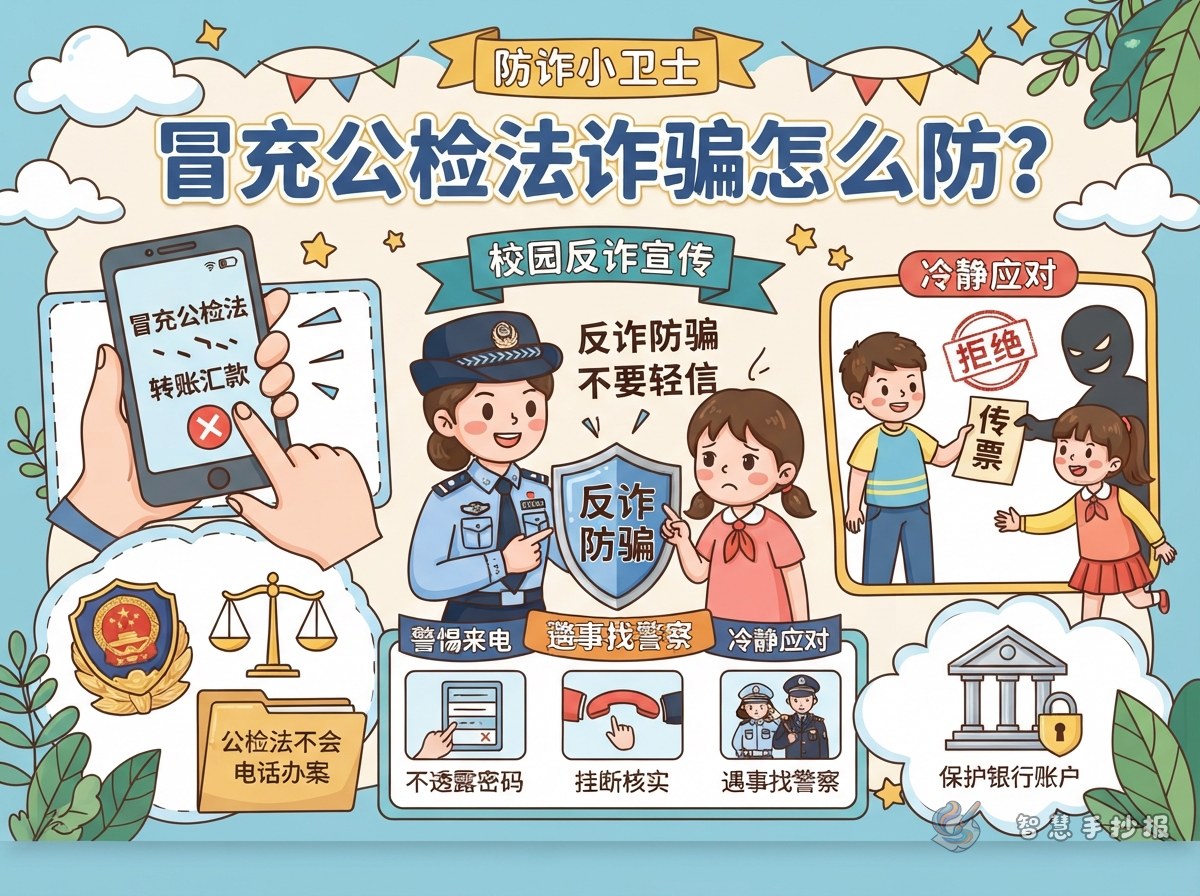
Why This Scam Deserves Its Own Poster
Of all the phone scams out there, the fake police call is the one that causes the fastest panic. The caller says you are involved in a case, claims your bank account will be frozen, and warns you not to tell your family. Children may not receive these calls, but grandparents and parents often do. That is why this poster should focus on one calm message: if a call about a case feels strange, hang up first and verify afterwards.
Split the Scam Into Three Steps and the Layout Appears
Left Column: How the Call Unfolds
- Step one: the caller gives an official-sounding title and speaks sternly to create pressure.
- Step two: the caller says your ID or bank card is linked to a case and demands secrecy.
- Step three: the caller asks you to move money to a so-called safe account, or asks for verification codes and card passwords.
Center: Four Big Words
Write Don't believe, don't share, don't pay, always verify in the largest letters on the page, placed in the middle or across the top half.
Bottom Right: Three Things to Do
- Hang up without arguing, and do not call back the number they gave you.
- Tell a parent, grandparent or teacher right away.
- Call the police or visit the nearest police station to check the facts.
Text You Can Copy Straight Onto the Poster
Rhyme: a call that says you broke the law is a trick, hang up first and stay calm; anyone asking for money, cards or codes is lying; if there is a real problem, officers will meet you in person, not ask for a secret transfer.
Short dialogue: “Hello, you are involved in a case, please cooperate.” Your reply is just one line: “I will not give my ID or bank card number over the phone. I will ask in person at the police station.”
You can also add a line for family members: when a strange call arrives, don't rush to follow instructions, talk it over with someone at home first. One more person thinking about it means one less chance of being tricked.
Headline, Colors and Simple Drawings
Keep the headline short and strong, such as “Hang Up First”, “I Don't Transfer Money”, or “Anti-Fraud Helper”. Use blue and white as the main colors and save red only for warnings, with no more than three main colors overall. Simple line drawings of a shield, an old telephone receiver, a question mark or an exclamation mark work well as dividers, and a border shaped like a curly phone cord adds character without any printed pictures.
A Final Check Before You Hand It In
- Did you include the key reminders: no transfers, no verification codes, no ID number over the phone?
- Did you tell readers who to turn to — a parent, a teacher, the police?
- Is the page filled evenly, with neat handwriting and no corrections or spelling slips?
If you would like a different column name or want to switch from three blocks to two, search for “智慧手抄报” in the WeChat mini program, pick an anti-fraud layout, adjust it, and then copy it onto paper.