Why Bats Appear in Auspicious Patterns
In traditional Chinese ornament, the bat is a favourite because of a sound rather than its appearance. The word for bat sounds the same as the word for blessing, so one bat beside a coin can mean blessing right before your eyes, and five bats together stand for the five blessings. A page that only shows bats without explaining this will lose its point, so start by making the wordplay clear.
- One bat with a coin: blessing within reach.
- Five bats around a longevity character: the five blessings.
- A bat with a peach: blessing and long life together.
Placing the Five Blessings on the Page
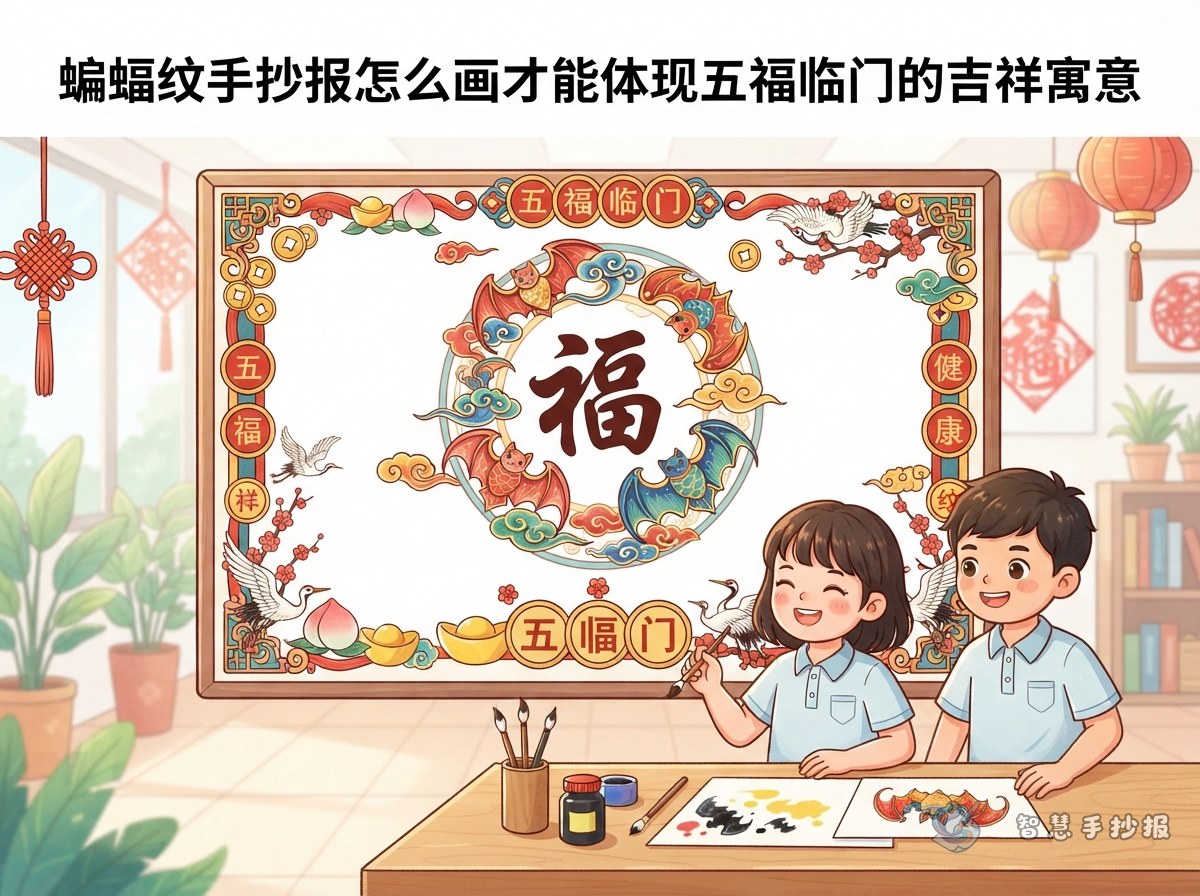
The easiest and most attractive plan is to treat the page as a round medallion. Leave a circle in the upper middle for a longevity character or a peach, then set five bats around it, all facing the centre. Divide what remains into a few panels so the design has a clear focus.
- Draw the page frame first, leaving a two-finger margin and a key-fret or cloud border.
- Mark the centre motif, using about one third of the sheet.
- Add panels: a vertical panel on the left for the explanation, one on the right for good wishes, and a lower panel for a small fact.
Text You Can Copy onto the Page
Short and clear works best. A few phrases and one small fact table are enough.
- Four-character wishes: five blessings at the door, blessing and long life, good fortune shining high, lasting blessings, blessing in front of your eyes.
- One explanatory sentence: the word for bat sounds like the word for blessing, so bats were painted on clothing, porcelain and window lattices as a wish for happiness.
- A small fact: the five blessings are usually described as long life, wealth, health and peace, virtue, and a good ending.
Drawing the Bat and Choosing Colours
You do not need a realistic bat. Three features are enough for people to recognise it: a small body, large wings and pointed ears.
- Draw an oval for the body, then add symmetrical wavy wings on both sides.
- Curl a few ruyi-shaped lines along the wing edges to give a pattern feel.
- Add two small eyes and pointed ears, and finish the tail with a small hook.
- For five bats, lightly mark five equal points in pencil before drawing each one.
Use vermilion or bright red as the main colour, gold for outlines, and dark ink or brown for writing. Do not cover the whole sheet with red; leaving space around the motif keeps it fresh. A red title block with gold letters and plain black body text is easy to read.
Sections, Balance and Common Mistakes
Three or four sections are usually enough for one sheet. More than that starts to look crowded.
- Title area: for example, the five blessings in traditional Chinese ornament.
- Motif area: the round medallion in the centre.
- Explanation area: why the bat stands for blessing and what the five blessings mean.
- Extra area: something you noticed yourself, such as bats on paper cuts, porcelain or embroidery.
Two common problems are drawing the bat so realistically that it loses its pattern quality, and squeezing all the text into one corner so the page looks uneven. Sketch the dividing lines lightly in pencil first, then colour. If you want to save time, you can choose a bat or auspicious pattern template in the Smart Handwritten Newspaper mini programme, swap in your own text, print it out and trace the lines.