Why the Fish Motif Fits a Lucky Poster So Well
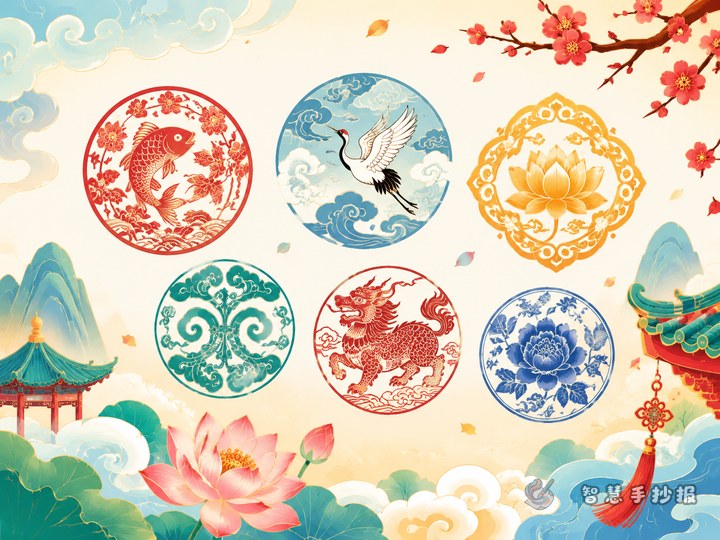
Fish designs appeared early in Chinese decorative art and never really went out of fashion. In Chinese, the word for fish sounds like the word for surplus, so a single fish stands for abundance year after year, while two fish placed together suggest blessings arriving in pairs. Add a lotus and you get the gentle picture of fish playing among lotus leaves. Settling on this idea first gives the whole newspaper a clear theme instead of a page full of random fish.
The shape is friendly for beginners too: a curved body, repeated scales and an open tail already look lively. Compared with dragons or phoenixes, a fish is easier to draw while still keeping a Chinese flavour, which makes it a good main image for a school newspaper.
Text You Can Copy onto the Page
Three fish designs and what they mean
- Single fish: one fish on its own with waves or lotus, a wish for plenty and comfort.
- Double fish: two fish facing each other or swimming one after the other, a sign of reunion, harmony and good things coming in pairs.
- Fish with lotus: fish combined with lotus flowers and leaves, a busy and cheerful scene meaning abundance year after year.
Short phrases to fill your columns
Write each phrase on a small card: abundance year after year, wealth with surplus, like a fish in water, a carp leaping the dragon gate, double fish bringing blessings, and fish playing among lotus leaves. They are short and easy to read, and they look complete once a small fish drawing sits beside them.
A poem line and a well-known story
A simple poem line about fish swimming east and west among the lotus leaves is easy to understand and easy to copy. The story of the carp leaping over the dragon gate also works well as a short paragraph about working hard and moving forward. Retell it in your own words rather than copying a long passage.
Layout Plans That Make the Fish Look Alive
The biggest mistake is placing one fish in the exact centre and leaving the rest of the page empty. Try these arrangements instead:
- Diagonal: put the main fish at the top left and the title at the bottom right, linking them with a few wave lines so the eye travels across the page.
- Circular: place the title inside a round frame in the middle, with small fish and lotus leaves swimming around it.
- Open space: draw only one large fish and one or two small ones, and leave the rest of the page for writing, which suits students who write a lot.
Three or four text columns are usually enough, for example “Fish Facts”, “Lucky Phrase Pocket”, “A Line of Poetry” and “My Own Fish Drawing”. Give each column a different border, and make the borders look like waves, scales or old coins.
Drawing Steps for Beginners
- Sketch the teardrop-shaped body of the main fish lightly in pencil before adding anything else.
- Add a triangle tail and a back fin, opening the tail wide so the fish looks energetic.
- Draw the eye and mouth, then fill the body with repeated half-circles or diamonds for scales.
- Add two or three wave lines or small bubbles beside the fish to show the direction of the water.
- Go over the lines in black ink, erase the pencil marks, and colour the drawing.
Red, gold and blue-green are the classic lucky colours. Use red for the fish, gold for a few scales and blue-green for the water, and keep the background mostly white for a clean result. If a realistic fish feels too hard, switch to a paper-cut silhouette or a small red fish stamp, which still looks traditional and takes far less time.
Naming Columns and Finishing Touches
Do not stop at the plain words “Fish Pattern Newspaper”. Try a title with a picture in it, such as “Fish Leaping for Good Fortune” or “A Little Fish Swimming into Lucky Patterns”. Column names can be playful too, like “Fish Pattern Magnifier”, “Lucky Phrase Pocket” or “The Small Fish in the Poem”. A better name instantly gives the page personality.
When the writing is done, check three things: is the lucky meaning explained clearly, does the page have a main and a secondary focus, and does every column have a border. Once these are settled, your fish pattern newspaper is complete. If you would like to try other traditional motifs alongside it, open the WeChat mini program “Smart Handwritten Newspaper” to pick a template, swap in a different pattern and add more columns.