Choose the Angle Before You Draw
The four great inventions are the first thing many students think of, but ancient China also produced a whole set of clever calculating tools. Counting rods and the abacus are perfect examples. Instead of calling the poster "about the abacus", try a title such as "From Counting Rods to the Abacus: How People Calculated". One object becomes a story with a direction.
Pick a short, vivid headline like "The Maths Inside One Bead". Under it, write one or two lead sentences explaining what the page shows and why it is worth reading.
Four Blocks That Fill the Page
Counting rods: the first calculating sticks
Long before the abacus, people used small bamboo or wooden sticks to stand for numbers. The sticks were laid horizontally or vertically to show different place values, and with them people could add, subtract, multiply and divide large numbers. Add a line such as "a few small sticks can handle big numbers" and draw two different arrangements side by side.
How an abacus is put together
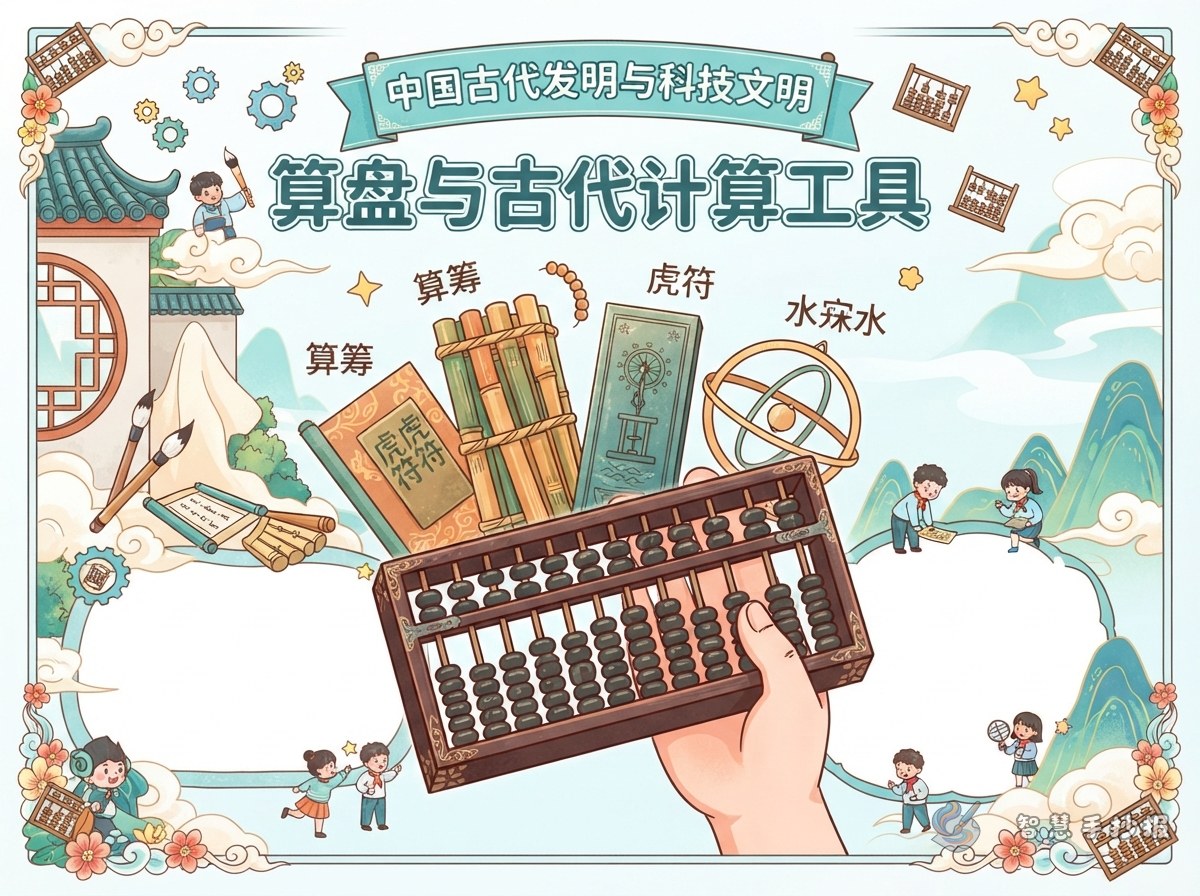
An abacus has a frame, a beam, rods, upper beads and lower beads. The beam divides it into two parts. One upper bead stands for five and one lower bead stands for one, while each rod marks a place value. Draw a large, simple abacus and label those five parts with straight lines.
Bead rhymes: say them and you can calculate
Rhymes such as "one up one" set out the order in which beads are moved. Copy a short rhyme and put one worked example beside it, showing how to move the beads for a sum like three plus four. Readers can follow the rhyme and see how it works.
Maths achievements worth a mention
Ancient Chinese maths books and the early calculation of pi are often described in popular science writing. Use careful wording such as "it is recorded that" or "roughly", and keep the focus on one idea: people valued accurate calculation long ago.
Text You Can Copy Straight Onto the Page
- Headline ideas: Wisdom in the Beads, From Sticks to Beads, How People Calculated Big Numbers.
- Lead line: With no calculator, people still kept their accounts straight, thanks to these small tools.
- Short slogan: One bead, one place value; a small movement shows great cleverness.
- Closing line: Calculating tools keep changing, but careful thinking never goes out of date.
Draw a timeline across the page: counting rods, the abacus, the spread of bead rhymes, and the tools we use today. One short sentence under each point is enough.
Layout: Leave Space for the Beads
- Put the headline and lead line in the top left, with the largest lettering and the brightest colours.
- Draw one big abacus in the centre as the visual focus.
- Place a vertical column of rhyme cards on the right, separated by light shading.
- Use the bottom left for counting rods and the bottom right for maths achievements and the timeline.
- Keep a narrow strip along the bottom for "tools we use today", echoing the ancient ones.
A Small Task and a Final Polish
Before starting, ask children to find an abacus, count its rods and beads, and move the beads to show a three-digit number. Writing down what they actually observe makes the page far livelier than copied text. For colours, try wood tones, deep blue and cream, with bright beads for contrast.
If you want the layout to come together faster, open the WeChat mini program "智慧手抄报", choose a calculation-themed template, replace the text with your own ideas, and then trace or print it. It saves a lot of time on ruling and spacing.