Begin with a Stone Bridge That Carries Its Own Forces
Instead of presenting Zhaozhou Bridge as only a famous historical site, make the handwritten newspaper focus on the engineering ideas behind it. A strong opening question is: “How did ancient builders make a stone bridge stand firmly across a river?” This introduces the Sui Dynasty, the designer Li Chun, and the connection between history and bridge structure.
The main title could be “Zhaozhou Bridge: Wisdom Built in Stone,” with a subtitle such as “Exploring Ancient Chinese Bridge Engineering.” A clear theme will keep the page from becoming a simple travel or history introduction.
Draw the Bridge in the Center and Build Four Viewing Windows Around It
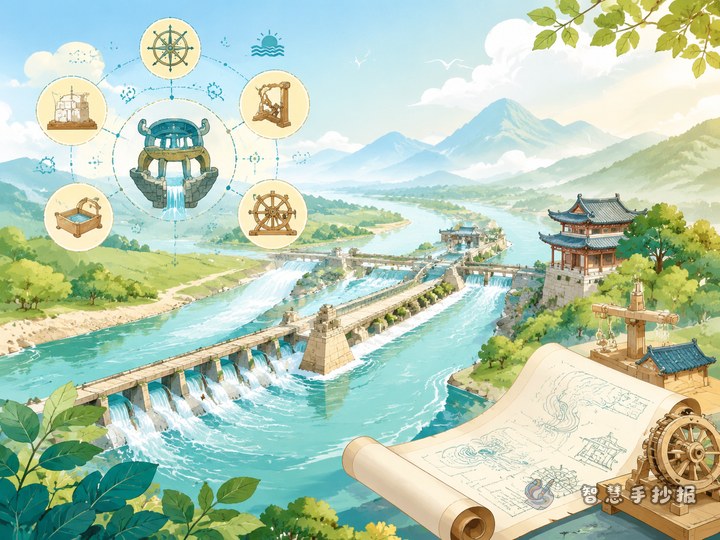
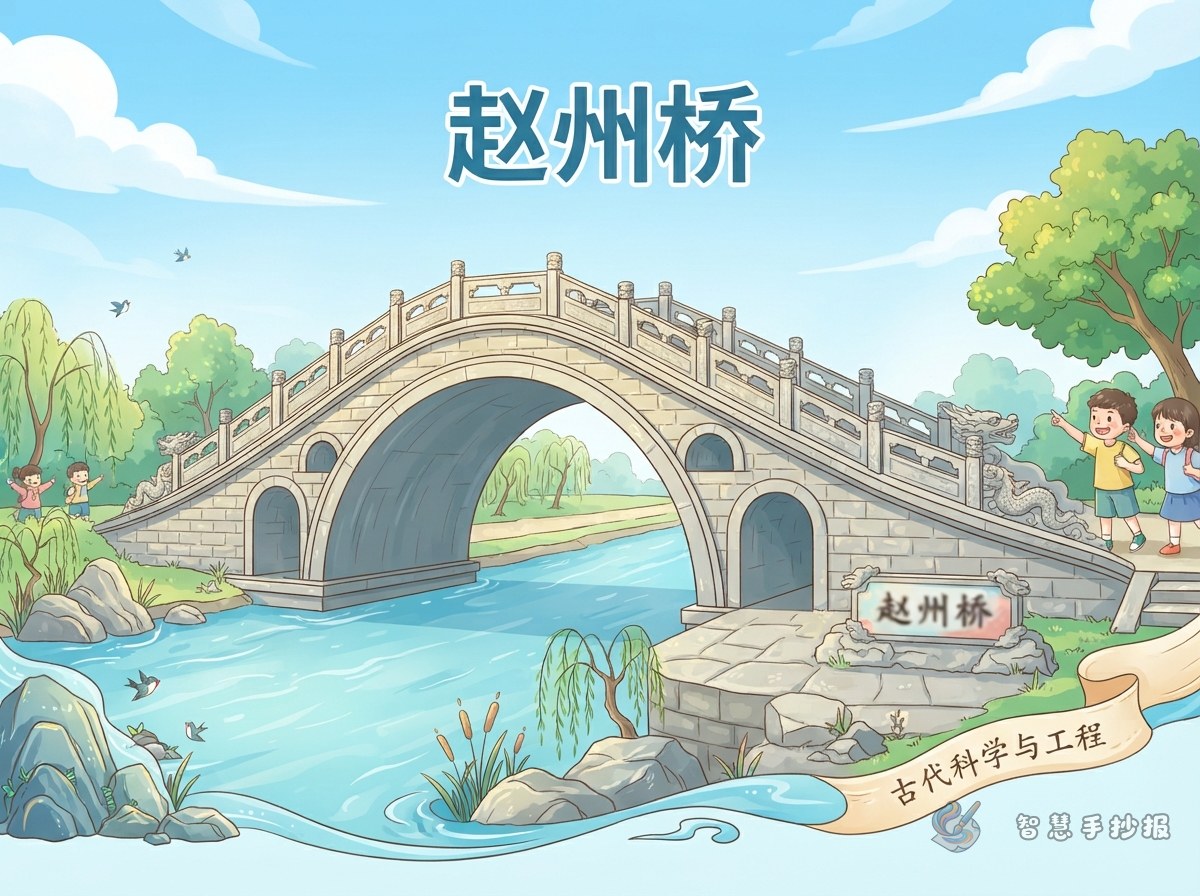
Try a layout with one large central illustration and four small sections around it. Draw the curved bridge, flowing water, and a few rocks in the middle, making the arch easy to recognize. Use bridge railings, clouds, or wave patterns as borders to create an elegant but scientific atmosphere.
- Bridge profile: Introduce the bridge as Anji Bridge, located over the Xiao River in Zhao County, Hebei. It was built during the Sui Dynasty and designed by Li Chun.
- Structure close-up: Add a small diagram of the main arch, spandrels, and smaller arches, and explain the open-spandrel arch design.
- Ancient engineering ideas: Explain how the structure reduced weight, distributed pressure, allowed water to pass, and saved materials.
- Lessons for today: Connect the bridge with modern engineering and highlight observation, calculation, practice, and maintenance.
Three Short Text Blocks Ready for the Page
A historical paragraph
Zhaozhou Bridge, also known as Anji Bridge, is a famous ancient stone arch bridge in China. It was built during the Sui Dynasty, with Li Chun responsible for its design. Without modern machines, ancient builders used measurement, calculation, and practical experience to create a bridge with both graceful form and clever structure.
A structure paragraph
The main arch of Zhaozhou Bridge spans the river, while smaller arches are placed near the shoulders of the main arch. This open-spandrel design reduces the weight of the bridge and helps water pass through during floods. The stones support one another, transferring the load from the bridge deck toward the foundations.
A paragraph about civilization
A bridge connects more than two riverbanks. It also connects transportation, daily life, and knowledge. Zhaozhou Bridge shows that technological civilization is not limited to complicated machines. Sound structure, careful construction, and improvements based on experience are also important forms of ancient wisdom.
Add a “How Forces Move” Card for a More Scientific Feel
If there is unused space, create a light-colored information card. There is no need for complicated formulas. Explain the arch principle in simple language: the load on the deck travels along the curved structure toward both sides, while strong stone and cooperating arch sections support the bridge together. Draw arrows beside the diagram to show the force moving downward and outward.
You can also add the question: “Why is the bridge arch curved instead of flat?” The answer is that an arch spreads the load toward both sides and reduces the direct pressure on the middle section. This question-and-answer box is easy for children to understand and makes the page explain an idea rather than only display facts.
Use Color and Lettering to Show the Strength of an Ancient Bridge
Choose blue-gray, ochre, dark green, and light blue for the stones, traditional setting, landscape, and river. Use dark brown or brick red for the title, black for the main text, and red boxes for key terms such as “open-spandrel arch,” “load distribution,” and “Sui Dynasty.” Make the bridge lines thicker than the writing so the central illustration remains visible.
Before finishing, check the spacing, text size, and heading levels. A parent or teacher can help the child sketch the proportions of the arches first, while the child adds the writing and decorations. For help organizing the layout, continue in the WeChat mini program “智慧手抄报” to explore suitable page arrangements and materials.