Why a Seven-Day Plan Fits Constitution Awareness Week
National Constitution Day falls on December 4, and many schools hold Constitution Awareness Week around that date. Instead of squeezing every fact onto one page, treat the whole newspaper as a seven-day schedule: one panel per day, one clear idea each. Nothing repeats, the writing feels lighter, and readers can follow the order at a glance.
This works especially well for older primary pupils, because it gives them both a timeline and a way to connect the Constitution to everyday life.
Day-by-Day Panels: One Small Question Each
- Day 1 – What is the Constitution: two or three sentences explaining that it is the fundamental law of the country and sets out basic state systems and citizens' rights and duties.
- Day 2 – Why National Constitution Day exists: note the date December 4 and explain that the day helps more people learn about and respect the Constitution.
- Day 3 – Flag, emblem and anthem: the Constitution states what they are, so add a simple hand-drawn symbol beside the text.
- Day 4 – My rights: the right to education, to protection and to take part in activities, written as “I can …” sentences.
- Day 5 – My duties: follow rules, care for public property and respect others; the smaller and more concrete, the better.
- Day 6 – Rules at school: class agreements, duty rotas and sports day rules are all small examples of rule awareness.
- Day 7 – Three things I can do: learn one fact about the Constitution, tell my family about it, and keep one rule around me.
If seven panels will not fit, merge them into two bigger sections or keep only Days 1, 4, 6 and 7, with the theme the Constitution and me at the centre.
Three Layouts That Do Not Look the Same
Horizontal timeline
Turn the paper sideways and draw a route from top left to bottom right. The seven days become seven stops, each in a small box. Put the main title at the top left and save a small note corner at the bottom right.
Calendar grid
Draw seven boxes of similar size and arrange them like a week on a calendar. Connect the boxes with thin lines or small icons. This keeps the page tidy and makes the word count easy to control.
Centre circle
Draw a large circle in the middle with the word Constitution inside, then divide the space around it into seven arcs, one keyword per arc. Curved writing takes practice, so sketch it once on scrap paper first.
Red and gold, or blue and white, work well. Use three sizes of lettering: largest for the title, medium for panel names and smallest for body text, and leave a margin around the page for your name and date.
Copy-Ready Lines, and How to Make Them Your Own
- The Constitution is the fundamental law of the country and a shared set of rules for us all.
- On December 4, National Constitution Day, learn one fact about the Constitution.
- I value my rights and I keep my duties.
- Rules are not there to limit us; they help everyone grow up safely.
- Start with the class agreement and be a citizen who follows the rules.
Add one concrete example and a copied line instantly sounds like yours. After “the right to education”, for example, write “so I can sit in my classroom and learn every day”. It is far easier to remember than a definition on its own.
Three Things to Sort Out Before You Start
- Check the teacher's requirements: paper size, name and class label, and the deadline.
- Write the text first, then draw the layout, keeping each day to about 30–50 words.
- Leave one small “my own sentence” area for your name and date.
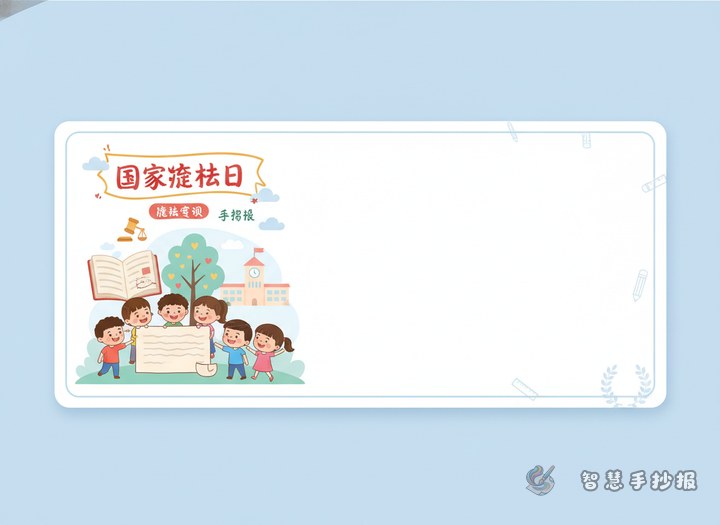
If you prefer not to start from a blank sheet, open the Smart Handwritten Newspaper mini program in WeChat, pick a Constitution awareness template, fill in these lines, and finish it with coloured pens. You can also arrange the layout in the mini program first and then copy it onto paper.