Why the Winter Solstice Deserves a Handwritten Newspaper of Its Own
Among the twenty-four solar terms, the Winter Solstice was the first to be treated as a true festival. It is also known as Yasui, the Winter Festival and the Longest Night, and an old saying claims it matters as much as the New Year. On this day the sun shines directly over the Tropic of Capricorn, so the northern hemisphere has its shortest day and longest night. After the solstice the daylight slowly lengthens, which is why people spoke of the returning sun.
Because it is both a solar term and a festival, and because it begins the countdown to warmer days, it gives you plenty to work with: poems, folk customs, and a picture that grows a little every day.
Four Columns That Keep Everything Organised
Decide on the columns before you write a single word. These four are easy to divide and easy to fill:
- Solar term file: the date (between 21 and 23 December), the alternative names, and the three seasonal signs.
- Customs encyclopedia: counting the nines, eating dumplings or sweet rice balls, greeting winter, giving shoes and socks, and drawing the countdown chart.
- Poetry corner: two or three short lines from Winter Solstice poems, each with your own one-sentence note.
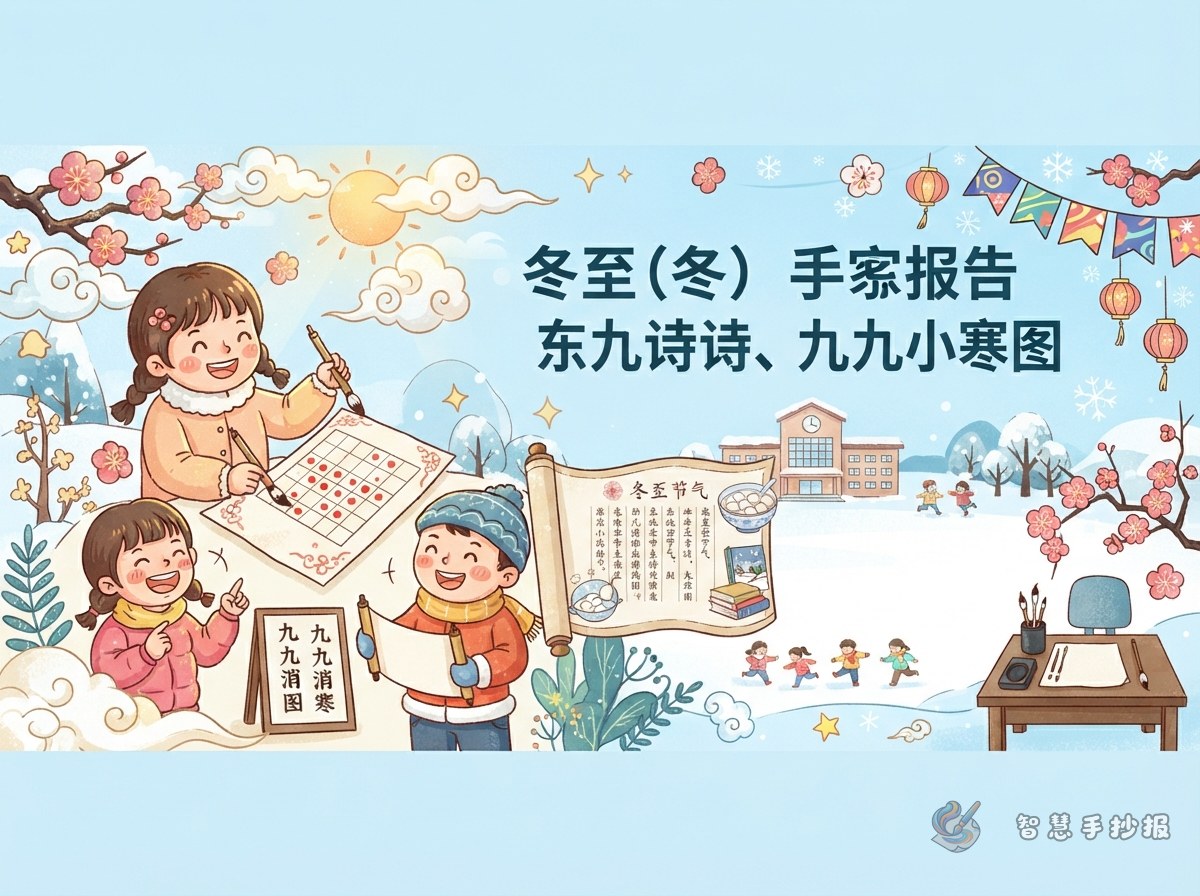
- Interactive corner: a plum branch with eighty-one petals, or nine characters of nine strokes each, filled in one petal or stroke a day.
Details From Winter Solstice Customs That Stand Out
Counting the Nines
From the Winter Solstice, every nine days makes one 'nine', and when you reach nine nines, eighty-one days in all, the cold has passed. Copy the Counting the Nines song along the bottom of the sheet: hands stay in pockets for the first and second nine; you walk on ice in the third and fourth; willow trees come into view in the fifth and sixth; rivers open in the seventh; wild geese return in the eighth; and by the ninth nine, ploughing begins.
Dumplings in the North, Sweet Rice Balls in the South
Northern families say that anyone who skips dumplings on this day will freeze their ears off, while many southern families eat sweet rice balls, winter rice cakes, red bean porridge or a sip of winter-brewed wine. Draw a bowl of dumplings beside a bowl of sweet rice balls, divide them with a thin line, and write that the same festival tastes different across the country.
Greeting Winter and Giving Shoes and Socks
In the past people visited one another to offer Winter Solstice greetings, and younger family members gave shoes and socks to their elders as a wish for good fortune and long life. A detail like this reads far better than a single line about eating dumplings.
Poetry for the Page: Two Lines and One Short Note
You do not need a whole poem. Two lines plus the poet's name and a brief note keeps the corner tidy:
- Du Fu, Xiao Zhi: 'Heaven and human affairs hurry on day by day; at the Winter Solstice the sun returns and spring is on its way.' Note: the light is already coming back.
- Bai Juyi, Winter Solstice Night in Handan: 'The Winter Solstice finds me at a post station in Handan; I hold my knees by the lamp, with only my shadow for company.' Note: a traveller's longing on the longest night.
- Du Fu, After the Solstice: a line about the days growing longer after the solstice while the poet thinks of home far away.
- Su Shi, Visiting the Auspicious Temple Alone at the Winter Solstice: a line about faint warmth returning underground while cold rain soaks the withered grass.
- Lu You, Winter Solstice: a line about the sun reaching its southernmost point while the house stays quiet.
Write the poem lines in neat regular script, slightly larger than the body text, and place the poet's name and the note in smaller letters at the lower right.
Turn the Nine-Nine Countdown Chart Into an Interactive Corner
This is the one part of the sheet that keeps working after it is handed in, because it invites the reader to do something every day.
- Choose a form: a plum branch with eighty-one petals, or nine characters such as 'ting qian chui liu zhen zhong dai chun feng', each with nine strokes.
- Draw the grid first: sketch the branch or the square frames lightly in pencil and count carefully to make sure there are eighty-one.
- Add instructions: write one line beside the chart explaining that one petal or stroke is coloured each day until spring arrives.
- Leave it partly empty: only colour the days that have already passed, so the blank part becomes something to look forward to.
Layout and Colour: A Cool Base With Warm Accents
The mood of the Winter Solstice is cold, quiet and inward, so keep the background in off-white, pale blue-grey or deep indigo. Write the main title in dark blue or ink black, then add warm orange and vermilion touches for dumplings, plum petals and small lanterns.
- Title area: a large horizontal title across the top, with simple plum blossom and dumpling drawings on either side.
- Division: split the sheet once across and once down to create four areas for the file, customs, poems and the interactive chart.
- White space: leave one to two centimetres between columns; it looks better than filling every gap with decoration.
- Borders: use snowflakes, sweet rice balls, roof eaves and bare twigs as small accents instead of repeating one pattern all the way around.
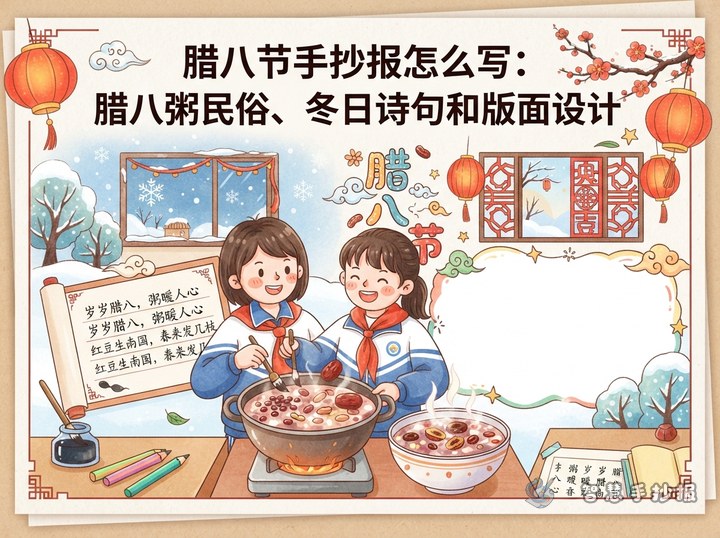
If you are unsure about the proportions, list the column names and their word counts first, then decide which block needs more text and which needs a picture. You can also open the 智慧手抄报 WeChat mini program, choose a layout frame under the festival poetry and folk customs templates, and drop the Winter Solstice poems and counting-the-nines material into it — handy for printing or copying by hand.