Choose the Focus: A Small File on Two-Character Surnames
This handwritten newspaper can place Chinese compound surnames at the center. A compound surname usually contains two or more Chinese characters, unlike the more common one-character surname. Ouyang, Sima, Zhuge, Shangguan, Huangfu, Murong, Duanmu, and Gongsun can all be used as examples.
Instead of listing many facts at the beginning, start with a simple question: why do some people have a two-character surname? Different compound surnames have different historical backgrounds. It is safer to summarize this as “each surname has its own story” and use only sources that you can explain clearly.
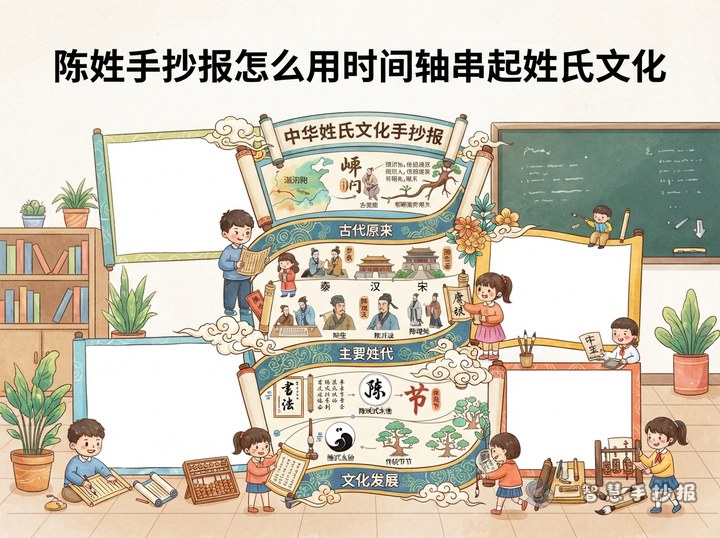
Design the Page as a Four-Panel Surname Notebook
- Center title: Write “A Close Look at Compound Surnames” in the middle and place the two characters inside connected seal-style frames.
- What is a compound surname? Add a short definition and list five to eight familiar examples.
- Historical figures: Choose people such as Sima Qian, Zhuge Liang, Ouyang Xiu, and Shangguan Wan'er, then give each one a brief introduction.
- My discovery: Create a small survey asking family members whether they have heard of compound surnames and which one they like best.
Arrange the four panels around the title like pages in an observation notebook. This keeps long paragraphs from crowding the page and creates a clear reading order: learn, explore, and discover.
Short Text You Can Copy into the Newspaper
A quick introduction
Compound surnames are a distinctive part of Chinese surname culture. They contain two or more Chinese characters. Some are connected with ancient official titles, places, territories, or family names, while others were passed down through changes in history. Each surname has its own development, so avoid claiming that all compound surnames came from the same source.
A surname and historical figure panel
- Sima: Sima Qian was a historian and writer of the Western Han period. You can describe him as a person who recorded history through writing.
- Zhuge: Zhuge Liang was an important figure in the Shu Han state during the Three Kingdoms period. His keywords can be wisdom and responsibility.
- Ouyang: Ouyang Xiu was a writer of the Northern Song period, making him suitable for a small section on surnames and literature.
- Shangguan: Shangguan Wan'er was a writer and political figure of the Tang dynasty and can add a female historical voice to the page.
Do not turn the figure section into a long biography. Write each person's name, period, identity, and one keyword, leaving enough room for borders and decorations.
A closing sentence
At the bottom, you can write: “A surname is not only a form of address, but also a cultural thread connecting history with the present.” It makes a natural conclusion and invites readers to think about family names and Chinese culture.
How to Create Layers with Compound-Surname Cards
- Use a pencil to mark the title and four panels first. Adjust their sizes according to the amount of text before drawing decorations.
- Turn each surname into a small “surname card.” Write the surname at the top and add pronunciation guidance, a historical figure, or a cultural keyword below it.
- Scrolls, traditional window patterns, leaves, and round seals make good borders. Choose no more than two decorative elements for each panel so the page stays neat.
- Use a palette of vermilion, deep blue, cream, or green. Keep the body text easy to read and outline only important words with a matching color.
Three Tips for Researching and Copying
- Separate the surname from the given name. In “Sima Qian,” Sima is the compound surname and Qian is the given name.
- Check pronunciation and historical explanations carefully. If sources give different explanations, write that there are different interpretations instead of inventing a definite answer.
- A primary school handwritten newspaper does not need to be filled with rare facts. A few well-chosen surnames, your own observations, and thoughtful design will usually be more effective than dense copying.
If you want to organize the title, panels, and decorations more quickly, you can continue planning in the Zhihui Handwritten Newspaper WeChat Mini Program, then copy and adjust the design to fit your paper.