Build the whole idea around the Nile
An Egypt-themed handwritten newspaper does not need to include every famous place. For a clear school project, focus on three key images: the Nile River, pyramids, and desert. Egypt lies in northeastern Africa. Much of the country is dry, while the Nile Valley and Delta provide important conditions for settlement and farming. Draw the Nile as a blue line across the page to connect geography, history, and culture.
Opening text you can use: Egypt is a country with a long and remarkable history. The Nile flows northward into the Mediterranean Sea, creating a green landscape that contrasts with the surrounding desert. Pyramids, ancient writing, and distinctive buildings form some of the country’s best-known cultural images.
Turn the page into a small map of Egypt
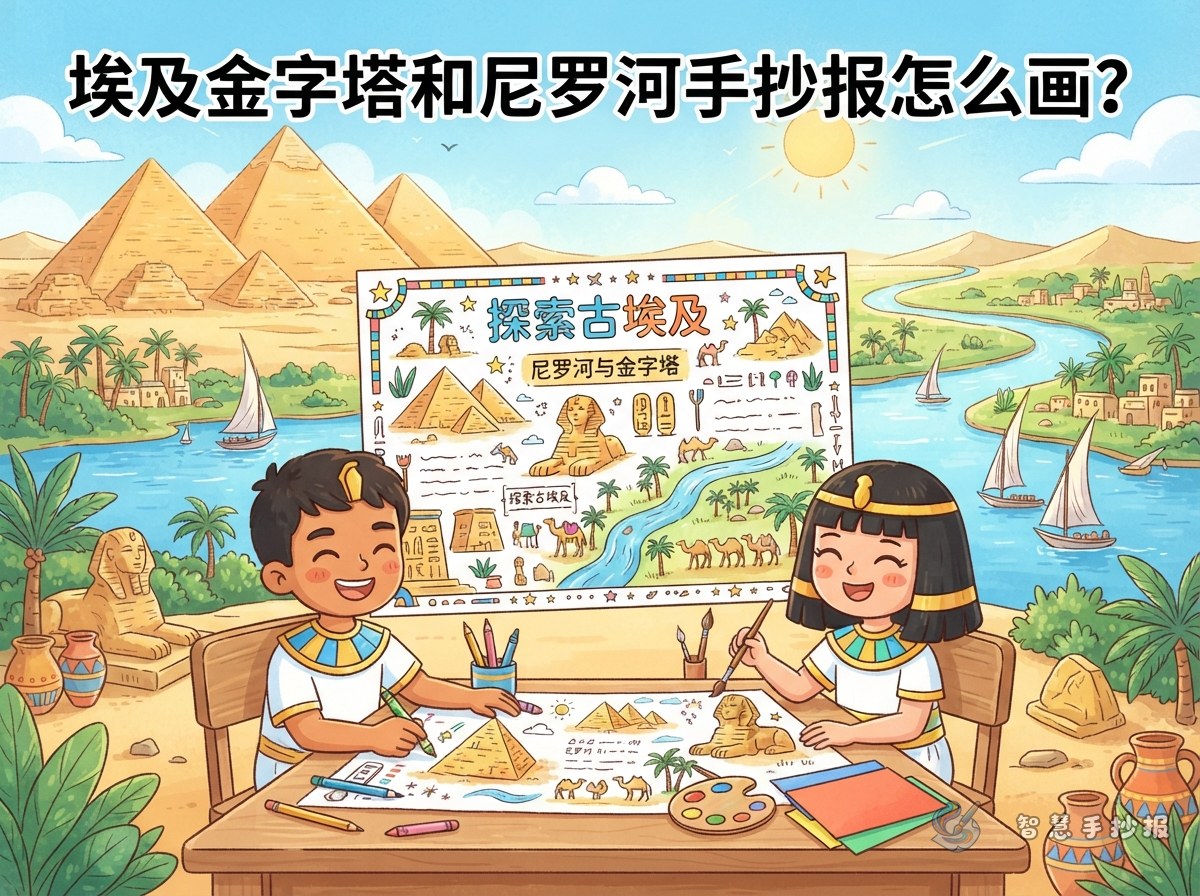
A horizontal layout works well. Put the title at the top, draw a winding Nile through the middle, place pyramids and desert scenery on the left, and reserve the right side for geography and culture notes. This arrangement gives the page a strong visual path.
- Title area: Use sandy yellow or brown lettering. Add a sun, palm tree, or a simple geometric border inspired by Egyptian patterns.
- Main illustration: Draw three pyramids of different sizes, show the Nile with a blue line, and add a few green plants along the riverbank.
- Geography panel: Include northeastern Africa, the Nile, the Sahara Desert, and the Mediterranean Sea. A small compass can make the map easier to understand.
- Culture panel: Introduce ancient Egyptian architecture, hieroglyphic-style decoration, and the impression of museum artifacts. Make it clear that ancient Egyptian civilization is not the same as modern Egyptian life.
Use four short sections to add depth
Why the Nile matters
You can write: Many cities and settlements in Egypt are located along the Nile. The valley and delta offer conditions that are more suitable for farming and daily life, while areas farther from the river are often broad and dry deserts. Draw blue water beside a few green fields for this section.
What the pyramids show
You can write: Pyramids are important architectural remains of ancient Egypt. Their geometric shapes and huge stone blocks show the skill of ancient builders. For a school drawing, simple triangular outlines, light-and-dark shading, and a sandy background are enough to create a sense of grandeur.
A tiny note on writing and patterns
Create a decorative border with simplified symbols such as an eye, sun, bird, or wave. These symbols are for page decoration, so do not present personally invented marks as accurate translations of ancient Egyptian writing.
Modern Egypt beyond the ruins
Leave a small space for modern cities, markets, food, or daily life. Use careful phrases such as “can be found in some areas” or “is worth learning about,” because lifestyles can differ between regions and families. This keeps the introduction respectful and balanced.
Choose colors that suggest the landscape
Use sandy yellow, earthy brown, Nile blue, and palm-leaf green as the main palette. Yellow works for the desert and buildings, blue highlights the river, green suggests life along the banks, and dark brown or black defines the outlines. A simple geometric border can add character without filling every space with complicated symbols.
If you draw people, use simple figures such as a traveler, farmer, or visitor to support different sections. Avoid exaggerated facial features as a shortcut for describing a country or its people. Clear illustrations leave more room for readable writing and make the project easier to finish.
Five steps from sketch to final page
- Use a pencil to mark the title, the Nile path, and four section boxes, leaving enough room for text.
- Place the pyramids, palm trees, and map outline before adding small decorations.
- Turn long facts into two or three short sentences, with one main idea in each paragraph.
- Color the large areas first, then outline the drawings and add details. Keep the main palette to three or four colors.
- Check the country name, geographic directions, and section text. Erase the pencil marks and strengthen the title at the end.
When the structure is ready, you can continue arranging the proportions, colors, and title style in the 智慧手抄报 WeChat Mini Program, turning this idea into a neat handwritten newspaper more quickly.