Turn a Matching Game into a Handwritten Poster
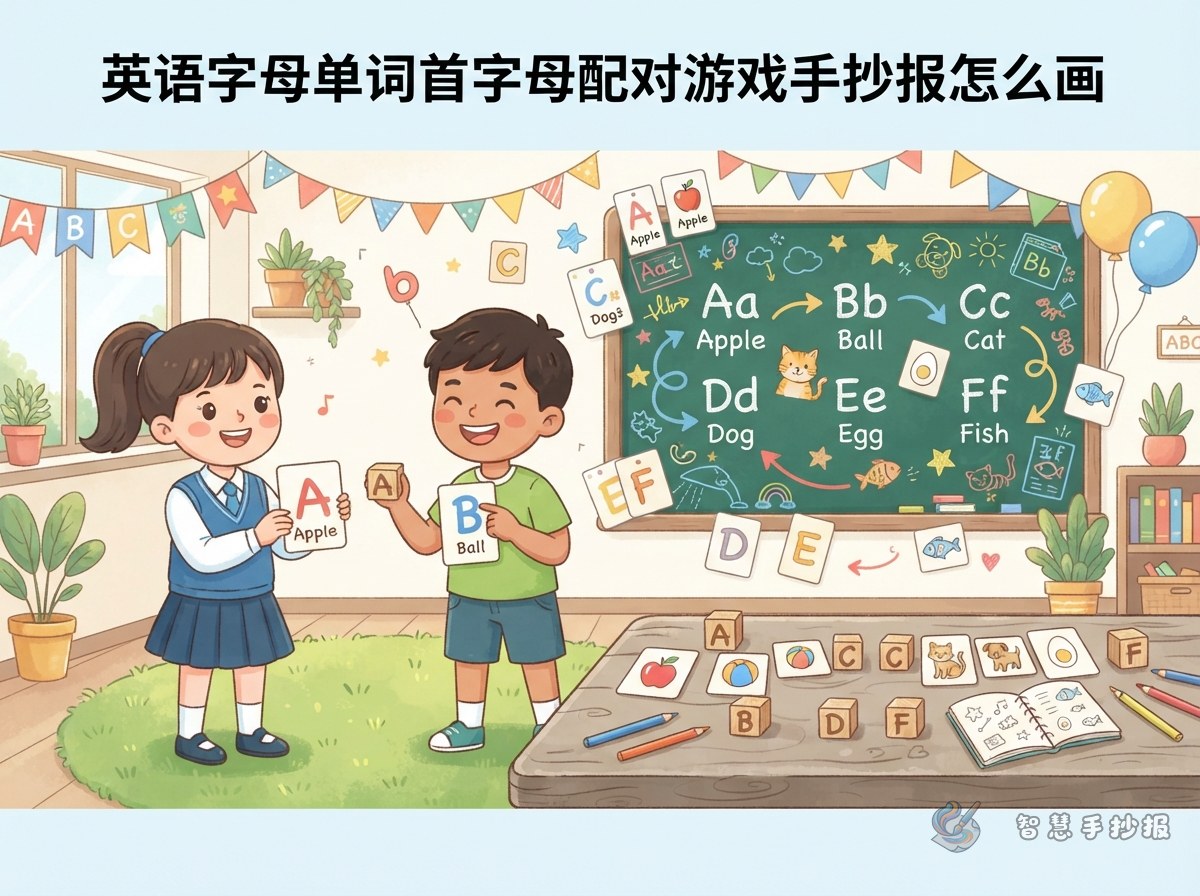
An English alphabet poster for beginners does not have to be a plain A–Z chart. You can turn it into an initial letter matching game: letters on the left, words and simple pictures on the right, and open space in the middle for children to connect. This makes the poster both a display and a game for first graders who are just starting to learn letters.
A good title is “Letter Friends” or “Match the First Letter.” Add a short subtitle like “Look at the letter and connect the word.”
Four Sections That Keep the Layout Lively
- Title area: Use bubble letters or colorful alphabet letters for the title, and draw two pencils beside it.
- Matching area: Make two columns. The left column shows uppercase and lowercase letters; the right column shows words and simple pictures. Leave a clear space in the middle for lines.
- Word bank: Put all the words used on the poster in one corner so children can check their answers.
- Mini challenge: Leave two or three blanks for children to complete, such as “__ is for apple.”
Letter and Word Pairs You Can Use
Choose 8 to 12 pairs instead of filling the whole page with all 26 letters. These words are easy to draw and read:
- A—apple, B—ball, C—cat, D—dog
- E—egg, F—fish, G—grapes, H—hat
- I—ice cream, J—juice, K—kite, L—lion
- M—moon, N—nose, O—orange, P—panda
If the child is ready for more, add Q—queen, R—rabbit, S—sun, T—tiger, U—umbrella, V—van, W—water, X—box, Y—yellow, Z—zebra.
Step-by-Step from Sketch to Final Poster
- Draw four boxes in pencil on A3 or A4 paper and decide where the title and matching areas will go.
- Write the letters in the left column. Give each letter its own small box and write uppercase and lowercase together, such as “Aa.”
- Draw simple pictures in the right column and write the English words. Leave about two fingers of space in the middle for connecting lines.
- Go over the outlines with colored pens, then draw the matching lines in a different color so they do not blend into the words.
- Add the word bank and mini challenge, then erase any extra pencil marks.
Layout Details for Young Learners
Write the letters large enough to read, and keep every matching box the same height. Use one clear style for all words, and avoid mixing too many letter forms. Limit the colors to three or four: blue for letters, orange for words, and green for matching lines. Simple pictures made from circles, triangles, and squares are enough; an apple, a ball, and a cat face are easy shapes. White space matters, too. Leave at least one finger of space between boxes so the page does not look crowded.
Ways to Keep Playing After It Is Finished
Turn the matching area into a flip-card game by cutting small cards from colored paper. The front can show a letter, and the back can show a word. Children can also act as little teachers and point to each line while saying “A is for apple.” If you want to try different fonts, adjust the section sizes, or start from a tidier layout, open the Smart Handwritten Poster WeChat mini program and continue your design there.