Why Beaks and Feet Make a Strong Science Handwritten Newspaper
Bird protection posters often end up as a wall of slogans: love birds, protect birds, do not hurt birds. The message is fine, but a whole page of slogans reads more like a chant than a science page. Switch the focus to beaks and feet and things change: they are the easiest parts of a bird to see while birdwatching, their shapes differ a lot, and they can be drawn, compared, and explained. One page can hold both science and a protection reminder.
This topic suits upper primary students especially well. You do not need to memorise many bird names; one main idea, that shape follows use, is enough to fill the layout.
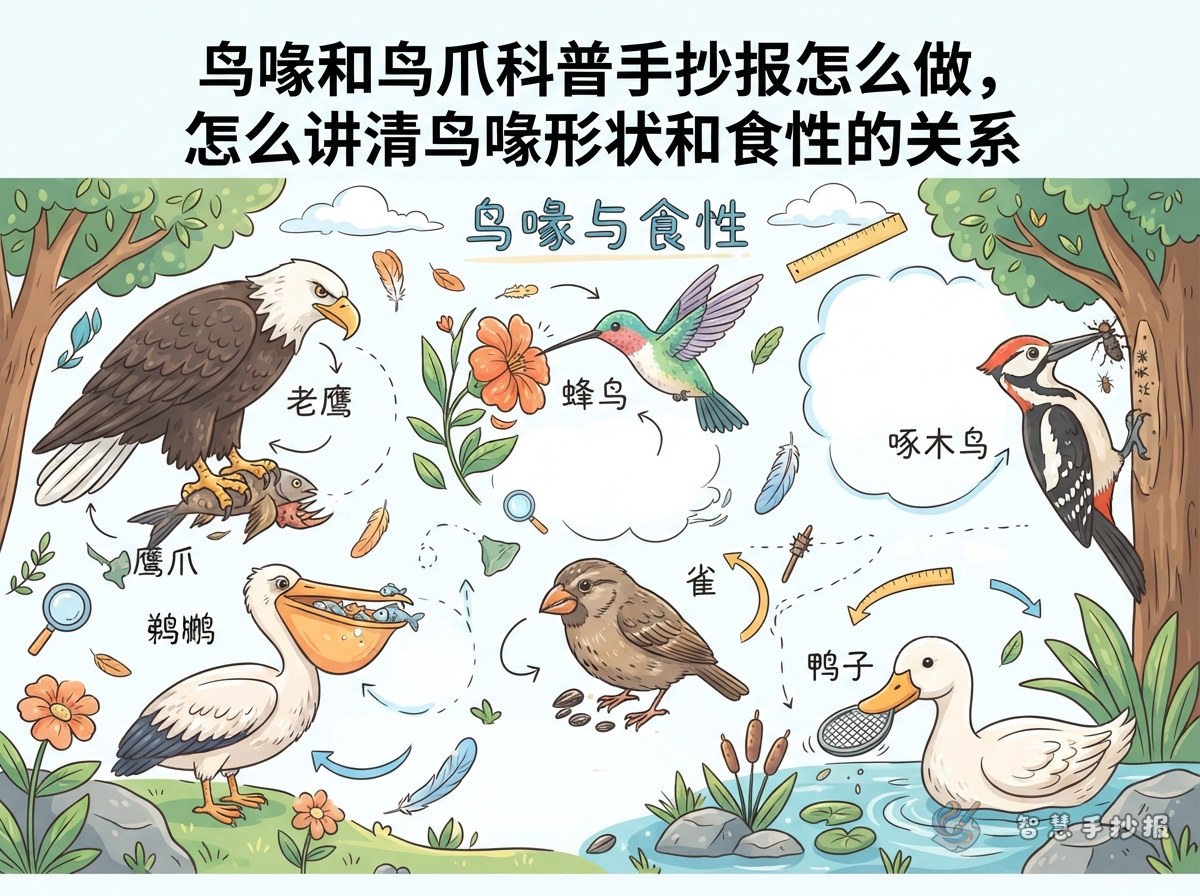
Start With Beak Shapes and the Food They Handle
This is the core block of the whole page. List a few pairs on scrap paper first, then put only three or four of them on the final version so the page does not feel crowded.
- Long and thin: reaches into flowers for nectar and into bark cracks for tiny insects.
- Short and cone-shaped: strong enough to crack hard seeds and grain.
- Hooked and pointed at the tip: good for tearing food, common among birds that eat other small animals.
- Broad and flat: works like a small shovel to filter tiny shrimp and insects out of water.
- Long and large: can be pushed into shallow water and mud to search for food.
Leave a little room in your wording. Writing “this shape is usually suited to…” reads better and stays more accurate than a hard and fast claim.
Feet Tell You Where a Bird Lives
Feet are a bit harder to draw than beaks, but showing toe length, thickness, and webbing is enough to make the difference clear. Try these four comparison boxes:
- Thin, bendable toes: grip branches firmly, common in birds that spend time in trees.
- Very long toes: spread the bird's weight so it can walk on water plants and floating leaves.
- Webbed toes: act like little paddles for swimming.
- Sharp claws and a strong back toe: help a bird hold on to food it catches under water.
Add one line beside this block, such as “feet are a bird's shoes”, and readers get it at once.
Layout: Let One Comparison Chart Fill Half the Page
A left-and-right comparison layout fits this topic best. One way to divide the page:
- Top title area: write “Beaks and Feet” as the main title and use a question as a subtitle, such as “Why do birds have different beaks?”. A straight or curved line both work.
- Middle drawing area: sketch four or five simple bird heads or feet, and leave a small box beside each for the matching food or habitat. Skip fine details and exaggerate the shape differences instead.
- Lower left knowledge corner: make a “look and guess” column that shows one beak shape and asks classmates what it might eat.
- Lower right action corner: add two or three protection reminders, such as keeping a distance, not disturbing birds, not dropping litter, and not feeding human snacks.
Keep the colour palette to three colours or fewer, use the same colour family for beaks and feet, and give text boxes a pale background. White space looks better than a packed page.
Short Lines You Can Copy Straight Onto the Page
Text on a handwritten newspaper should be short. These lines work well as column intros or small labels next to a drawing:
- “A bird's beak is its cutlery.”
- “Want to know what a bird eats? Look at its beak first.”
- “Where a bird's feet rest often tells you where it lives.”
- “The best birdwatching posture is to watch quietly and not disturb.”
- “A bird's shoes are easy to miss, but they decide where it can stand.”
If there is still space, add a small “questions I noticed” box and write down something you wondered about while watching birds. That is far more interesting than copying a ready-made conclusion.
A Quick Check Before You Finish
- Is the page focused on one idea, or did it drift into other bird facts?
- Does every comparison have both a drawing and one sentence?
- Did you avoid over-strong claims, such as matching one beak shape to one bird?
- Are the protection reminders written as real actions instead of only “protect birds”?
- Are titles and column names free of spelling mistakes, with clear line spacing?
If you are short on time, open the 智慧手抄报 WeChat mini program, pick a bird-themed layout, and lock the column positions first. Filling in your own observations afterwards is much faster than staring at a blank sheet.