Choose One Story Before You Draw Anything
Unlike the Spring Festival or Mid-Autumn Festival, the Laba Festival does not have a single fixed folk tale. At least three versions are widely told, so the first step is to pick one main character and build the whole sheet around it instead of writing a little about each.
- Red beans drive away evil spirits: long ago, people believed evil spirits troubled children at night. Red beans were thought to keep them away, so a red bean porridge was cooked on Laba day.
- Zhu Yuanzhang's porridge: while he was poor and hungry, he gathered scattered grains from a wall corner and cooked them into a pot of porridge. Even later, he remembered the taste.
- The Buddhist enlightenment story: Laba is said to be the day of the Buddha's enlightenment. Temples cooked and shared porridge, and the custom spread among ordinary families.
Any of the three works well. You can also use the red bean story as the main line and mention the other two in one closing sentence.
Shrink the Legend into Three Short Paragraphs
A sample: the red bean story
Paragraph one: people in an old village could not stop their children from being frightened at night. Paragraph two: someone found that cooking red beans into porridge and letting the family share it helped the children sleep peacefully, so the dish became a Laba custom. Paragraph three: over time more grains were added, and now red beans are only one of many ingredients.
Keep each paragraph between forty and sixty words, with one idea per paragraph. Read the three paragraphs together before copying them onto the sheet.
Four Content Blocks That Fit on One Sheet
- The legend: the largest text block, telling the story you chose.
- Laba customs: porridge cooking, pickled Laba garlic, ancestor offerings and temple porridge sharing. Pick three or four.
- Inside the porridge: six to eight common ingredients with small drawings.
- My family's Laba: one or two sentences about what you saw or tasted.
Make the Porridge Bowl the Centre of the Page
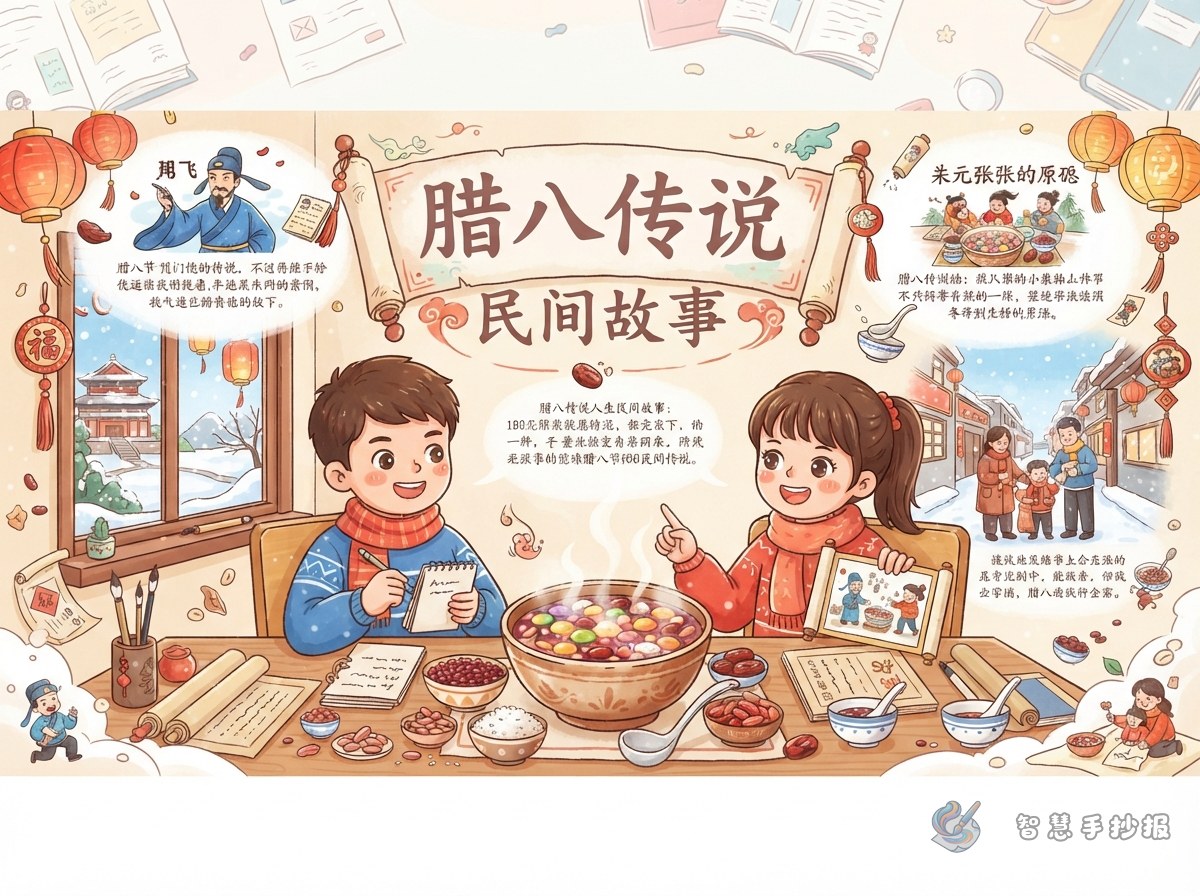
A simple and attractive approach is to draw a large bowl in the middle with a few lines of steam, then write the main title across the bowl and arrange everything else around it.
- Centre: the bowl, the steam and the main title.
- Left side: the legend, framed as a lantern or a scroll.
- Right side: customs in small diamond-shaped boxes.
- Bottom: a row of ingredient icons that doubles as a divider.
- Corners: a few plum blossoms, snow dots or firecrackers, not too many.
Limit yourself to three or four colours. Use warm tones for the background, dark ink for the text and your boldest pen for the title. Leave a finger's width of space between blocks and around the edges.
A Quick Check Before You Hand It In
- Do the main title and subtitle make the festival and topic clear?
- Does the story have a beginning, a middle and one personal closing sentence?
- Is there enough white space between text blocks, with a tidy border?
- Are the festival date and custom names written correctly?
- Is there only one main picture instead of many small ones competing for attention?
If you would rather not hunt for wording yourself, open the 智慧手抄报 WeChat mini program, choose a festival layout you like, drop in the chosen legend and column titles, then copy everything onto paper in your own handwriting.