Start with the main idea: what are the Twenty-Eight Mansions?
This poster can begin with a simple explanation: ancient Chinese observers divided the sky into recognizable star regions. The Twenty-Eight Mansions are not twenty-eight single stars, but twenty-eight groups of stars near the path of the Moon and the Sun. People used them to describe celestial positions, record time, and connect the sky with seasons and daily life.
A useful short paragraph for the opening box is: The Twenty-Eight Mansions were an important star system in ancient Chinese astronomy. They worked like sky coordinates, helping people describe where the Moon appeared and supporting the study of calendars and seasonal changes.
Use the Four Symbols to make the layout clear
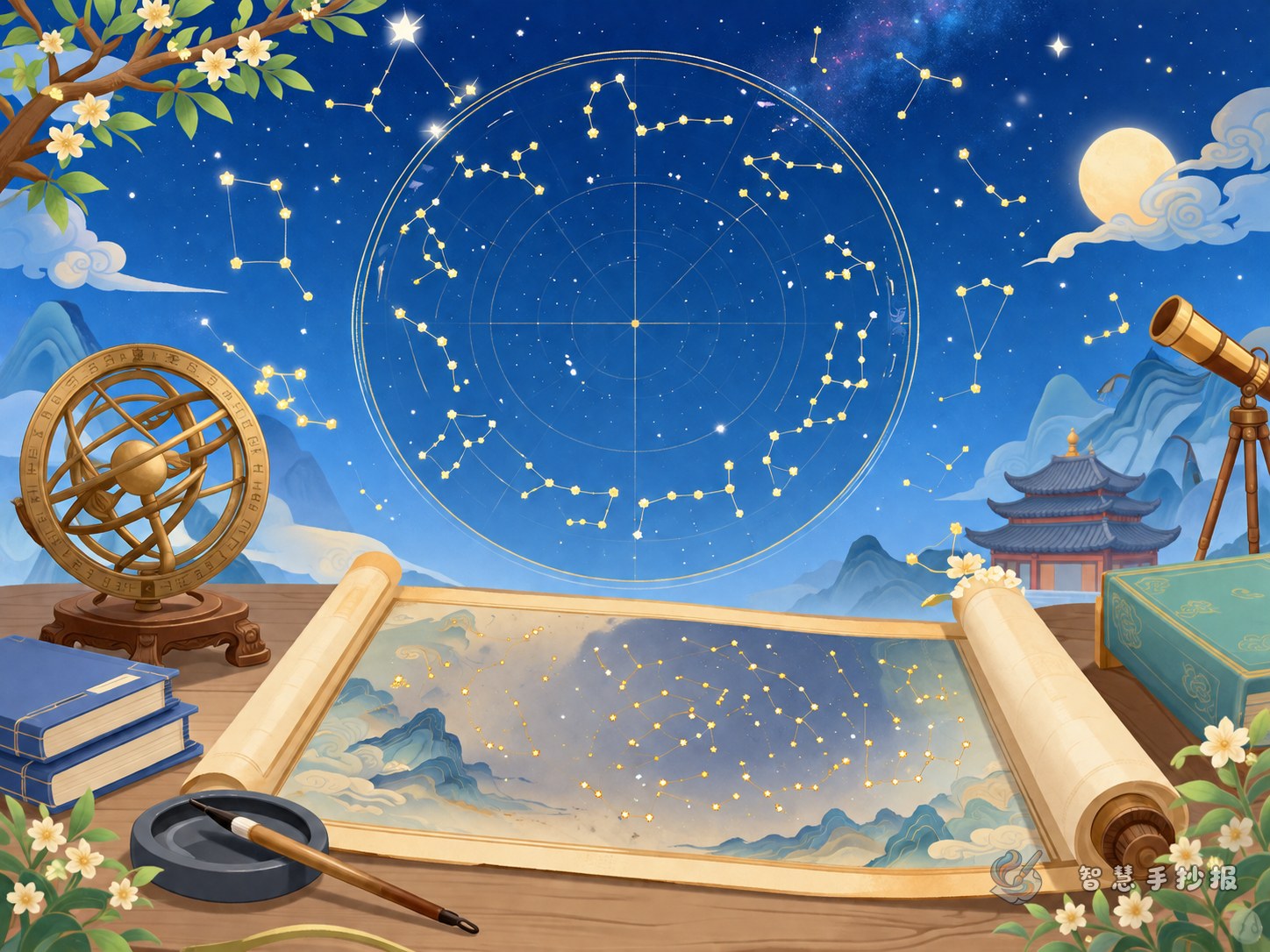
The Twenty-Eight Mansions can be grouped into the Azure Dragon of the East, the Vermilion Bird of the South, the White Tiger of the West, and the Black Tortoise of the North. For a handwritten poster, draw a round sky compass in the center, place the four symbols in four directions, and write the mansion names around the outer circle.
- Azure Dragon of the East: Jiao, Kang, Di, Fang, Xin, Wei, Ji. Use green or blue dragon-like lines.
- Vermilion Bird of the South: Jing, Gui, Liu, Xing, Zhang, Yi, Zhen. Add red and orange feather shapes.
- White Tiger of the West: Kui, Lou, Wei, Mao, Bi, Zi, Shen. Decorate with light tiger-stripe patterns.
- Black Tortoise of the North: Dou, Niu, Nu, Xu, Wei, Shi, Bi. Use dark blue waves and simple tortoise patterns.
Ready-to-use writing sections
Small facts about the ancient sky
Ancient observers did not have modern telescopes, but they watched the sky carefully for a long time. They named star groups and used them to describe positions in the heavens. The Twenty-Eight Mansions are one of the most representative systems.
How it connects with calendars
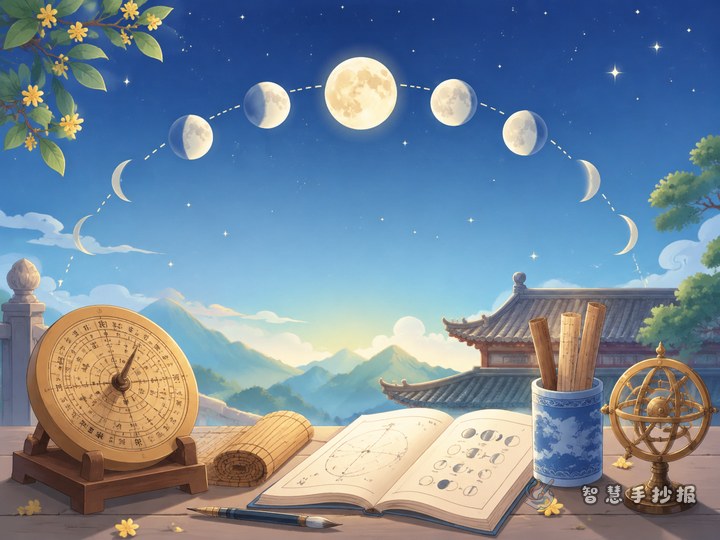
The Moon appears in different parts of the sky from night to night. By observing which mansion the Moon passed through, ancient people could help record time. Together with observations of the Sun, shadows, and seasonal changes, this knowledge supported calendar making.
How ancient people observed
Ancient astronomy was based on careful observation. People watched where stars rose, where the Moon appeared, and how the seasons changed, then turned these patterns into practical timekeeping experience.
A drawing plan that is easy for students
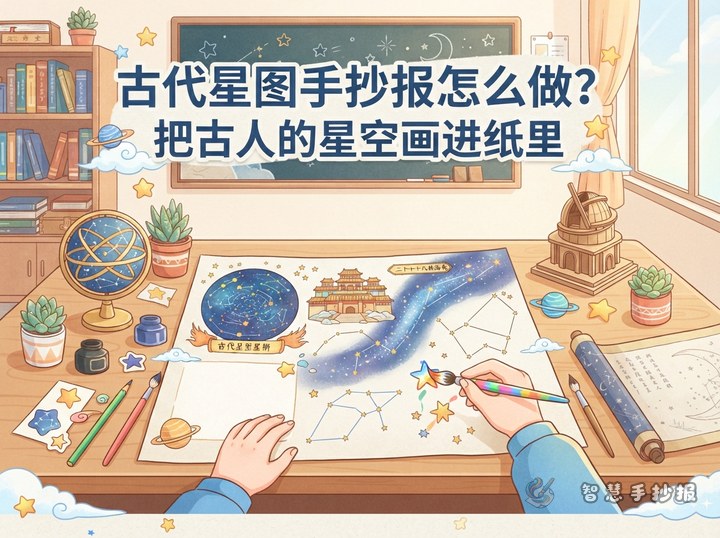
Students do not need to draw every mansion as an accurate star chart. A clear symbolic style is enough: use a dark blue background, golden star dots, four symbolic animals, and a round border. A strong title such as “The Twenty-Eight Mansions: Ancient Sky Coordinates” will make the poster easy to understand.
- Place the title in the upper left corner with a scroll or cloud shape.
- Draw a round Four Symbols sky chart in the center.
- Add two text boxes on the right: “Sky Facts” and “Link to Calendars.”
- At the bottom, draw a child observing stars, bamboo slips, or a simplified star map.
Colors and decoration ideas
Use dark blue, golden yellow, green, and red. Dark blue shows the night sky, gold shows starlight, and green and red fit the symbolic animals. Borders can look like scrolls, clouds, star trails, or traditional window patterns.
If you want to organize titles, sections, and border ideas more quickly, you can open the Zhihui Handwritten Poster WeChat mini program and continue creating a poster with the Twenty-Eight Mansions, the Four Symbols, and starry-sky elements.