Begin with the idea of how the love of books is passed on
Rather than listing many academy names, build the handwritten newspaper around the journey of a book. Books were collected, organized, shared, discussed, and turned into knowledge through study. Place the ideas of “books, reading, reflection, and inheritance” around the main title so the whole page follows one clear theme.
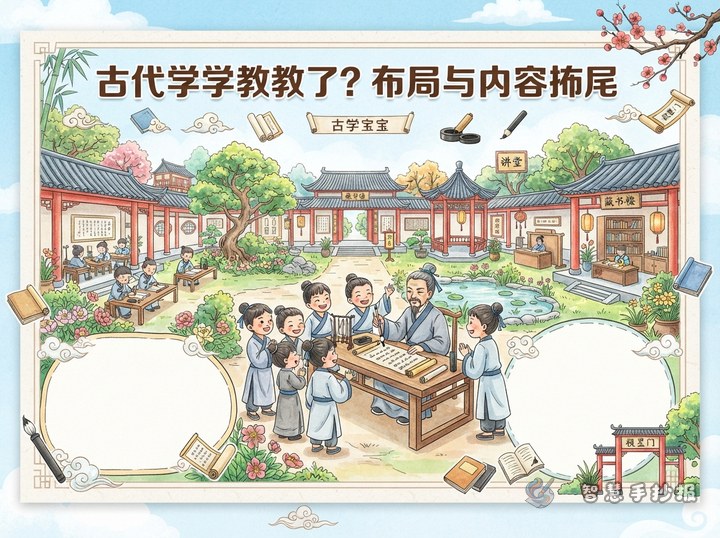
- Main title: The Heritage of Learning in an Ancient Academy.
- Key words: book collection, lectures, reading, reflection, and practice.
- Best for: Children who enjoy traditional culture and want to include their own reading thoughts.
Draw a library that seems to open from the page
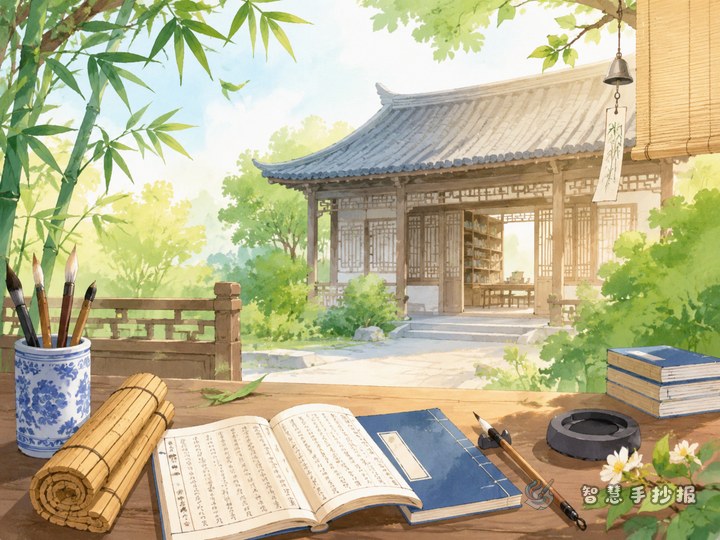
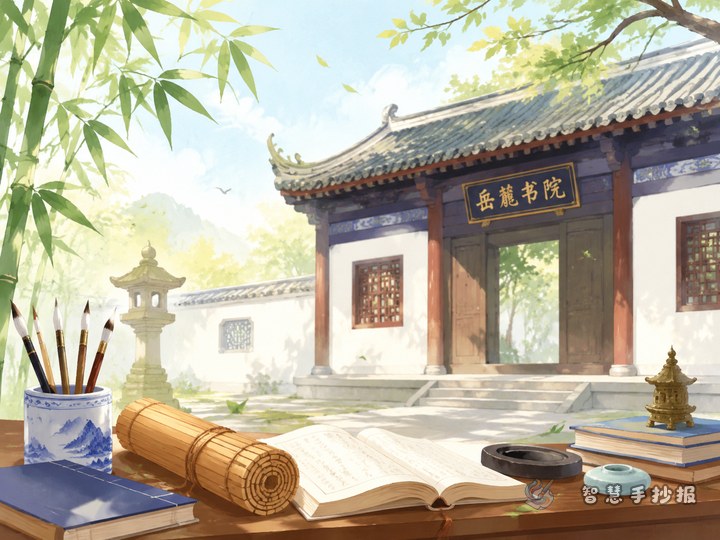
For the center, draw an open book, with a simple ancient academy library rising above its pages. Add scrolls on the shelves, together with an inkstone, writing brush, and bookmark. Keep the roof and shelves simple, using brown outlines, and leave enough blank space on the pages for writing.
- Write the title at the top and decorate it with a scroll or seal-shaped border.
- Place a “Library Notes” section on the left, with small shelves or bamboo slips.
- Place “How to Read” on the right, using a series of small pages to show the steps.
- Reserve the bottom for “My Reading Action,” where students can write a personal plan.
Four sections that connect the library with everyday learning
Library notes
You can write that ancient academies were not only places for lectures. Many also valued the collection, organization, and circulation of books. Some academies took part in printing and sharing texts, allowing more learners to access knowledge. Three or four sentences are enough; the section should support the handwritten newspaper rather than read like an encyclopedia.
Five steps for reading
- Look at the title and contents to understand the book’s direction.
- Read carefully and mark unfamiliar words or important sentences.
- Ask questions whenever something is unclear.
- Recall the main ideas and explain them in your own words.
- Put useful ideas into practice in study and daily life.
A saying with a personal explanation
Write “Reading requires focus; learning grows through accumulation” in a small box, followed by your own explanation. For example, reading a few pages, learning one new word, and thinking about one question each day can gradually create lasting progress. This makes the section more meaningful than copying a saying alone.
My reading action
Let the handwritten newspaper include the student’s own voice. Write “I will read for twenty minutes each day,” “I will record three thoughts after finishing a book,” or “I will share a favorite story with my family.” This connects ancient learning culture with a child’s present-day life.
A paragraph you can adapt for the page
The fragrance of books in an academy: Books in an ancient academy did not simply rest on shelves. They were passed on through lectures, reading, and conversation. Reading is not finished when the words have been seen; we should ask questions, think carefully, and turn useful ideas into action. One book can inspire one person, or help many people learn and grow together.
Finish the page with a calm, classical color palette
Try ivory, light brown, dark green, and a touch of cinnabar red. Ivory works well as the paper color, light brown suggests wooden shelves and scrolls, dark green can highlight headings and borders, and red is best saved for seals and key words. Keep each paragraph short and make the handwriting even. Before finishing, check that the title stands out, the sections have breathing room, and every part supports the theme of academies and reading. To continue adjusting the layout and decorations, open the WeChat Mini Program “智慧手抄报”.