Build the theme around a study hall discussion
Instead of focusing only on academy buildings or reading methods, this handmade newspaper can show how learning happened through lectures, questions, and conversations. Use How Did Ancient Academies Teach? as the main title, with the subtitle “Learning through questions and discussion” to give the page a lively story.
An opening paragraph could explain that an ancient academy was not only a place for reading, but also a place where teachers and students explored ideas together. A teacher explained the classics, students took notes and asked questions, and discussion helped them understand the lessons more deeply. This reflects respect for teachers, a love of learning, and independent thinking.
Three sections for one lecture scene
Who taught at the academy?
Introduce the role of the academy head, often called the “mountain leader” in traditional Chinese usage. This person usually guided teaching and was respected for both learning and character. You may also write about how a teacher explained classical texts and answered students’ questions. Add a simple drawing of a teacher holding a scroll in front of the study hall.
How did students take part?
Use the section title “I Have a Question.” Describe students marking important points, asking for help after class, and discussing lessons with classmates. Add this short sentence: Asking questions helps turn heard knowledge into personal understanding.
What did students gain?
Summarize the results with four words: understanding, truth-seeking, learning together, and putting ideas into practice. Place them inside bookmarks or speech bubbles. Explain that learning is not only about remembering answers; it is also about thinking about reasons and applying good ideas in daily life.
Short writing materials for the page
- Main idea: An academy becomes lively through teaching, and knowledge becomes clearer through exchange.
- Values: Respect, curiosity, careful thinking, cooperation, and action.
- Question and answer: Why did ancient people value lectures and discussion? Face-to-face explanation and conversation helped students understand the classics and compare different ideas.
- Closing line: We can also discover the joy of learning by reading, asking questions, and sharing today.
To keep the page clear, choose one main sentence, the five values, and one short question-and-answer paragraph instead of filling every space with text.
Arrange the page as hall, questions, and discoveries
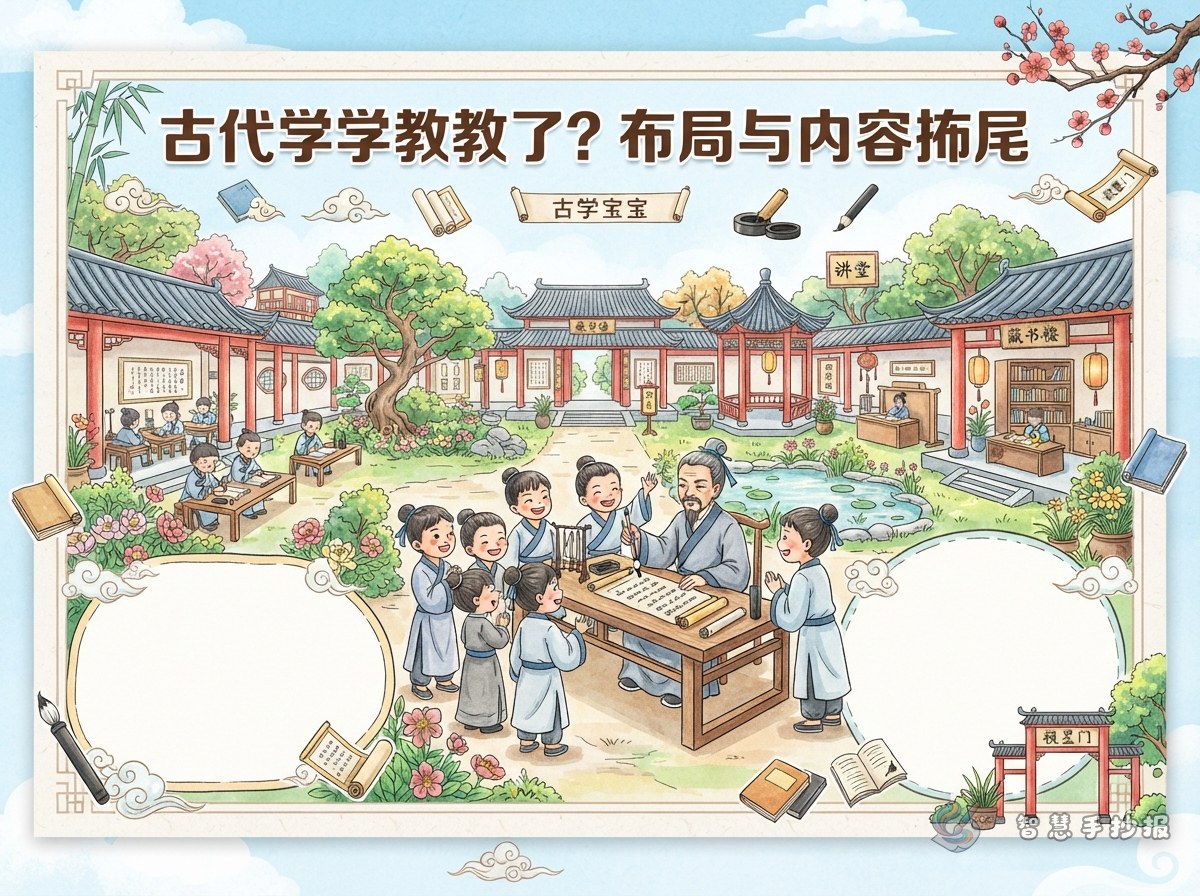
A horizontal three-part layout works well. Draw a teacher lecturing in an ancient study hall on the left, place a large “I Have a Question” dialogue box in the center, and put “What I Learned” on the right. Write the title inside a scroll-shaped frame at the top, then add an open book, an inkstone, and bookmarks along the bottom to connect the sections.
Try ivory, light brown, deep green, and red as the main colors. Use dark brown or green for the title, and red only for key words. Leave enough blank space so the page remains comfortable to read. Sketch lightly first, then outline and color the figures, scrolls, and speech bubbles.
End with a personal learning action
Add a small box called “My Learning Action” in the lower-right corner: read one page today, ask one question, or share one new idea with a classmate. This connects the spirit of ancient academy discussions with present-day study. When the layout needs further organizing, continue creating it in the WeChat mini program Zhihui Shouchaobao.