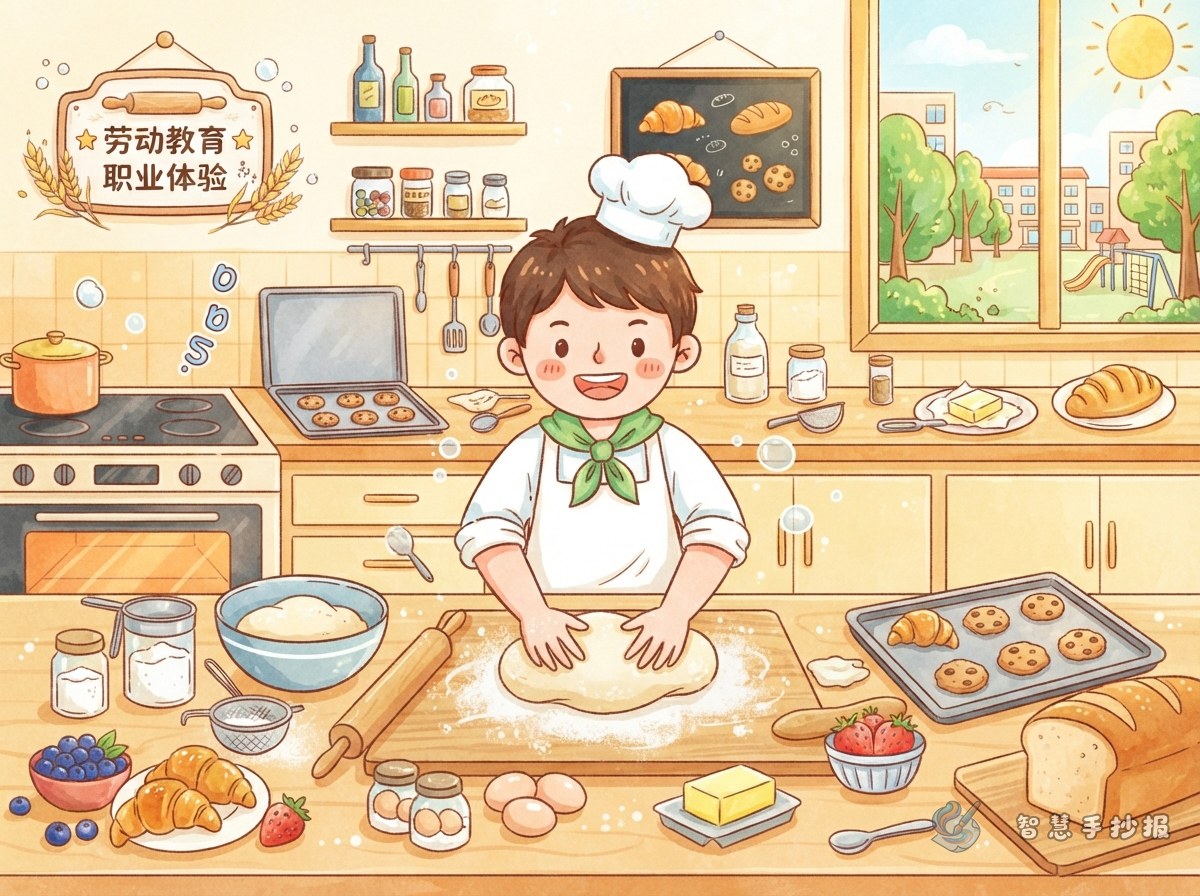
Why a bakery is a great setting for a labor education poster
Bakery work has a rhythm you can feel with your own hands: weigh, knead, wait, shape, bake, decorate. Unlike jobs you can only watch from a distance, this one invites you to take part. That makes it a natural fit for a handwritten newspaper about hands-on practice, patience and respect for the results of labor. The strongest posters describe what happened at the workbench, not what a textbook says about bread.
Four kinds of content worth putting on the page
1. A clear line from flour to bread
Write the six steps in order: gather ingredients, weigh the flour, knead, proof, shape and bake. Add one sentence about what you did and one short feeling for each step, and your flow becomes both informative and personal.
2. Observation notes about the dough
Try something like, "At first the dough felt firm. After resting under a damp cloth, it puffed up and bounced back when I pressed it." Small observations like this show care and attention.
3. A small mishap
Flour on your apron, sticky hands, forgetting to preheat the oven. Describe the problem and how you solved it. A little trouble makes the poster feel real and keeps readers interested.
4. An honest reflection
Choose one angle: time, patience, teamwork or not wasting food. Two or three sentences are plenty.
Layout idea: bring the workbench onto the paper
- Center: draw a workbench with a flour bag, rolling pin, mixing bowl and oven, plus an arrow running from kneading to baking.
- Left column: six small boxes for the steps, joined by dotted lines like a bakery assembly line.
- Right column: a toast-shaped box for your reflection, outlined in dark brown.
- Bottom strip: one closing line, such as "Good bread is made with time and patience."
Sentences you can copy or adapt
- Dough never lies. It shows whether you kneaded enough.
- A simple step is still hard to do well again and again.
- Waiting for the dough to rise is part of the work too.
- Turning ingredients into food feels really satisfying.
- Respecting food means respecting the people who make it.
Small details that make the page look better
Use creamy white, soft yellow, caramel brown and pale orange, so the whole page feels warm like fresh bread. Shape the title like a puffy loaf and outline it with a wavy line. Leave breathing room between text boxes, then fill the gaps with flour dust, wheat ears or tiny forks. When you finish, read it once more and check whether "what I did" comes through clearly. That matters more than fancy decoration.
To save time, sort your notes into three parts — process, observation and reflection — then open the Smart Handwritten Newspaper WeChat mini program, pick a layout you like and drop the text in.