Begin with a railway crossing mountains and rivers
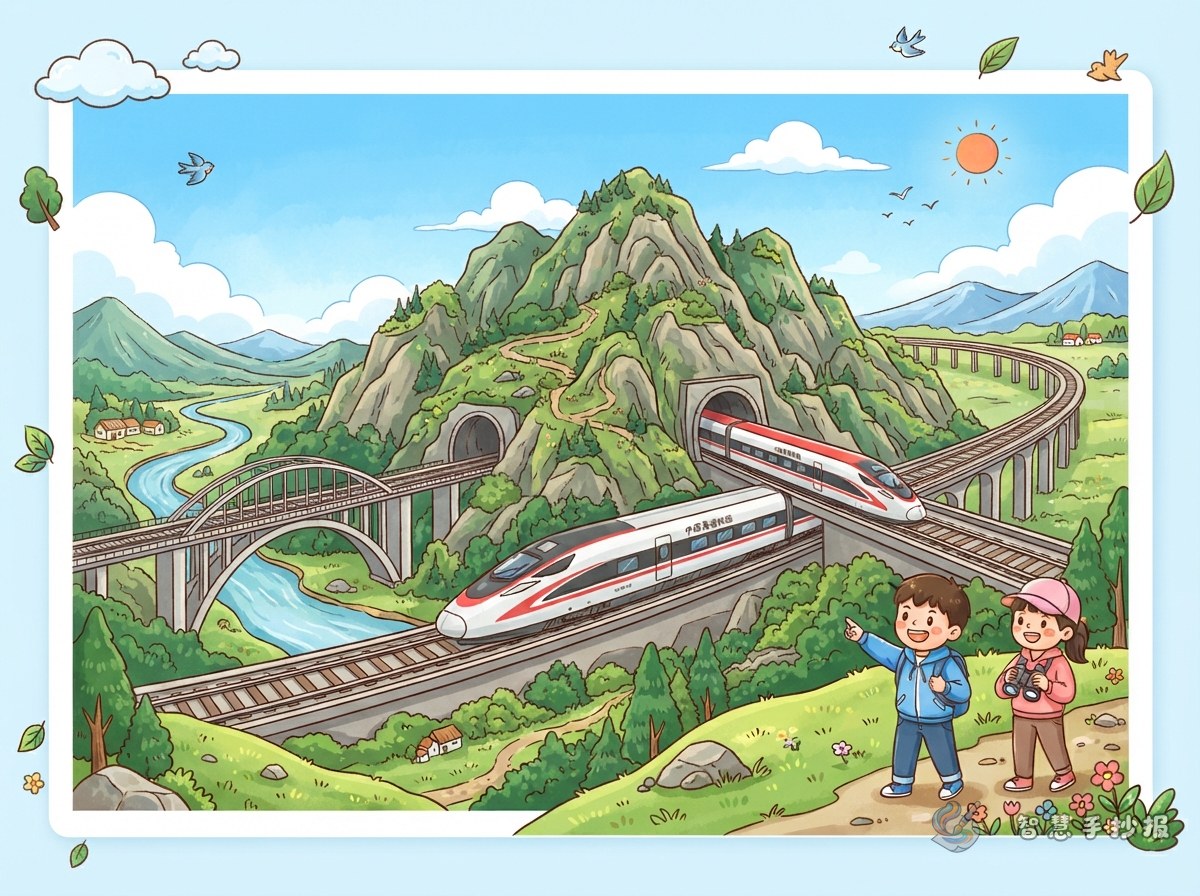
Build the handwritten newspaper around the question of how railway bridges and tunnels help trains cross difficult landscapes. Place a train in the center, with the track running from the lower left to the upper right. Let it pass through a tunnel, cross a river bridge, and continue toward distant hills. This creates a sense of movement while showing how railway engineering extends routes through complex terrain.
A suitable title is “Railway Bridges and Tunnels: Connecting Mountains and Rivers,” with the subtitle “How Transportation Technology Changes Travel Routes.” Use blue sky, mountains, rivers, and clouds as a light background, leaving enough open space for the text.
Explain the topic with three knowledge cards
- Railway bridges: When a railway must cross a river, valley, or road, a bridge supports the track and keeps the train moving along its planned route.
- Railway tunnels: When a high mountain blocks the way, a tunnel allows the train to pass through the mountain instead of making a long detour.
- Construction and maintenance: Railway bridges and tunnels require surveying, design, construction, and regular inspection. Drainage, structural strength, and track conditions all matter for safe and smooth travel.
Draw the three cards in the shapes of a small bridge, a tunnel, and a toolbox. Keep each card to two or three sentences so the page remains easy for children to read and visually lively.
Text material ready to copy
Short article: Railways are not built only on flat ground. When a route meets a river, valley, or mountain, a railway bridge crosses the gap while a tunnel passes through the mountain. Working together, bridges and tunnels connect cities, villages, and distant places. They show not only the power of engineering, but also the wisdom of respecting the landscape, planning carefully, and continuing to explore.
Subheadings and slogans: “A bridge connects two shores,” “Through mountains, the railway moves forward,” “Every section of railway reflects engineering wisdom,” and “Safety inspections make every departure more reassuring.” Place these lines on the bridge deck, near the tunnel entrance, or beside the train windows to connect the words with the drawings.
Turn the page into a three-dimensional railway map
- Write the main title in large letters at the top, adding arrows, clouds, and a small route map nearby.
- Draw a river bridge on the left with water and a small boat below it, and a mountain tunnel on the right with lights and tracks at its entrance.
- Use the train as the visual focus in the middle, connecting the bridge, tunnel, direction signs, and other railway elements.
- Create a “My Future Railway” section at the bottom, where students can write ideas such as safer, greener, or more convenient trains.
Use dark blue, green, orange, and gray: blue for technology and sky, green for the landscape, orange for the train and title, and gray for tracks and bridge structures. Sketch the layout in pencil first, then outline it in black so the decorations do not cover the writing.
Keep one clear message in the finished work
The page does not need too many technical terms. The key is to help readers understand that bridges cross gaps, tunnels pass through mountains, and both support safe and smooth railway transportation. Before finishing, check that the title stands out, the knowledge cards are clearly separated, and the train follows one consistent direction. If you want to organize the sections and layout more quickly, continue creating in the 智慧手抄报 WeChat Mini Program.