Why a family meeting makes this poster easier to draw
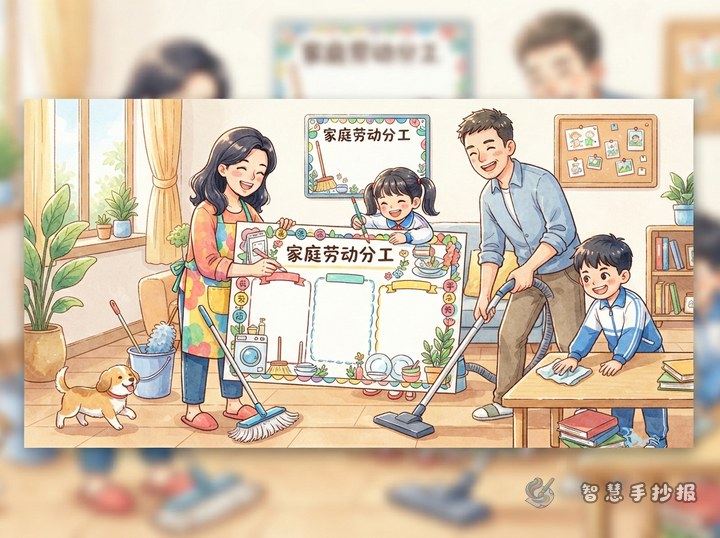
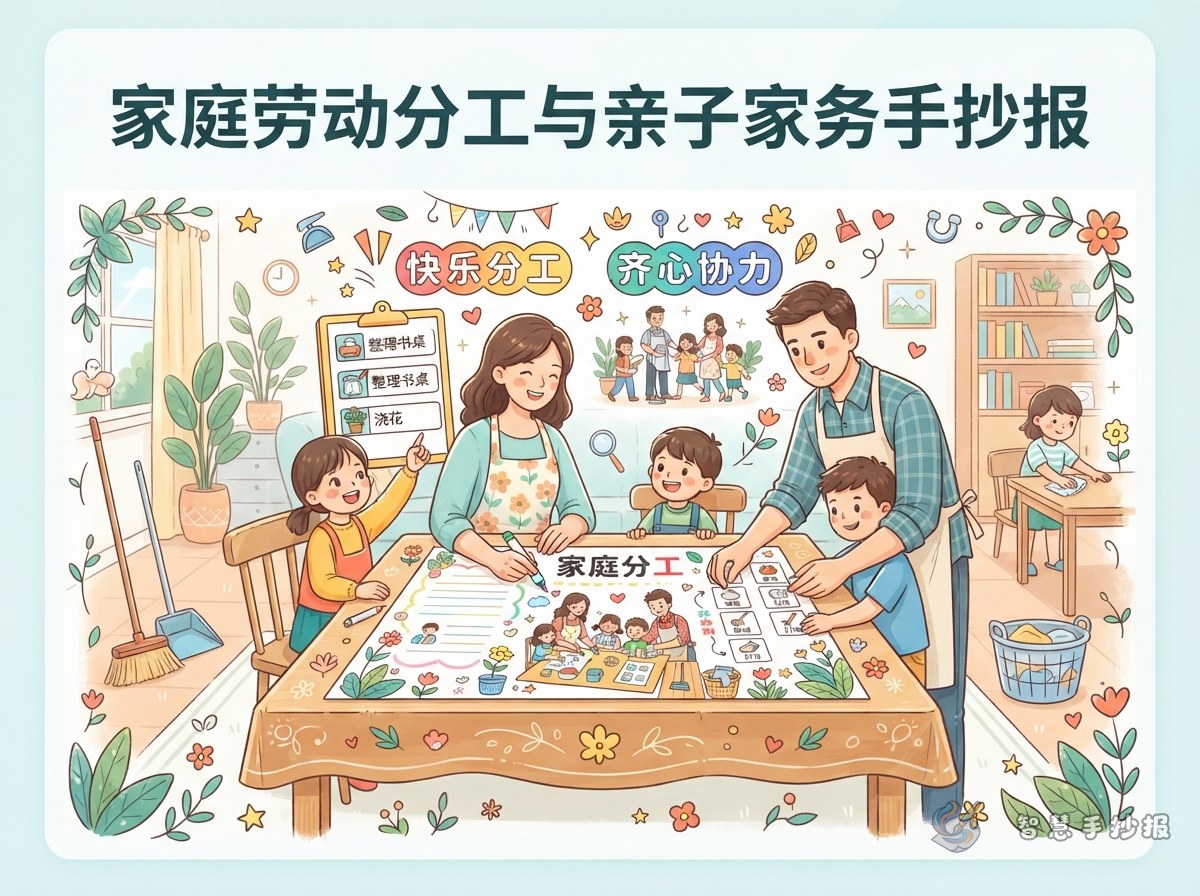
A chore poster often ends up as a plain table: who sweeps, who washes up, who takes out the rubbish. It reads like a notice. Turn it into a family meeting instead and the page comes alive — a table, a few chairs, some speech bubbles, and a division of work that the family talked through together. Children suddenly have plenty to write, and readers stay interested.
This angle also gives the poster a natural sequence: what we thought about before, what each person said, and what we finally agreed. Those three steps become your sections without any padding.
Layout: table in the middle, jobs around the edge
Try a centre-plus-four structure. It suits the meeting idea far better than splitting the page in half.
- Centre: a round table with a notebook and pencil, title in a banner above it.
- Top left: before the meeting — which chores exist and which ones cause the most mess.
- Top right: what everyone said — one speech bubble per family member.
- Bottom left: the agreed jobs, listed by room.
- Bottom right: our family rules — timing, checking and helping out.
Two details that keep the page readable
- Give each family member a different bubble colour and point the bubble tails towards the table so it looks like a real conversation.
- Draw short arrows linking a problem to its solution, for example “dishes pile up in the sink” pointing to “ten minutes together after dinner”.
Three sections that must be filled properly
Section one: the chore list
Sorting by room is easier than sorting by person. Write two or three main jobs for the kitchen, living room, bathroom and balcony, then add the person and rough time in brackets, such as “wipe the table (me, after dinner)” or “take out the rubbish (Dad, before bed)”.
Section two: speech bubbles
Each person says what they will do and why in one short line. Keep the bubbles small — room for a dozen words is plenty, and the empty space makes the page look tidy.
Section three: the agreement box
Three practical rules are enough: when the job happens, who checks it, and how to swap when someone is busy. This is the part that makes the poster feel real.
Sentences you can copy straight onto the page
- Chores are not one person's job; they are our family's job.
- Talk first, divide second, and remember what we agreed.
- My part is small, but it removes one worry from home.
- Doing it badly can be fixed by learning; never doing it cannot.
- I help you today, you help me tomorrow.
Short dialogue works too: “Who's bringing the washing in?” “Me, but I need someone to help fold.” “Then we'll do it together.”
Working order: boxes, then words, then colour
- Sketch the centre table and four section frames lightly in pencil, without filling the whole page.
- Write the longest section, the chore list, first so you know how much room is left.
- Add the speech bubbles and the agreement box, keeping bubble writing small.
- Ink the outlines and colour last, using light shades around the table and bubbles so the text stays clear.
Three common mistakes to avoid
- Too much text: a completely filled page hides the key points, so leave breathing space in every section.
- Names without timing: a job with no time rarely gets done, so add phrases like “after dinner” or “before bed”.
- Forgetting teamwork: writing only separate duties loses the warmth of parent-child cooperation, so add a swap rule in the agreement box.
If you want a different set of sections or ready-made borders and title styles to trace, open the 智慧手抄报 WeChat mini program to pick a template, adjust the layout and finish your family meeting poster.