Pick One Main Line: Sound Makes Five Stops Inside the Ear
A hearing poster can easily turn into a list of parts. Instead, draw one route across the page and give it five stops. Each stop answers just one question: who collects, who vibrates, who amplifies, who converts.
- Stop 1 — Outer ear: it works like a small funnel and gathers sound from around you.
- Stop 2 — Ear canal: sound travels down this short tunnel until it meets the eardrum.
- Stop 3 — Eardrum: a thin, tight membrane that shakes when sound hits it.
- Stop 4 — Three tiny bones: the smallest bones in the body carry the shaking onward and make it stronger.
- Stop 5 — Cochlea and auditory nerve: fluid and hair cells inside the cochlea turn the movement into signals, and the nerve sends them to the brain.
Place this route in the middle of the sheet and let every other box support it. Readers will understand the whole poster at a glance.
Short Sentences You Can Copy at Each Stop
Outer Ear and Ear Canal
The outer ear collects sound from every direction, and the ear canal guides it to the eardrum. A simple everyday example: cup your hand behind your ear and the sound becomes louder.
The Eardrum
The eardrum is thin and springy, so it shakes as soon as sound arrives. Loud sounds make it shake strongly, soft sounds make it shake gently. You can call it the little drum inside your ear.
The Three Tiny Bones
Behind the eardrum sit three of the smallest bones in the human body. They work like a tiny bridge, passing the shaking along and giving it a boost so the cochlea can pick it up easily.
Cochlea and Auditory Nerve
The cochlea is filled with fluid and thousands of tiny hair cells. When the fluid moves, the hair cells bend and create nerve signals. The auditory nerve carries those signals to the brain, and that is the moment we really hear.
Divide the Page Into Three Columns
- Left column: a large ear cross-section, with the eardrum, three bones and cochlea labelled and numbered 1 to 5.
- Middle column: a curved arrow route running from the outer ear to the cochlea, with the words collect, vibrate, amplify, convert and report along it.
- Right column: two small boxes, one for ear-care tips and one for a question the reader still wonders about.
- Bottom strip: one experiment written in a coloured frame, clearly separated from the facts above.
A title such as “A Sound's Journey Into the Ear” sounds more like a poster and is easier for younger students to remember than a textbook phrase.
Two Experiments You Can Really Do
The Cup Eardrum
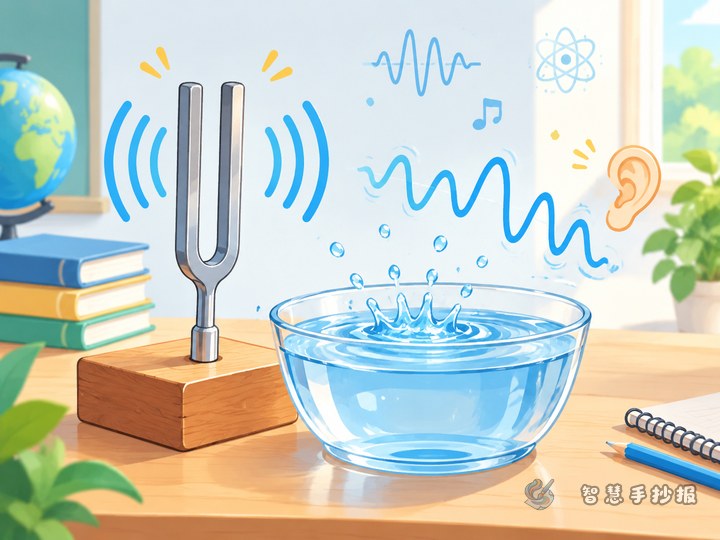
Stretch a piece of cling film tightly over a cup and place a few grains of rice or tiny paper scraps on top. Talk loudly at the film or hold a vibrating tuning fork near it. When the grains jump, the film is shaking just like an eardrum. Draw a small figure shouting at the cup beside the notes.
Cover Your Ears and Talk
Gently block your ear canals with your fingers and say something quietly. You can still hear your own voice because the sound travels through the bones of your head to the cochlea. Two sentences about bone conduction are enough for a small side box.
Save a Box for Ear Care
- Keep headphone volume low and listening time short.
- Near very loud noises, open your mouth or cover your ears to protect the eardrum.
- Never poke sharp objects into your ears; they clean themselves.
- If your ears hurt, ring or you cannot hear clearly, tell a parent or teacher.
Short lines and a few small icons are enough here, and they turn the poster from facts into something the reader can actually use.
If the layout still feels difficult, open the Smart Handwritten Newspaper WeChat mini program and look for a sound-and-hearing layout. Swap in your own title and sentences, then add colours and a border to finish the sheet.