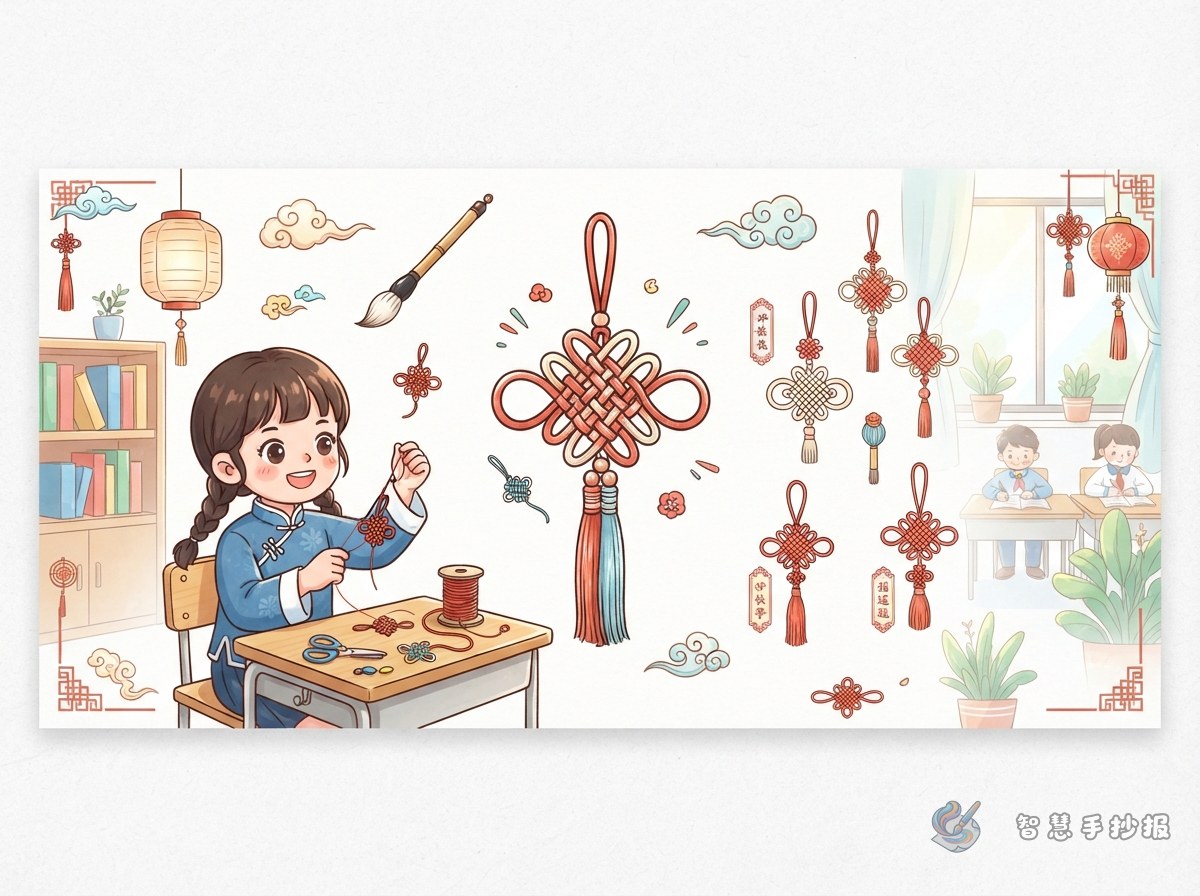
Pick One Main Line Before You Draw
A Chinese knot page does not have to cover everything. Choose one clear thread, such as cord making, knot types, meanings or blessings. That gives you both heritage notes and text that is easy to copy neatly.
- Origins box: start with knot records and explain how cord work became decoration and a way to send good wishes.
- Knot gallery: choose four to six common knots, draw them small and add one meaning for each.
- Meanings and blessings: the word for knot sounds like the word for luck, so knots often stand for good fortune, reunion and safety.
- My thoughts: add one or two sentences about tying a knot, seeing one, or receiving a small knotted gift.
Notes You Can Copy Straight Onto the Page
The knot gallery is the most eye-catching part. Simple drawings are fine as long as the meaning is clear.
- Panchang knot: lines loop without breaking, suggesting something long and continuous.
- Double-coin knot: shaped like two coins overlapping, it suggests plenty and completeness.
- Ruyi knot: based on the ruyi shape, it means that everything goes as you wish.
- Lucky knot: four even sides, often seen as a sign of good fortune and peace.
- Round-brocade knot: round outside and tight inside, like a cluster of brocade, suggesting a bright future.
- Heart-to-heart knot: two cords linked together, often used for friendship and close bonds.
One sentence beside each knot is enough. Short notes look tidier and are easier to read than long paragraphs.
Use a Single Cord as Your Layout Line
To keep the page from looking loose, draw one cord from the top left to the bottom right and hang the columns on it like small lanterns. It is easy to do:
- Sketch the cord line in pencil, either as a curve or as straight lines with bends.
- Mark four or five points along the cord and write a column title at each point.
- Place the column text on both sides of the cord, alternating left and right.
- Add a small knot or tassel at the end of the cord to finish the layout.
If you would rather not draw a long cord, turn the columns into four square knot shapes and arrange them in two neat rows.
Colors, Corners, and a Title That Stands Out
- Palette: use red and gold as the main colors on a cream or light tan background, with black or dark brown text.
- Border: a simple row of square patterns, small dots or soft waves around the edge is enough.
- Title: place a gold band under the main title, or use a square panchang pattern behind it, and write the letters thick and clear.
- Illustrations: one or two larger knots are plenty; fill the rest with small knots, tassels and red lines.
- White space: leave a finger-width gap between columns so the page can breathe.
Draft First, Decorate Later
On scrap paper, mark where each column will go and estimate how many lines of text it needs. Then lightly rule the columns on the final sheet, write the title, draw the knot shapes, and copy the body text last. Start with the longest column, then fill in the short notes and labels so nothing gets squeezed.
If you want ready-made layouts, open the 智慧手抄报 WeChat mini program and choose a Chinese knot or intangible cultural heritage theme, then keep arranging and coloring your draft into a finished page.