Why the guqin works well for an intangible heritage poster
The guqin, also called the seven-stringed zither, is one of China's oldest plucked instruments. It is closely tied to poetry, painting, and scholar life. In 2003, guqin art was proclaimed a Masterpiece of the Oral and Intangible Heritage of Humanity, and it later entered China's national intangible cultural heritage list. That gives a guqin poster both a visual subject and solid cultural-heritage content.
For younger students, the guqin is made of simple lines and has an elegant shape that is not hard to draw. For parents and teachers, its famous pieces and poems are easy to turn into short text blocks.
Section ideas for the body of your poster
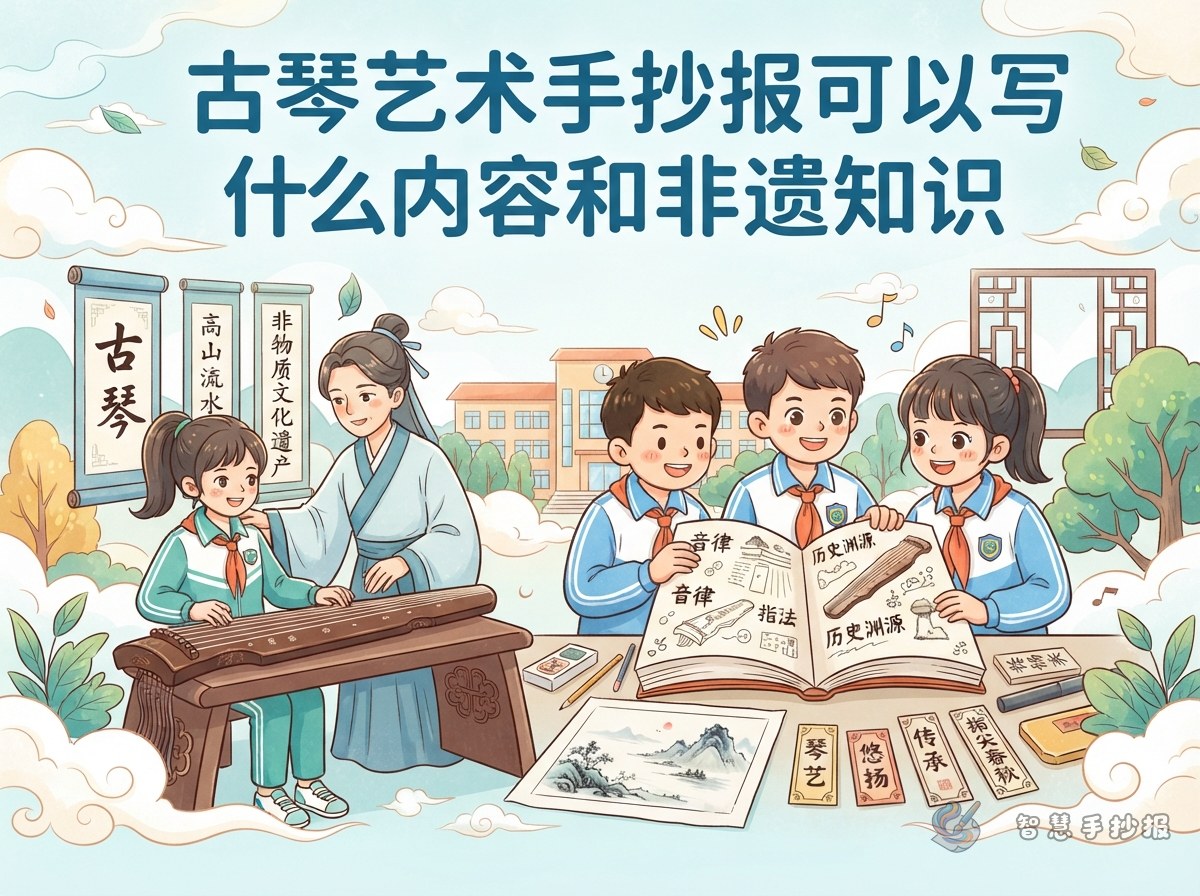
- Heritage card: name, other names, and when it was listed as intangible heritage, in two or three sentences.
- Parts of the guqin: draw the instrument and label the bridge, strings, studs, and feet.
- Famous pieces: choose two or three titles and add one short line about each.
- Guqin in poetry: copy one or two lines and note the poet.
- My reflection: one or two sentences about how the music made you feel.
Short facts and lines you can copy
Quick facts
- The guqin usually has seven strings, which is why it is called the seven-stringed qin.
- Thirteen small dots, called hui, mark the harmonic positions on the surface.
- Common shapes include the Fuxi, Zhongni, Lianzhu, and Luoxia styles.
- Its sound is soft but lingering, often described as quiet and distant.
Pieces and poetry
- High Mountains and Flowing Water are linked to the idea of a true friend who understands you.
- Three Variations on Plum Blossom takes the plum blossom as its theme.
- Three Refrains at Yangguan is often connected with farewell and friendship.
- Sitting alone in the bamboo grove, I play the qin and whistle a long tune. — Wang Wei
- On the cold seven strings, I listen quietly to the wind in the pines. — Liu Changqing
Layout tips for a calm, traditional look
- Title area: place it at the top or top left, using short titles such as Guqin Art or Seven Strings.
- Main image: draw a vertical guqin in about one third of the page, with a few cloud lines or distant hills beside it.
- Text columns: divide the page with two or three straight or wavy lines, leaving some white space.
- Decorations: add bamboo leaves, seal frames, or scroll edges in the corners, but do not fill every gap.
Small details that make a big difference
- Use light pencil guidelines before writing, so the columns stay straight.
- Make titles clearly larger than the body text.
- Limit the palette to two or three main colours; use red only for small accents.
- Check the spelling of piece titles and poems before copying them.
- Go over the borders at the end and even out the empty spaces.
When you are ready to finish the layout
If the content is ready but the layout still feels difficult, open the Smart Handwritten Newspaper WeChat mini program. You can browse traditional arts and intangible heritage categories, choose a frame or layout, and fill in the text above to complete your poster step by step.