Why Sound Is Worth Drawing, Not Just Hearing
Sound cannot be seen or held, yet something is always moving when we hear it. A strong theme for this newspaper is that sound comes from objects vibrating: first something shakes, then sound is made, and finally an ear receives it. Once that route is clear, the whole page has a centre instead of becoming a pile of experiment pictures.
A question-style title works well, such as "How can we see sound?" Add a subtitle like "Small experiments with a tuning fork, water and rice." It sounds like a child's voice and still shows the science focus clearly.
Three Simple Experiments You Can Sketch on the Page
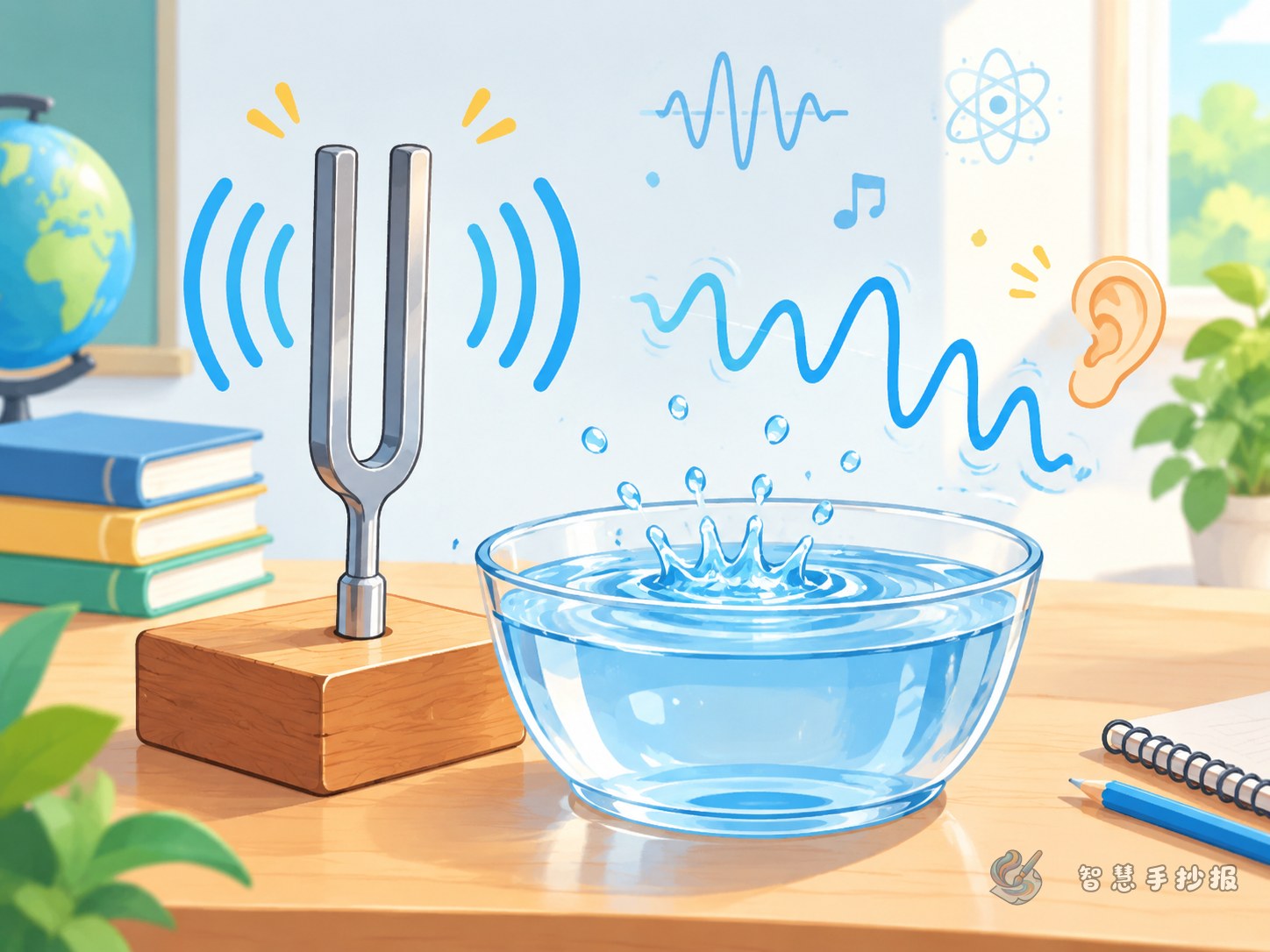
A tuning fork makes water jump
Tap the tuning fork lightly, then dip the tip into water and watch the splash. Draw the fork at the rim of the cup and add three to five curved lines for the drops, with a caption: "Sound made the water move too."
Rice grains dance on a drum
Place a few grains of rice on a drum and tap it. The grains bounce up and down. Focus on the changing height of the grains by drawing two or three at different positions, then add a small arrow showing up and down.
A ruler buzzes at the table edge
Press one end of a plastic ruler on the table edge and flick the other end. You hear a buzz and see the ruler shake. Draw it as a three-panel strip: press, flick, shake, then write "the faster it shakes, the higher the sound."
Laying Out the Page as One Clear Journey
Vibration, travel and hearing form a single route, so arranging the page along that route keeps readers from jumping around.
- Keep a tall area on the left for the tuning fork and water experiment, marking the start of vibration.
- Draw a horizontal or wavy line to a small ear picture in the middle and label it "vibration travels through the air."
- Put a mini word list at the top right: vibration, sound source, air carries sound.
- Leave an observation box or a "what I still wonder" corner along the bottom for what you noticed.
Music notes, wavy lines and tiny loudspeakers make good borders, but they should never cover the words. Light blue, pale yellow or cream backgrounds with darker letters and drawings look clean and bright.
Sentences and Science Words Kids Can Copy
- Tap it, shake it, and sound comes out of the vibration.
- A tuning fork does not sound by itself; our tap makes it vibrate.
- Vibration passes to the air, and the air carries it to our ears.
- Splashing water, jumping rice and a shaking ruler are all proof of vibration.
- One try is not enough; repeat the test so your record is more accurate.
Write word explanations as single sentences, for example: vibration means an object moving quickly back and forth; a sound source is an object that is making sound. Short sentences plus one-line explanations are easy to copy and easy to remember.
Building the Page Step by Step
Sketch the sections and main pictures in pencil first, then colour and write once the layout feels right. The drawings do not need to look exactly like the real objects; showing the action and the result is enough. If you would rather skip repeated redrawing, open the WeChat mini program and search for "智慧手抄报" to choose a sound-themed layout, fill in your experiment pictures and sentences, then copy it onto paper for a neat finished newspaper.