Start with the “personality” of sound
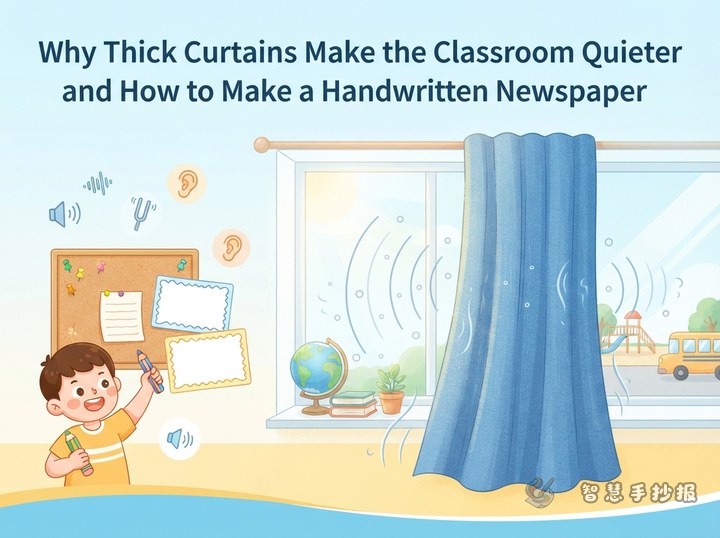
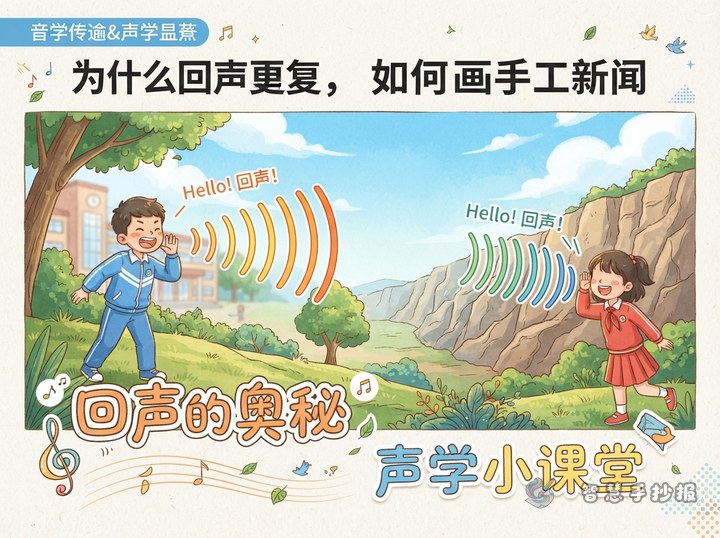
This poster can present sound as something with different personalities: some sounds are high and sharp, some are low and deep; some are loud, while others are soft. In the title area, use a question such as “Why do sounds have pitch and volume?” and add simple drawings of sound waves, a drum, guitar strings, and an ear.
Key ideas to include
Pitch: how fast something vibrates
When an object vibrates quickly, the sound is usually higher. When it vibrates slowly, the sound is usually lower. For example, a short thin rubber band often makes a higher sound, while a longer or looser one makes a lower sound. A side-by-side drawing of fast and slow vibration works well in the poster.
Volume: how strongly something vibrates
If you hit a drum harder, the drumhead vibrates more strongly and the sound becomes louder. If you tap it gently, the vibration is smaller and the sound is softer. You can draw big waves for loud sounds and small waves for quiet sounds.
Sound travels before we hear it
Sound starts from a vibrating object and travels through a medium such as air to reach our ears. A simple sentence for the poster is: Vibration makes sound, a medium carries sound, and the ear receives sound.
Short writing materials for the poster
- Sound is produced by vibration. When vibration stops, the sound gradually disappears.
- The highness or lowness of a sound is called pitch.
- The loudness or softness of a sound is called volume.
- The same object can sound louder or softer when we use different force.
- Protecting our ears is an important part of learning about sound.
Add a mini experiment section
Prepare a paper cup and several rubber bands. Stretch the rubber bands across the cup opening and pluck them gently. Tighten or loosen the bands to compare pitch, then pluck with different force to compare volume. On the poster, show this as a three-step comic: prepare, pluck, and record.
Layout ideas that are easy to draw
- Top left: Place the title in bright colors such as blue and yellow.
- Top right: Draw examples of high and low sounds, such as a bird and a cow.
- Center: Put the main knowledge box and connect points with sound-wave lines.
- Bottom left: Add the rubber band experiment with numbered steps.
- Bottom right: Write ear-protection tips to connect science with daily life.
A helpful finishing tip
Before making the final poster, collect five key words: pitch, volume, vibration, travel, and ear protection. Then you can open the WeChat mini program of Zhihui Shouchaobao, choose a clean science-style layout, place the writing materials into each section, and finish with simple sound-wave and musical-instrument drawings.