Use a Time-Travel Story as the Main Idea
This handwritten newspaper can begin with a simple question: How can a leaf, a shell, or a footprint stay inside rock for such a long time? Build the page around the journey from living things to buried remains, then to rock layers, and finally to discovery. This makes the topic easier to understand than a list of facts.
Good title ideas include “How Fossils Are Formed”, “Ancient Stories Hidden in Rocks”, or “Life Prints in Stone”. Add drawings of a magnifying glass, rock layers, a small hammer, and a brush to create a friendly geology exploration mood.
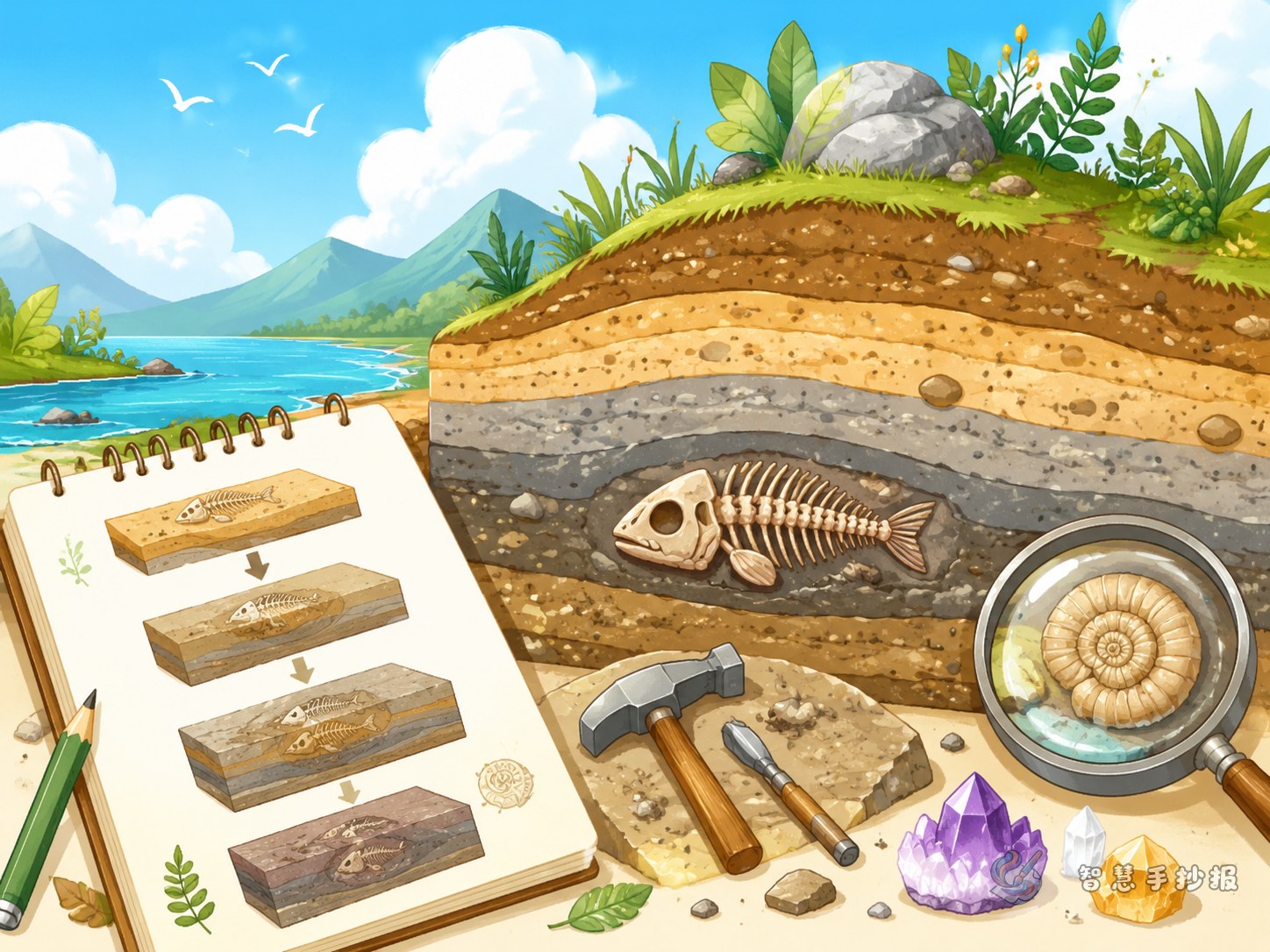
Explain Fossil Formation with Four Picture Panels
- Panel 1: Ancient life. Draw fish, shells, leaves, or dinosaur footprints. Add the note: “Ancient living things once lived in oceans, forests, or near lakes.”
- Panel 2: Buried by sediment. Write: “Remains or traces were quickly covered by mud and sand, which helped protect them.”
- Panel 3: A long change. Draw layers of rock. Write: “Sediment was pressed into rock, and some remains or traces were preserved or replaced by minerals.”
- Panel 4: Discovery. Draw a young geology explorer cleaning rock with a brush. Write: “After erosion or careful digging, fossils help us learn about Earth’s past.”
Short Text Materials for the Page
What Is a Fossil?
A fossil is the preserved remain, trace, or sign of an ancient living thing found in rock. Common fossils include shell fossils, plant fossils, insect fossils, dinosaur bone fossils, and footprint fossils. Fossils are like an old photo album of Earth, recording life and environments from long ago.
Why Fossils Matter
Fossils need the right conditions and a very long time to form, so not every living thing becomes a fossil. By studying fossils, scientists can learn what ancient organisms looked like, where they lived, and how Earth’s environments changed over time.
A Safe Observation Reminder
If you find an unusual rock outdoors, do not hit dangerous cliffs or damage the natural environment. Take a photo, record the place and shape, and ask a teacher or parent for help. Real fossil protection should follow proper rules.
Design the Page Like a Rock-Layer Map
A horizontal layout works well. Draw colorful rock layers along the bottom, and place one section in each layer: fossil formation, fossil types, observation notes, and protection tips. Put a large rock cross-section in the center, with shells, fish bones, leaves, and footprints hidden in different layers.
- Colors: sandy yellow, light brown, gray-blue, and orange suit the rock and discovery theme.
- Borders: use pebbles, magnifying glasses, brushes, and footprints as decorative patterns.
- Text boxes: make them look like rock pieces, observation cards, or specimen labels.
- Spacing: do not fill every corner with words. Leave room for drawings and clear headings.
Add a Small Interactive Corner
Create a section called “Guess the Fossil.” Draw three outlines, such as a leaf, a shell, and a footprint, then let readers match them with names. You can also add “My Geology Observation Card” with color, texture, hardness, and where the rock was seen. This shows a simple scientific observation method.
After planning the content, students and parents can open the 智慧手抄报 WeChat mini program to continue choosing layouts, organizing text, and making a printable or easy-to-copy handwritten newspaper reference.