Why Children's Clothing Beats Imperial Robes for a School Poster
Dragon robes and ceremonial dress look impressive, but their patterns are dense and easy to give up on halfway through. Children's clothing is the opposite. Tiger hats, five-poison bibs, patchwork jackets and long-life locks have rounded shapes, simple outlines and bright colours. They also carry a clear story: who made the garment, when it was worn, what was stitched on it, and what the family hoped for.
Five Pattern Groups You Can Copy Straight Into the Poster
1. The tiger on a tiger hat
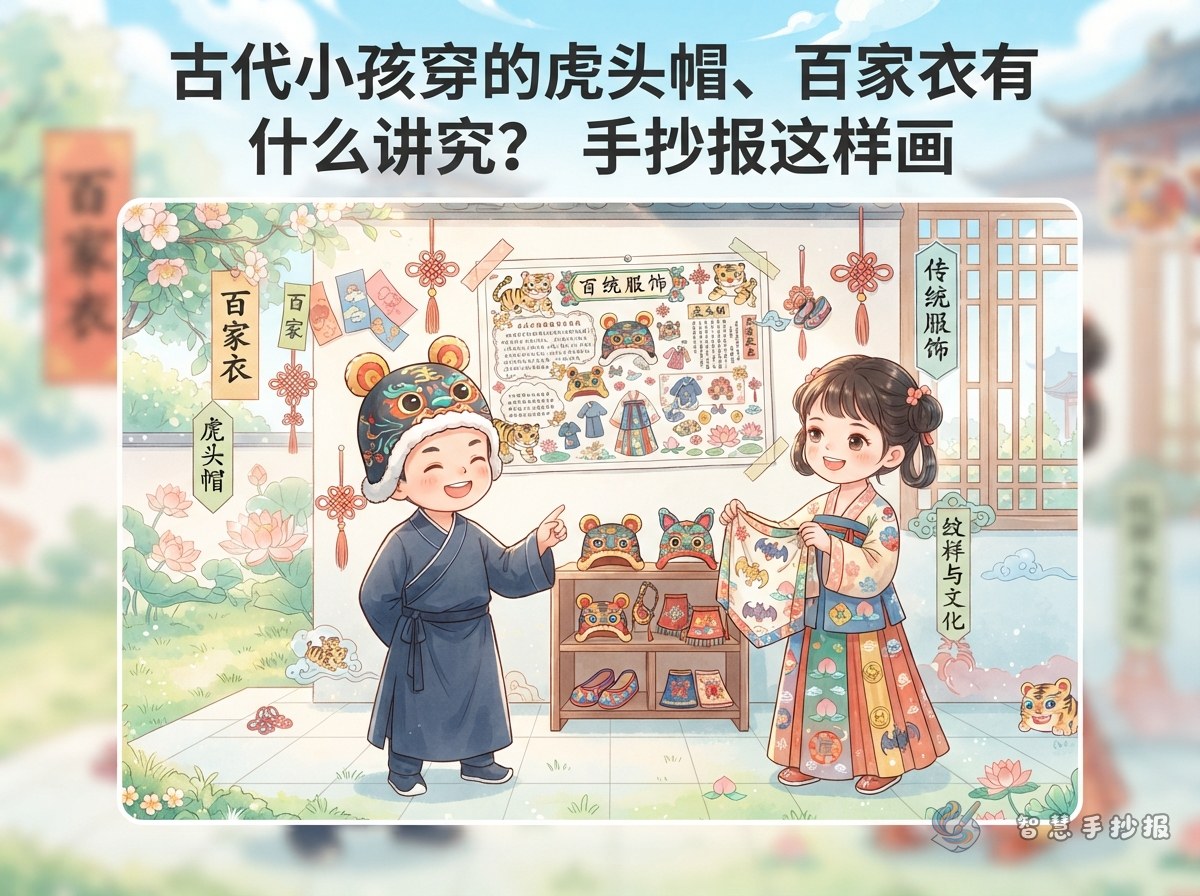
A tiger face sits on top, two ears stand at the sides, and the character for king is often added on the forehead. The tiger was believed to protect the home and children from fright. This is the easiest motif to draw and works well as the main picture.
2. The five-poison bib
Snake, scorpion, centipede, gecko and toad were embroidered on a bib, using the idea of one danger driving out another. The five small creatures are simple shapes and can be lined up as a decorative border.
3. Patchwork cloth
Scraps collected from relatives and neighbours were sewn into one garment, a way of gathering everyone's good wishes. Draw a dozen coloured squares and explain them in a single sentence.
4. The long-life lock and character patterns
Lock-shaped pendants often carried words such as long life, peace or blessing. The characters themselves can be used as decoration, arranged in a circle or along an edge.
5. Pomegranate, grape and lotus seed pod
These fruits hold many seeds and stand for a full, prosperous family. Three small round fruits plus one short caption add variety to the page.
Three Layout Plans to Choose From
Big central image
Place one large tiger head in the middle, leave a text block on each side of the ears, and line up three small boxes below for the tiger, five-poison and patchwork patterns. Clear and easy for a first attempt.
Timeline from birth to childhood
Draw a curving line from the lower left to the upper right, marking moments such as the first-month tiger hat, the summer bib, the first-birthday lock and patchwork clothes at New Year. Two short lines beside each point turn the page into a small story.
Patchwork pockets
Sketch several irregular cloth shapes around the edge of the page, write one pattern and its meaning inside each, and keep the centre free for the title. The generous white space keeps the page looking tidy.
How to Fill the Text Boxes
- Pattern label: name plus one line of meaning, kept under twenty characters.
- Where it was worn: hat, bib, collar or shoe, so readers can picture the object.
- Who gave it: most children's clothing was prepared by relatives and friends, which adds warmth to the page.
- My own wish: finish with a sentence you write yourself.
Four Small Drawing Tricks
- Sketch the outline lightly in pencil first, then go over it in black, so the paper stays clean.
- Fold the paper to draw half of any symmetrical shape, then open it out.
- Leave the inside open and fill it with dots, short strokes and wavy lines instead of solid colour.
- Keep to one or two main colours and let white space do the rest.
Once the boxes and text are ready, you can open the WeChat mini program 'ZhiHui ShouChaoBao' to pick a different border, title lettering or small pattern set, then replace the sample text with your own writing.