Start with the main idea: a badge was more than decoration
When students see ancient costume patterns, they often focus only on beauty. For this topic, the stronger angle is to explain the connection between clothing, identity, hierarchy, and ritual rules. A rank badge was a square panel on the front and back of an official robe. It was decorative, but it also helped identify the wearer’s role and status.
You can open the page with a short sentence: rank badges on ancient official robes combined visual beauty with ritual order, showing the cultural idea that clothing reflected social structure.
Useful sections for your page
Section 1: What is a rank badge?
This should be a short and simple introduction, perfect for the upper left corner.
- A rank badge was usually square
- It appeared on the front and back of official robes
- It helped show identity and rank
- It was part of ancient ritual dress rules
Section 2: Civil officials and military officials
This section works well as a comparison box so readers can understand it quickly.
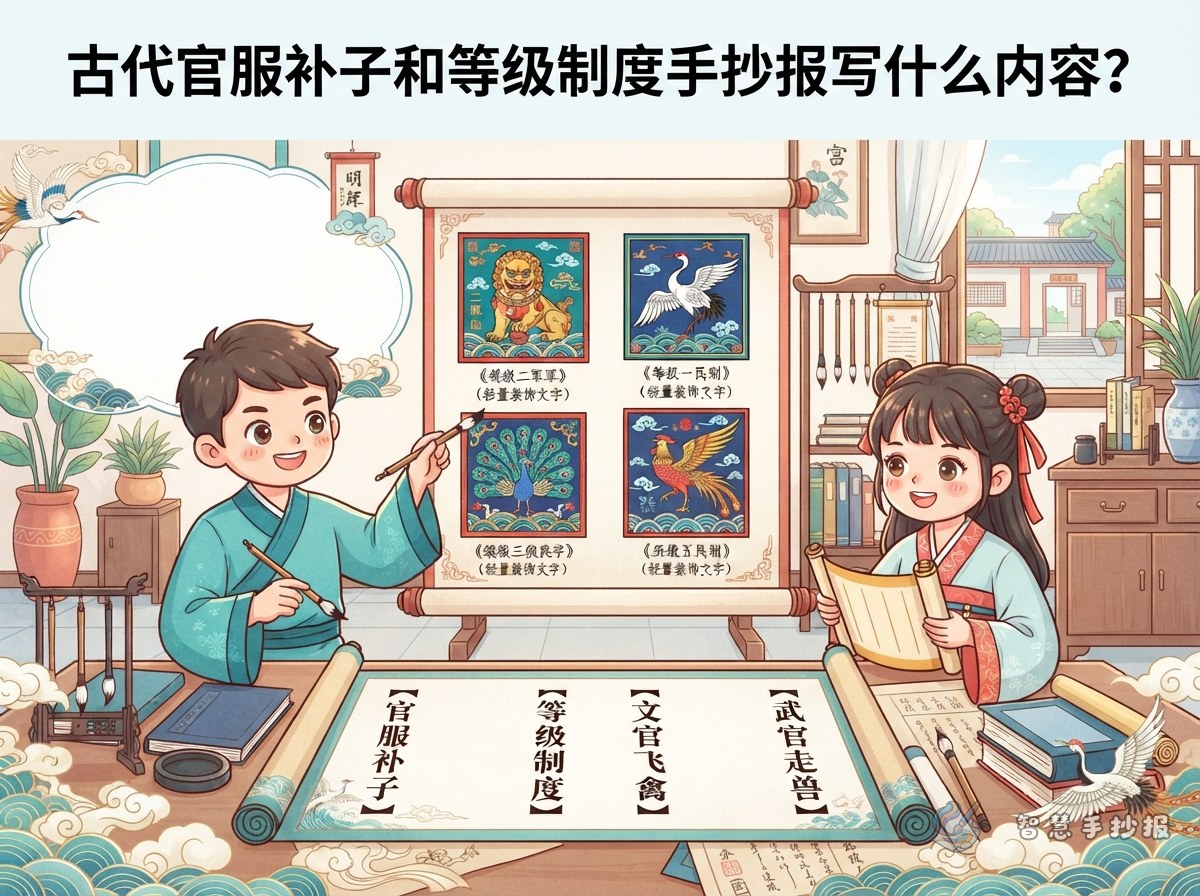
- Civil officials: often connected with bird-themed motifs and a refined image
- Military officials: often linked with stronger animal motifs and a sense of power
- Common point: both followed ritual rules rather than personal choice
Section 3: How badges reflected hierarchy
Explain that different patterns stood for different ranks and that clothing could not be worn freely without rules. For younger students, this idea can be simplified into one sentence: By looking at costume patterns, we can understand ancient social order.
Short text materials to copy into the newspaper
If you still have space, add a few clear sentences to make the page fuller.
- Ancient official rank badges symbolized identity and ritual order.
- Costume patterns carried cultural meaning, not just beauty.
- Different motifs represented different social roles.
- A single badge can reveal the structure of ancient dress regulations.
You may also include a personal thought, such as: I think ancient clothing patterns were like a silent language that showed both beauty and proper etiquette.
Design around the badge, not only the robe
This topic becomes more recognizable if the badge itself is the visual center. Instead of drawing a full complicated robe, build the page around a square badge shape.
- Place the main title in a square badge-style frame
- Use the left and right sides for civil and military comparisons
- Add ritual facts and personal reflections at the bottom
- Decorate corners with simple cloud or repeating traditional motifs
Suggested colors include red, deep blue, gold, and black. Keep the palette neat so the words remain easy to read.
Balance knowledge and visual appeal
A good handwritten newspaper is not a pile of information. Keep each section to a few sentences and match it with small borders or icons. Highlight key terms such as “rank badge,” “civil official,” “military official,” “hierarchy,” and “ritual” so teachers and classmates can find the main points quickly.
If you already have the topic but want to improve the title style, layout, or color matching, you can continue creating in the Smart Handwritten Newspaper WeChat mini program.