Open with a Question That Sparks Curiosity
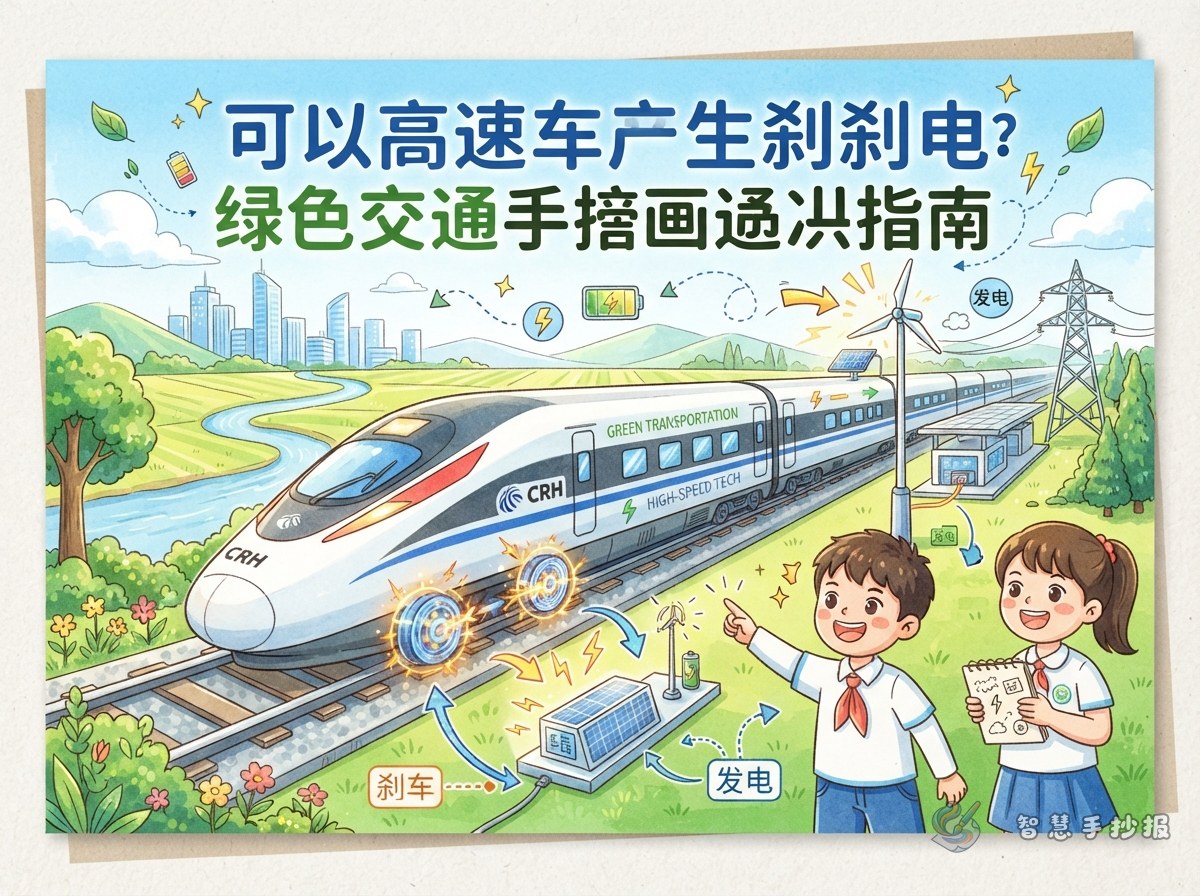
Place the question Can a high-speed train generate electricity while braking? across the top. Add a wheel and a small lightning symbol beside it so readers immediately connect trains, braking, and electrical energy.
A short introduction can say: High-speed trains must travel smoothly and stop safely, but engineers also work to use energy efficiently. Under suitable conditions, the traction system can convert part of the train’s kinetic energy into electricity while the train slows down. This is known as regenerative braking.
Turn the Science into an Energy Journey
Make a large flow diagram the visual center of the poster. Complicated machinery is unnecessary; four pictures and clear arrows can explain the main idea:
- Train in motion: A moving train has kinetic energy.
- Slowing begins: Some traction motors operate as generators.
- Energy changes form: Part of the kinetic energy becomes electrical energy.
- Safe stopping: Regenerative braking works with other braking systems.
Use blue arrows near the moving train and gradually change them to green near the electricity symbol. Motion lines around the wheels will make the process easier to follow.
Build Four Compact Fact Panels
What Is Regenerative Braking?
Regenerative braking is a method of recovering some energy when a vehicle slows down. A traction motor can drive the wheels, but in a different operating state it can also help generate electricity.
Why Are Other Brakes Still Needed?
A train cannot depend on only one braking method. Different speeds, routes, and operating conditions require several systems to work together for smooth and dependable stopping.
How Does It Save Energy?
During ordinary slowing, much of a vehicle’s motion may eventually be dispersed as heat. Regenerative braking aims to recover part of that energy so it can be used more effectively.
What Makes Transportation Greener?
Greener transportation includes public transit, efficient vehicles, improved power systems, and thoughtful operation. Energy recovery shows how railway technology can combine safe travel with better energy use.
Arrange the Page as a Train Energy Lab
- Top: Add the main title with small track and lightning decorations.
- Left: Draw a slowing high-speed train and place the introduction nearby.
- Center: Use the energy-flow diagram as the main visual feature.
- Right: Stack four short fact panels with three to five lines each.
- Bottom: Add a “Greener Travel Actions” strip about following travel rules, caring for public facilities, and choosing public transport when appropriate.
Technology blue and eco green work well as the main colors, while silver-gray can be used for the train body and tracks. A broken track-line border can connect the sections and guide the reader’s eyes across the page.
Finish the Poster in Three Stages
- Sketch the title, train, arrows, and fact panels in pencil, leaving enough room for the central diagram.
- Add short text and check that the sequence from kinetic energy to electrical energy is clear. Avoid uncertain statistics.
- Outline and color the page, emphasizing the arrows, wheels, and electricity symbols while keeping all text easy to read.
To explore more section combinations and page arrangements, continue creating in the 智慧手抄报 WeChat Mini Program, then adjust the words and drawings to fit your paper size.