
Start with one clear goal: the same tune, two ways of writing it
Many students split a music poster down the middle, jianpu on the left and staff notation on the right, and it ends up looking like two pages glued together. A stronger idea is to treat them as two ways of writing the same song, so a reader instantly sees that these numbers are those positions on the staff. Try a main title like “One Song, Two Ways to Write It” with the subtitle “Jianpu and Staff Notation Side by Side”.
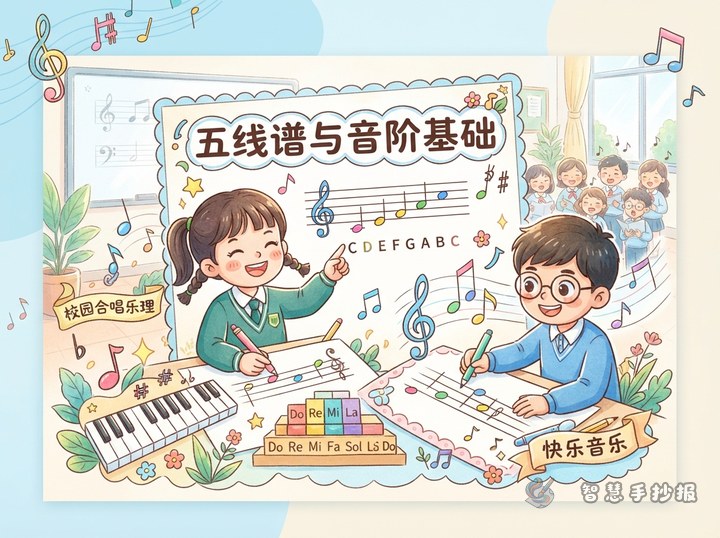
Build the three-column strip: letter names, solfège, numbers
This is the most useful part of the whole poster. Divide a long horizontal band into three rows of cells and run from do up to si:
- Letter names: C D E F G A B, the fixed names for pitch positions.
- Solfège: do re mi fa sol la si, the names we actually sing.
- Number notation: 1 2 3 4 5 6 7, the most compact way to write on paper.
Small drawings make it livelier: a star beside do, a cat beside mi, a single note beside la.
Do not forget to mark where do sits
In treble clef, middle C sits on the first ledger line below the staff, while in jianpu the position of 1 depends on the key signature. One line saying “1 = C” tells readers exactly where the chart starts.
Draw a matching ruler down the centre
A table alone can feel like copied definitions. A matching ruler makes it hands-on:
- Draw five evenly spaced horizontal lines in the middle of the page, about one centimetre apart.
- Place a small dot on each line and in each space, nine positions in all.
- Use coloured arrows to link every dot to a numbered cell on the right, writing 1 to 7.
- Put middle C in the treble clef cell and outline it in red to highlight the starting point.
- Add a small blue note at the bottom: numbers shift with the key, letter names never do.
Make it useful: finding your own part's first note
Add a “choir warm-up” box. Before rehearsal, a singer checks which number their part starts on, then finds that same note on a line or space of the staff. Leave two or three blank lines for readers to fill in, and the poster becomes a quiz card classmates can use on each other.
Plan the layout and colours
- Left side: the three-column strip, pale yellow background, largest lettering.
- Centre: the staff matching ruler, lines in blue, do marked in red.
- Right side: the choir exercise and a short list of pieces being rehearsed.
- Bottom band: one memory rhyme in big letters to anchor the page.
Keep to three colours: one for numbers and notes, one for arrows and connecting lines, one for headings. The page will look calm instead of crowded.
Close with a line worth remembering
“Notes live on lines, notes live in spaces; numbers are jianpu, letters are names, and singing makes them solfège.” Read it twice and it sticks. If you want neater tables and consistent borders, open the Smart Handwritten Poster mini program, pick a music layout and drop your finished text into it.