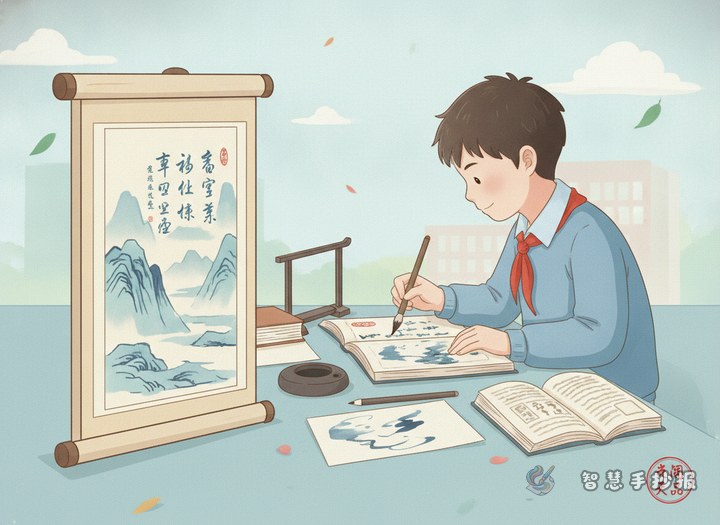
Pick One Main Line: Character Change Carries the Whole Poster
A calligraphy and Mandarin poster that only copies famous quotes can feel scattered. Using the evolution of Chinese characters as the main line gives the page an order: readers follow it from oracle bone script to today's regular script and see how a character changed over time. Settle on one theme sentence first, such as three thousand years of the character for mountain, and let every other box support it.
- Choose only one main line: time order, one character's changes, or the story of a radical.
- Keep four to six boxes so there is room for sample characters and a title.
- Sketch on scrap paper before drawing on the final sheet.
Five Stage Boxes and What Goes Inside
You do not need every dynasty. Five stages work well: oracle bone script, bronze script, small seal script, clerical script and regular script. Two or three lines plus one enlarged sample character per box is enough.
- Oracle bone script: shapes look like pictures, carved on shells and bones with thin, straight strokes.
- Bronze script: cast on bronze vessels, with rounder and thicker lines.
- Small seal script: a standardized script with even strokes and left-right symmetry.
- Clerical script: rounded lines were flattened and horizontal strokes gained a wave-like finish.
- Regular script: the script we write and print today, square and clearly separated.
Add one line under each box showing how the character is read in Mandarin, and the calligraphy and Mandarin parts connect naturally.
Layout: A Timeline Plus Zoom Boxes
Dividing the sheet into three areas is the simplest plan: a timeline across the middle with five boxes hanging from it, a zoom box on the left showing one character in all five styles, and a narrow column on the right for Mandarin tips. Draw the arrow from past to present, not the other way round.
- Rule the zoom box with a light pencil grid and erase the lines after writing.
- Number the five stages in one colour so the order is obvious.
- Keep the title under about a third of the page; empty space makes the page readable.
- Leave a finger-wide gap between text boxes in case one needs to be redrawn.
Where Mandarin Fits Naturally
Character evolution is about shape and Mandarin is about sound, so the two support each other. A narrow tip column is enough; there is no need to give it a whole block.
- Add pinyin to each sample character and watch for characters with more than one reading.
- Put one or two tongue twisters in a corner and read them aloud when the poster is finished.
- Write a closing sentence to read out, such as reading a three-thousand-year-old character in Mandarin.
- Limit hard-to-read place names or surnames to one or two lines so they do not take over.
Step Order and Common Slip-Ups
- Fix the theme sentence, sketch the layout, and only then start writing.
- Draw every box and the timeline in pencil, check the proportions, then add colour.
- Fill the wordiest box first and do the title last.
- Write sample characters in pencil before going over them in black pen.
- Check for wrong characters and wrong pinyin before handing the poster in.
If the sketch never looks right, open the 智慧手抄报 Mini Program in WeChat, choose a calligraphy and Mandarin poster template, and place the timeline, boxes and borders before filling in your own text.