Begin with a Sound Journey Through Mountains and Water
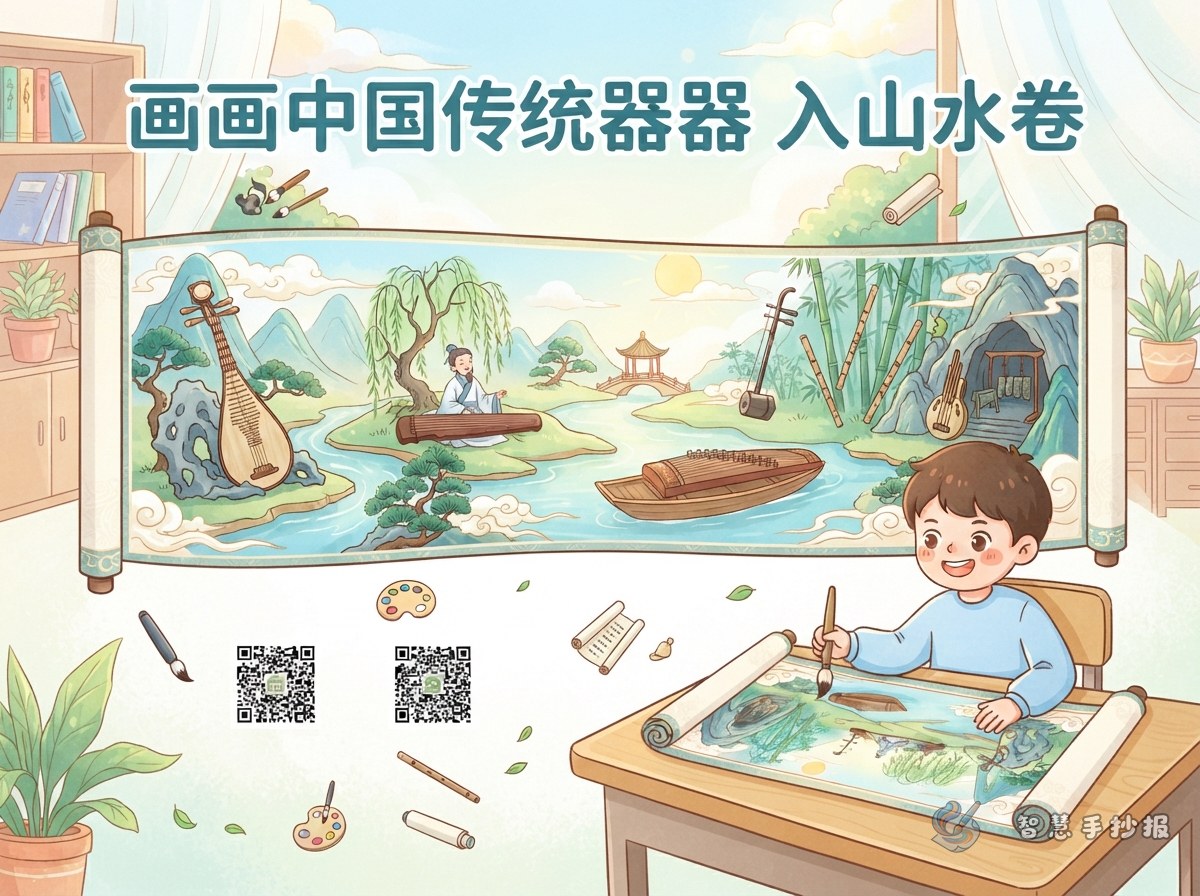
Instead of dividing the page into ordinary boxes, design this handwritten newspaper as a horizontal landscape scroll. Place the title above distant mountains, draw a river or winding path from left to right, and arrange traditional instruments and short information cards along the route. Readers can then follow the page like a cultural journey filled with imagined sounds.
A suitable main title is Chinese Sounds Hidden in Mountains and Water. A subtitle could say, “Discover traditional instruments and feel the beauty of Chinese folk music.” The focus should not be on filling the page with instruments, but on matching mountains, water, bamboo, moonlight, and instruments in one coherent scene.
Create Four Sound Stops Along the Scroll
Listen to the guqin in the distant hills
At the beginning of the scroll, draw distant mountains, pine trees, and a small guqin. You can write: “The guqin feels calm and deep, like an echo returning from a faraway mountain.” This creates a quiet and elegant mood.
Meet the bamboo flute in the forest
For the second stop, draw a bamboo grove with leaves moving in the breeze, together with a bamboo flute. Add this short description: “The flute sounds bright and lively, like a gentle wind passing through bamboo and carrying a cheerful feeling into the distance.”
Enjoy the pipa under the moon
Place the pipa beside the moon, a bridge, or warm lantern light. Emphasize its curved body and strings. A useful text line is: “The pipa has a rich sound, sometimes lively and sometimes tender, like a story unfolding beneath the moon.”
Hear the yangqin beside the river
At the end of the scroll, draw a riverbank, sunset, and yangqin. Write: “The yangqin has a bright, crisp sound that adds a lively color to traditional music.” These are artistic associations for a school project, not quotations from a particular poem or person.
Turn the Information into Easy-to-Read Cards
Do not place long paragraphs beside each scene. Use a consistent small-card format to keep the page organized. Suggested sections include:
- Instrument Profile: Write the instrument’s name, a visible feature, and one or two simple facts.
- Sound Association: Use words such as distant, bright, lively, or tender to describe the feeling of the sound.
- Scene Pairing: Explain whether the instrument is paired with mountains, bamboo, moonlight, or a riverbank in your artwork.
- My Discovery: Leave a small space for the instrument the student most wants to learn about or likes best.
At the end of the scroll, add a closing paragraph: “Traditional instruments do more than create beautiful melodies. They also carry Chinese ideas about beauty, emotion, and everyday life.” This gives the project a clear ending and connects instrument appreciation with traditional culture.
Arrange the Page Like a Painting
- Use a pencil to sketch mountains, a river, or a winding path that guides the eye from left to right.
- Place the title in an open area near the top. Decorate it with clouds, birds, or a seal-shaped border.
- Scatter the four instrument stops along the path rather than placing them in one straight row.
- Put each information card in an empty area and limit it to two or three lines for clear handwriting.
- Add small clouds, strings, bamboo leaves, or music symbols around the edges without taking space from the main text.
Finish with Light Colors and a Careful Check
Use an ivory, pale blue, or light green background. Green and blue can show the landscape, while brown or dark blue can outline the instruments. Use warm yellow for the moon and title to create contrast. If the ink-wash style looks too dark, keep the paper bright and use deeper colors only for rocks and borders.
Before finishing, check three things: Can the title be understood at a glance? Can the four sections be read along the scroll? Is the handwriting clearer than the decoration? Complete the pencil sketch first, then outline, color, and copy the text. For faster layout planning, students and parents can continue organizing the project in the WeChat mini program from Wisdom Handwritten Newspaper.