Why Some Instruments Look Like Newcomers
Most instrument posters start with the familiar grouping of wind, bowed, plucked and percussion, or introduce guzheng, dizi and gongs one by one. That works, but it can read like a shopping list. Try a different opening question instead: which instruments we know today actually arrived from somewhere else?
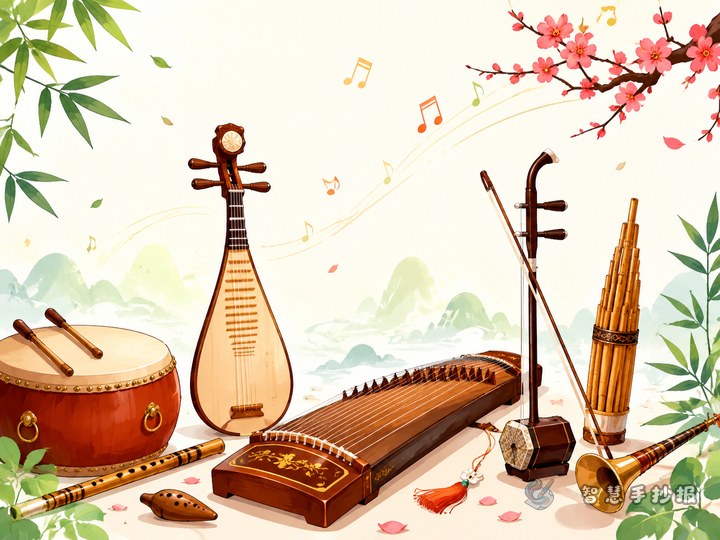
That question gives your poster a storyline. The pipa and konghou are often described as travelling along the Silk Road. The erhu is linked to bowed instruments of northern peoples. The suona and yangqin are often traced to Central and West Asia. All of them gradually became sounds Chinese stages cannot do without.
Mini Profile Cards You Can Copy
One small card per instrument is easier to read and easier to draw than a long paragraph. Use this format:
- Name: Pipa, whose name once suggested the way it is played.
- Looks: A pear-shaped body with four strings, held upright against the player.
- Sound: Bright and crisp, like raindrops when fast, like quiet speech when slow.
- Specialty: Dramatic battle scenes and gentle lyrical passages alike.
- Story: It came from the west and appears in murals and old poems.
For the erhu, mention two strings and one bow, a sound close to the human voice. For the suona, describe its loud, bright voice that suits celebrations. For the yangqin, explain that it is struck with small hammers, almost like a tiny percussion instrument. Add a quick sketch to each card and the page already looks tidy.
Layout: Let One Route Connect Everything
Since the theme is travel, let the layout follow a line. Three options work well:
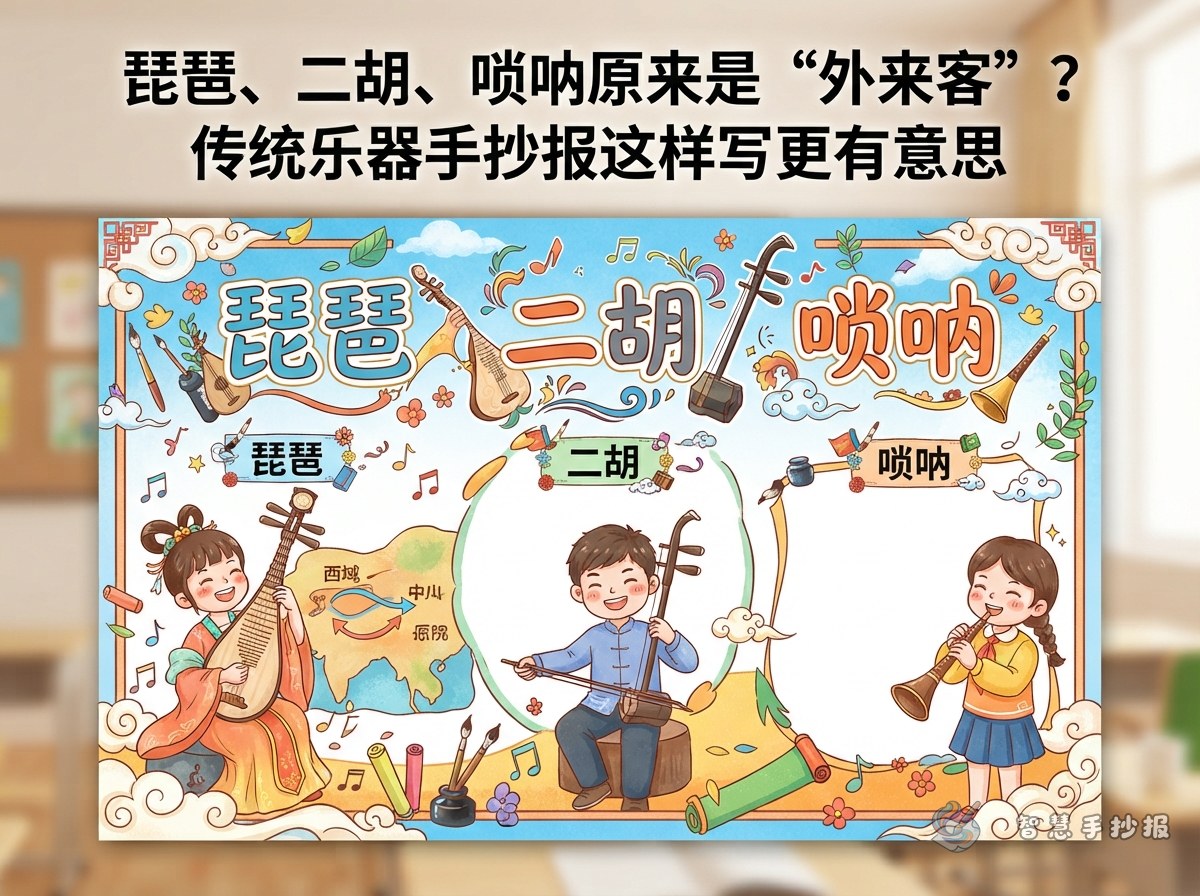
- Route map: Draw a simplified map with desert and mountains on one side, cities and a stage on the other. Place the cards along the route with arrows or caravan silhouettes.
- Winding path: Draw a curved path from top left to bottom right, set the cards along it and decorate with small details like lanterns and willow branches.
- Two-column contrast: One column for where it came from, one for what it became in China, separated by a bold heading and a decorative border.
Make the main title conversational, such as Friends Who Travelled a Long Way. Keep it centred at the top, put your name and class in the lower right corner, and leave enough white space.
Three Sentence Patterns to Reuse
- Contrast: It did not always look the way it does now, but its special sound stayed.
- Blending: It came from far away and now sits beside the dizi and the gongs, playing Chinese music together.
- Feeling: Close your eyes and it sounds less like an instrument and more like someone telling a story.
Finish with a small section called Today's Chinese Music Stage, noting where these instruments sit in a modern ensemble, and your poster has a clear beginning and end.
Small Reminders Before You Start
Choose three or four instruments rather than ten, because depth reads better than breadth. Use cautious wording such as often said to come from, so you avoid overclaiming. For colours, try sand yellow and ochre for the journey and vermilion and green for the Chinese stage, so the two halves of the page contrast nicely.
If you want to speed up the layout, open the Smart Handwritten Poster mini program in WeChat, pick a traditional instrument template, drop in your profile cards and section titles, then print and colour by hand.