Pick One Story Line Before You Draw
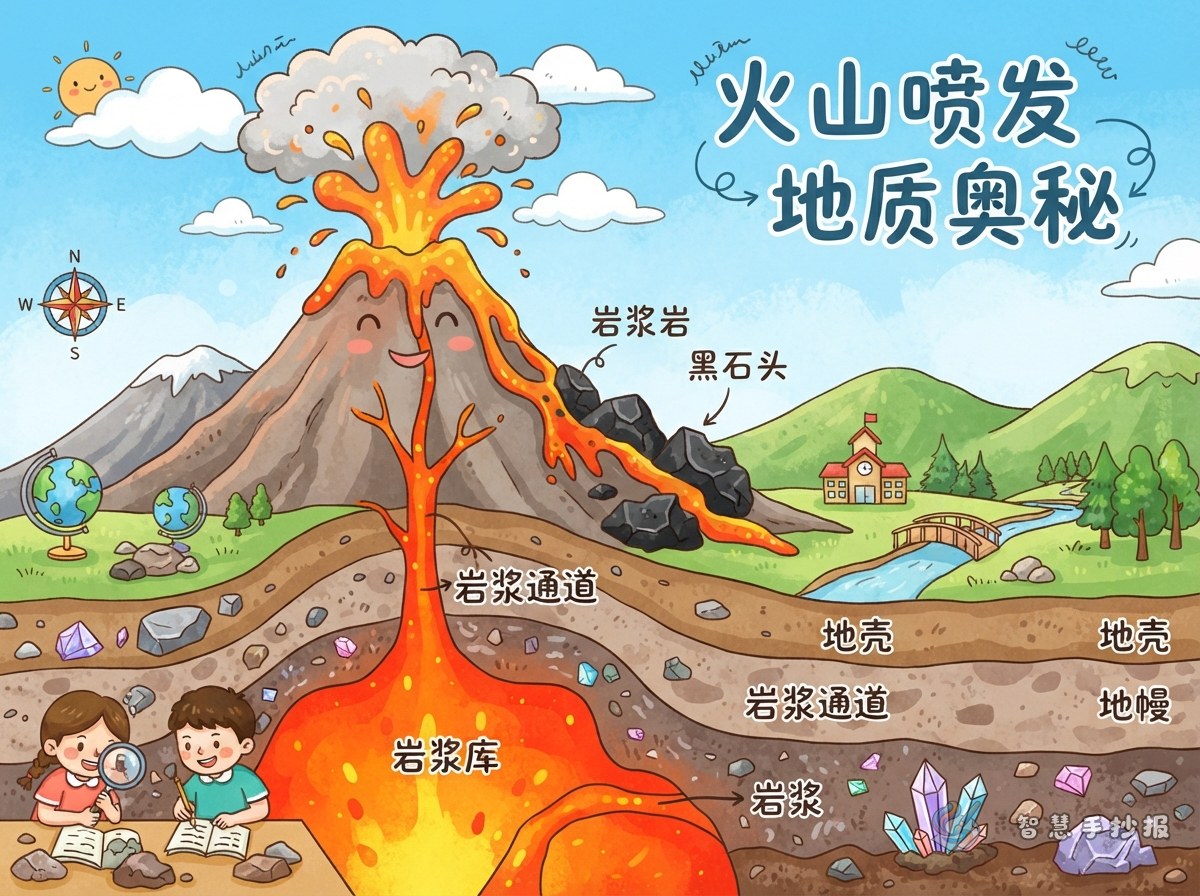
The usual problem with a volcano poster is a single smoking mountain in the middle and empty space around it. Before drawing, decide on one sentence: how magma travels from deep underground to the surface and turns into stone. That sentence becomes the order of the whole page.
Break it into four panels: magma underground, magma moving up a channel, eruption at the surface, cooling into rock. You can arrange them as a horizontal comic strip or stack them as a vertical path from the ground to the sky.
Three Facts That Fill the Page
Why magma moves upward
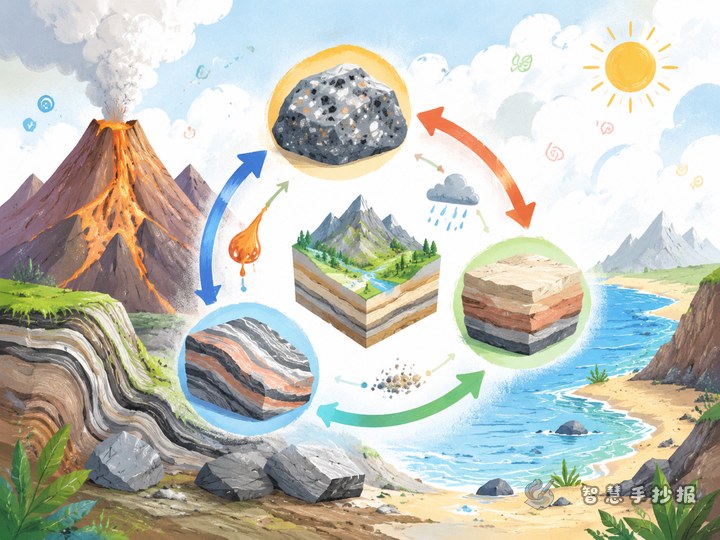
Deep underground, hot rock becomes sticky magma. It is lighter than the rock around it and is pushed by pressure, so it works its way up through cracks. When an opening forms, we see an eruption.
Fast cooling and slow cooling look different
Rock made from the same magma can look different depending on where it cooled. Magma that reaches the surface cools quickly, so crystals barely grow and the grains look fine. Magma trapped deep underground cools slowly, so crystals have time to grow and the grains look coarse. Draw two small boxes side by side, one with tiny dots and one with big grains.
Volcanoes are not only dangerous
- Volcanic ash and weathered volcanic rock can become rich soil for farming.
- Volcanic areas often have hot springs and geothermal heat for warming homes and making electricity.
- Minerals in volcanic rock and the ash itself are useful materials.
Short Text You Can Copy Onto the Sheet
Keep sentences short and add a small heading to each block. Pick a few of these and rewrite them in your own words:
- Magma is the hot, sticky material under the ground.
- Magma that reaches the surface cools into volcanic rock.
- Fast cooling gives fine grains; slow cooling gives coarse grains.
- The crater is the doorway magma comes out of.
- Fallen ash can slowly become soil over many years.
- When you visit a volcano, follow the rules and stay away from danger zones.
Layout: Let the Eye Travel Upward
Try a vertical flow. Use the lower part of the page for the underground scene, with a magma chamber and a winding channel. In the middle, draw the cone and the ash plume with a few curved lines drifting sideways. Split the top into two blocks: a rock card on one side and a volcano-and-people box on the other.
Borders help too. Use wavy lines for the underground section and straight lines with small dots above ground, so readers know where they are without reading a word. Place the title slightly off-centre at the top and leave room for the plume to rise, which keeps the page from feeling cramped.
Two Small Boxes That Make It Feel Like Real Research
The first is a rock card with four lines: name, colour, grain size, and where it formed. Draw two or three of them as cards. The second is an observation tips box with safety reminders and simple methods, such as checking colour, feeling the grain, and noting where the rock was found.
If you want to swap the layout or add more boxes after the rough draft, scan into the Smart Handwritten Newspaper WeChat mini program, adjust the sections on a template, and then copy the final version onto paper.