Begin with a story-shaped timeline
A geological time theme works well when a winding timeline runs across the whole page. Readers can follow it like a river from the ancient Earth to the world they see today. Use “Journey Through Geological Time” as the main heading and add a short subtitle about rocks, mountains, and landforms. There is no need to crowd the page with difficult dates; a clear sense of change is more important.
- Main image: Draw a blue-green winding river to represent the timeline and place four “time stones” along it.
- Reading path: Start in one upper corner, pass through four stops, and finish at “Earth Today.”
- Visual focus: Make the title, timeline, and four stops larger than the ordinary notes.
Four stops on the geological journey
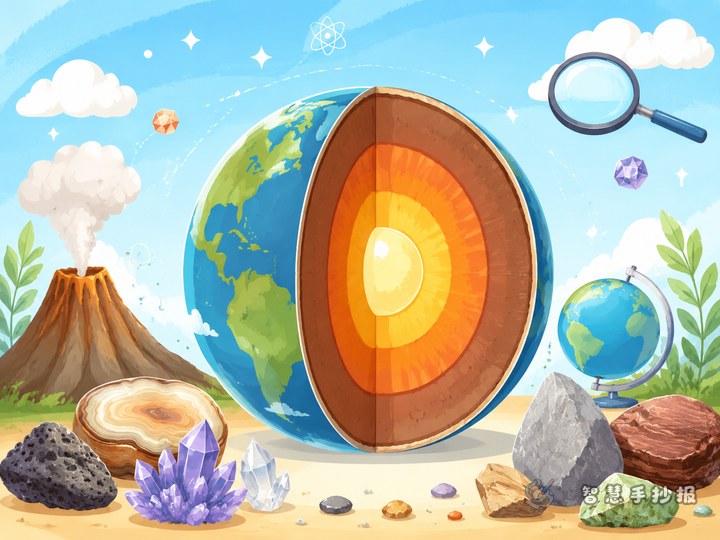
Stop one: The ancient Earth
Write: “The early Earth went through heat, cooling, and gradual surface changes. This was the beginning of its geological story.” Add a small Earth with a red-orange glow to show the distant starting point.
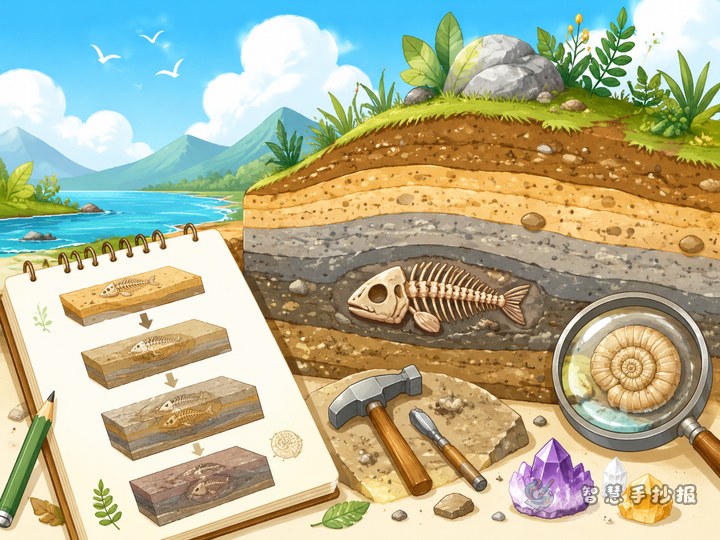
Stop two: Oceans and rock layers
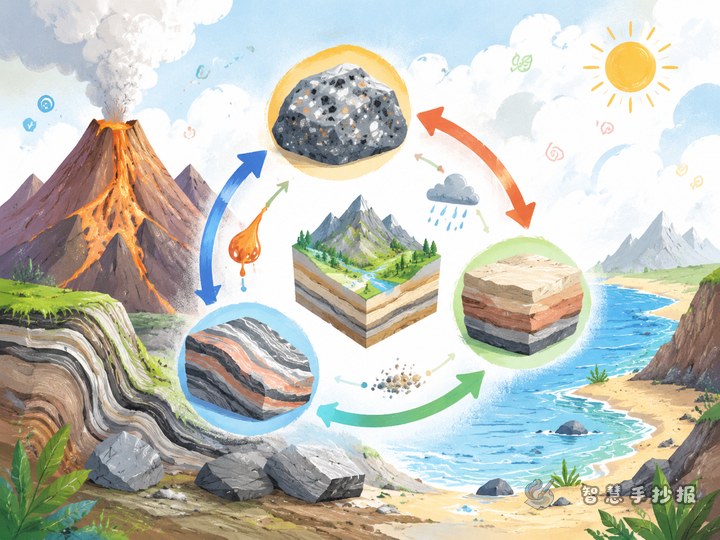
Write: “Water, wind, and sediment have helped shape the surface again and again. Rock layers are like pages that preserve clues about past environments.” Use waves, pebbles, and horizontal layers to connect the ocean with the land.
Stop three: Changing life
Write: “Over very long periods, life appeared, flourished, and changed as the environment changed.” Add simple leaves, shells, or life silhouettes without making the drawings too complicated.
Stop four: Landforms today
Write: “Mountains, valleys, coasts, and soil are still slowly changed by weathering, erosion, and deposition.” Draw a mountain, a river, and a coastline at the final stop to show that Earth is still active.
Turn the page into an explorer’s map
- Lightly sketch an S-shaped timeline that begins near the title and travels toward the bottom of the page.
- Place four round or rock-shaped text boxes at the turns. Give each box one heading and two or three short lines.
- Reserve a corner for a “geology word guide” explaining rock layer, landform, weathering, and sedimentation in child-friendly language.
- Add a compass, magnifying glass, footprints, and a geology hammer in the open spaces, but keep them away from the main text.
Short lines ready to copy
- Earth is a geological storybook that opens very slowly.
- Rock layers keep clues left by changing environments.
- A mountain may need an extremely long time to form.
- Looking at a stone is one way to look at Earth’s journey.
- Today’s landforms are scenery shaped by a very long history.
Use color to show the passage of time
Use red-brown and orange for the ancient Earth, blue, gray, and sand colors for oceans and rock layers, green for changing life, and blue-green with brown for today’s landforms. Write the body text in black or dark gray and outline the headings with a broad pen. Before finishing, check that the timeline flows in one direction, each section has enough space, and every sentence is easy to read. To arrange the title, sections, and decorations more smoothly, continue making the project in the 智慧手抄报 WeChat mini program and adjust the content to fit the paper size.