Why Start with a Timeline Instead of a Name List
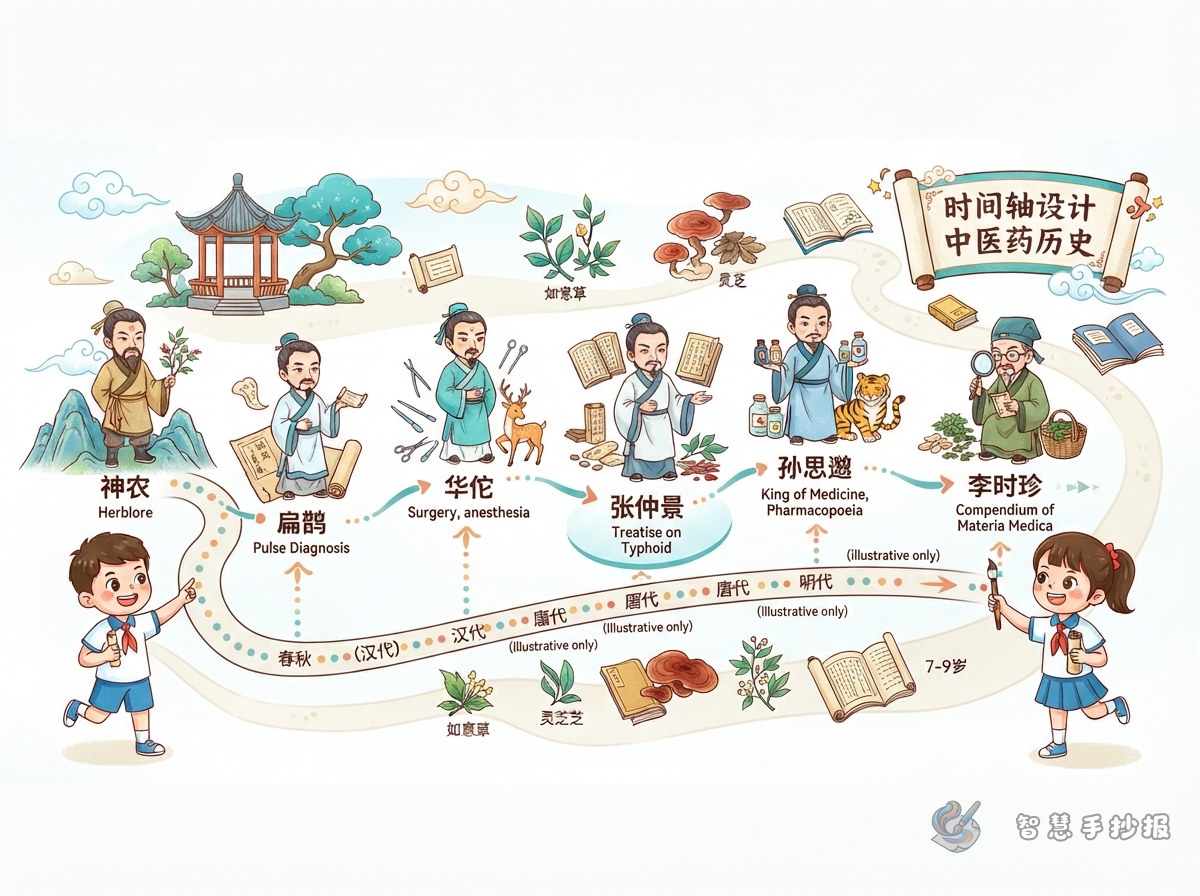
Chinese ancient physicians lived across many different periods, so writing them one by one can easily turn a poster into a plain list. A timeline gives the page a clear reading order. Readers can move from left to right or top to bottom and see how medical knowledge and stories developed over time.
- It creates a natural sequence.
- It connects several physicians on one path.
- The spaces around the line become ready-made areas for story cards.
- It gives the poster a strong closing line, such as “The heart of healing passes from age to age.”
Choosing Names for Each Period
Earliest Times and the Pre-Qin Era
- Shennong: tasting herbs and identifying their properties. This works well as the starting point, with small herb drawings nearby.
- Bian Que: observation and pulse reading. His stories are short and easy to turn into a story card.
Han and Tang Dynasties
- Zhang Zhongjing: honored as a medical sage, he wrote an important work on cold damage and other diseases. A small consultation scene fits this card.
- Hua Tuo: surgery stories and the Five Animal Frolics. The movement theme makes this card lively.
- Sun Simiao: a Tang physician known for medical writings and the spirit of sincere practice.
Song, Yuan, Ming, and Qing
- Li Shizhen: compiling a major materia medica. Draw herbs, a basket, or mountain paths beside his card.
- Qian Yi: a famous figure in children’s medicine, good for a caring angle.
- Ye Tianshi: a later physician connected with warm-disease studies, useful if the poster needs one more name.
If the page is small, do not include everyone. Four to six figures with strong stories are enough.
Planning the Page: Main Line, Story Cards, and Space
On a landscape poster, place the timeline slightly below the middle and make it bold. Write period names inside small flags or circles. Alternate the physician cards above and below the line instead of pushing them all to one side.
- Main line: about one third of the page, with a clear arrow or direction.
- Story cards: one box or cloud shape per person, kept at similar sizes.
- White space: leave room between figures for herbs, medicine gourds, or old books.
- Color groups: use one color family per period, such as green for early times, red-brown for Han and Tang, and blue for later dynasties.
What to Put on Each Story Card
- First line: period and name, such as “Eastern Han · Hua Tuo.”
- Second line: one keyword, such as surgery, Five Animal Frolics, or materia medica.
- Third line: one short story or contribution, about 40 to 70 Chinese characters.
- Fourth line: a personal thought, such as what you admire or learn from this doctor.
Title Ideas and Short Lines
- “One Line, a Thousand Years of Healing”
- “From Tasting Herbs to Writing a Materia Medica”
- “The Heart of Medicine Passes On”
- “Reading Chinese Ancient Physicians Along a Timeline”
Keep the main title large at the top, then add a smaller line below it to explain the sections. This makes the page easier to read at a glance.
Before You Start Drawing
Sketch the timeline, story cards, and title lightly in pencil first. Write the text on scrap paper, shorten it, and then copy it onto the final sheet. If you want help with the layout, open the WeChat mini program “Smart Handwritten Newspaper,” choose a theme about Chinese ancient physicians and medical stories, and place your own text into the prepared timeline and card areas.