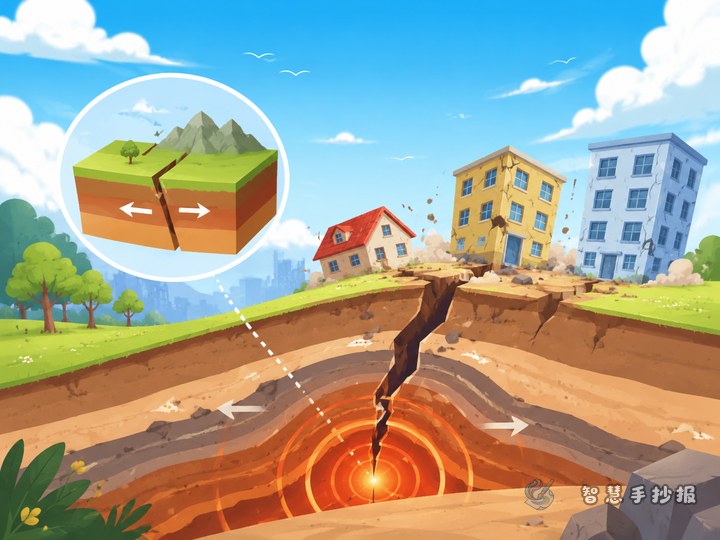
Set One Goal: Can Readers Tell the Two Words Apart?
Magnitude and intensity are often copied onto a school poster as if they meant the same thing. A poster has limited space, so instead of packing in every earthquake fact, solve one problem: after reading, a classmate should be able to say that magnitude is how big the earthquake itself was, and intensity is how strongly a place was affected.
Once that goal is clear, choosing material becomes easy. Sentences about energy, the focus and "one earthquake, one magnitude" go into the magnitude column. Sentences about buildings, ground shaking, distance from the epicentre and "it differs from place to place" go into the intensity column. Two baskets, no confusion.
Plain Explanations You Can Copy Straight Onto the Page
Magnitude: how much power the earthquake has
Write something like: magnitude shows how much energy an earthquake releases, and one earthquake normally has only one magnitude. The larger the magnitude, the more energy is released. Add a small "power meter" drawing beside it, with arrows that grow thicker as the magnitude rises.
Intensity: how hard this place was shaken
Write something like: intensity describes how much the ground, buildings and objects were shaken or damaged. For the same earthquake, intensity is high near the epicentre and lower further away, and it can also be higher on soft ground or among older buildings. Show this with a few squares in different shades, darker nearby and lighter far away; it reads faster than a long paragraph.
Three Panel Blocks That Work Well in a Layout
- Side-by-side comparison: draw a vertical line down the middle, label the left side "Magnitude" and the right side "Intensity", give each a different heading colour, and keep the number of bullet points equal so the page looks balanced.
- Reminder box: below the comparison, add a rounded box with the line "One earthquake has one magnitude, but it can have many intensities." This is the sentence readers should remember.
- Everyday example strip: use two or three lines, for example, "In the same earthquake, people near the epicentre felt strong shaking while people far away felt only a gentle sway." It turns an abstract idea into a picture.
If space remains, tuck a mini quiz into a corner with two true-or-false statements, so classmates can test themselves after reading.
Slip-Ups to Avoid
- Do not swap the definitions. Write one sentence for each term with one example, then check both before copying in neat handwriting.
- Do not write "a magnitude 6 earthquake means intensity 6 everywhere". That makes intensity sound like a fixed number.
- Do not pile up technical terms to fill space. Replace words younger students cannot read and keep sentences short.
- Do not state a conclusion without a reason. Add "because distance from the epicentre and ground conditions differ" and the panel suddenly feels complete.
Headlines and Short Lines Ready to Use
- Magnitude measures energy, intensity measures impact.
- One earthquake, one magnitude; different places, different intensity.
- The closer to the epicentre, the stronger the shaking usually feels.
- Read the numbers, but also learn how to stay safe.
- Understanding earthquakes helps us protect ourselves.
Use "Magnitude and Intensity: What Is the Real Difference?" as the main headline, with a small subtitle beneath it. Write the headline in thick marker and the body text in a neat pen, and keep to three colours or fewer for a cleaner look.
When the writing and layout are done, you can search for the Smart Handwritten Poster mini program on WeChat if you want to try another panel style, adjust the colour scheme or rewrite the headline, and finish this earthquake science poster with a template you like.