Tell the Story of a Growing Crystal
Build the poster around one question: how do hard, geometric crystals gradually appear? Use dissolving, evaporation, crystallization, and growth as the main sequence. A simple salt-crystal observation can connect the scientific explanation with a hands-on activity.
Key Facts Worth Including
Why crystals have regular shapes
The tiny particles inside many substances can arrange themselves in repeating patterns. Under suitable conditions, more particles join the pattern and a crystal may develop flat faces and a regular shape. Temperature, available space, solution concentration, and time can all affect its growth.
How crystals and minerals are connected
Many minerals occur as crystals, including quartz and halite. However, not every crystal-shaped material is a mineral. Table salt can form sodium chloride crystals, and sugar can also crystallize, but sugar is not normally classified as a mineral.
Create a Salt Crystal Observation Station
This safe, supervised activity can become the main feature of the handwritten poster.
- Gradually stir salt into warm water until a little salt remains undissolved at the bottom.
- Pour the salt solution into a clean container and place it where it will not be knocked over or filled with dust.
- Observe it at the same time each day and record the water level, crystal changes, date, and a small sketch.
- Do not taste the materials. Clean the container and wash your hands after the activity.
Use honest notes such as “only salt water today,” “the water level is lower,” or “small grains appeared near the edge.” If no crystals appear yet, record the waiting time and surrounding conditions instead of inventing a result.
Arrange the Page Like an Ordered Crystal
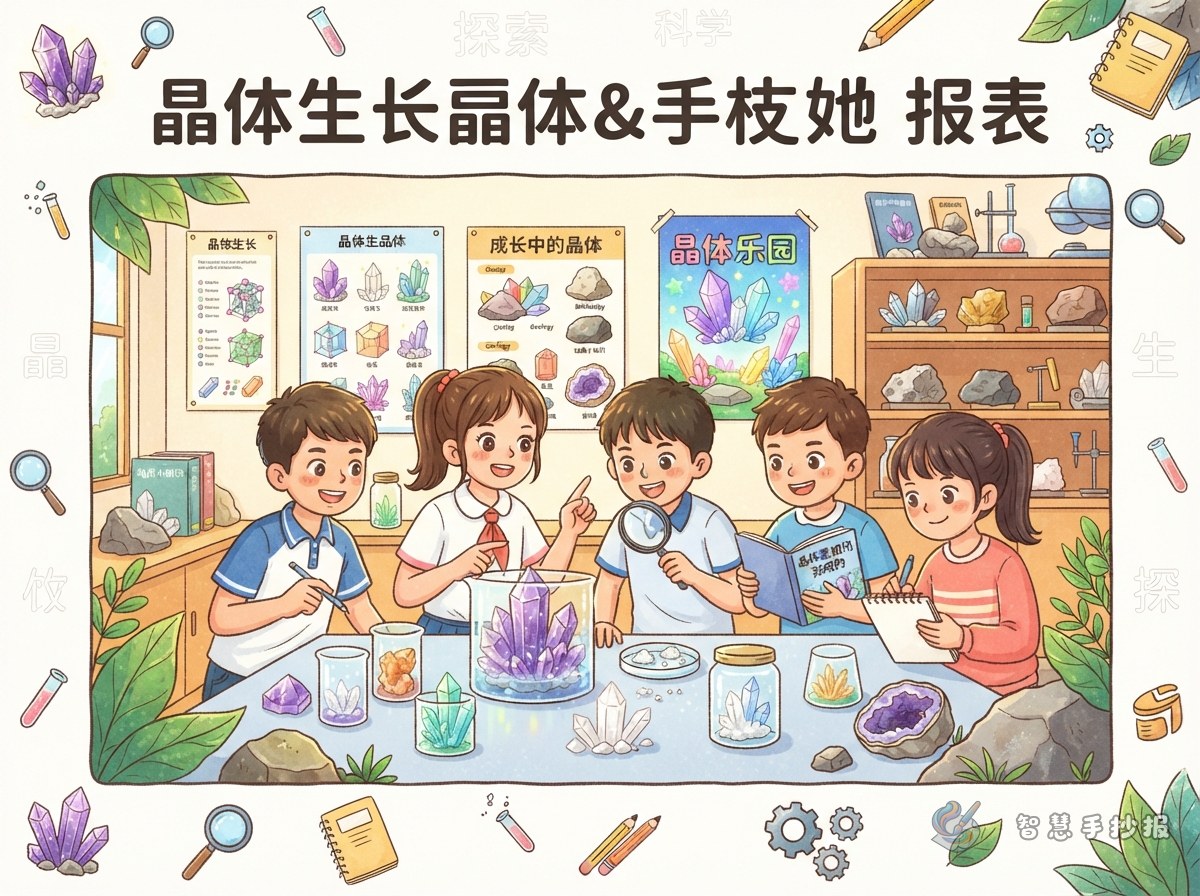
- Center: Draw one enlarged crystal and label its faces, edges, and vertices.
- Left side: Add a short flowchart showing how crystals form.
- Right side: Place an observation table with spaces for the date, result, and prediction.
- Bottom: Include small mineral cards for quartz, halite, and other suitable examples.
Light blue, purple, and golden yellow work well for this theme. Polygon borders can echo crystal shapes, while clear handwriting and generous spacing keep the scientific information easy to read.
Finish With Scientific Questions
Add sections called “What I Discovered” and “What I Still Wonder.” A student might compare a cool location with a well-ventilated one or ask why different substances make different crystal shapes. After preparing the facts and observation notes, students and parents can open the Smart Handwritten Poster WeChat Mini Program to choose a layout, adjust each section, and continue creating the poster.