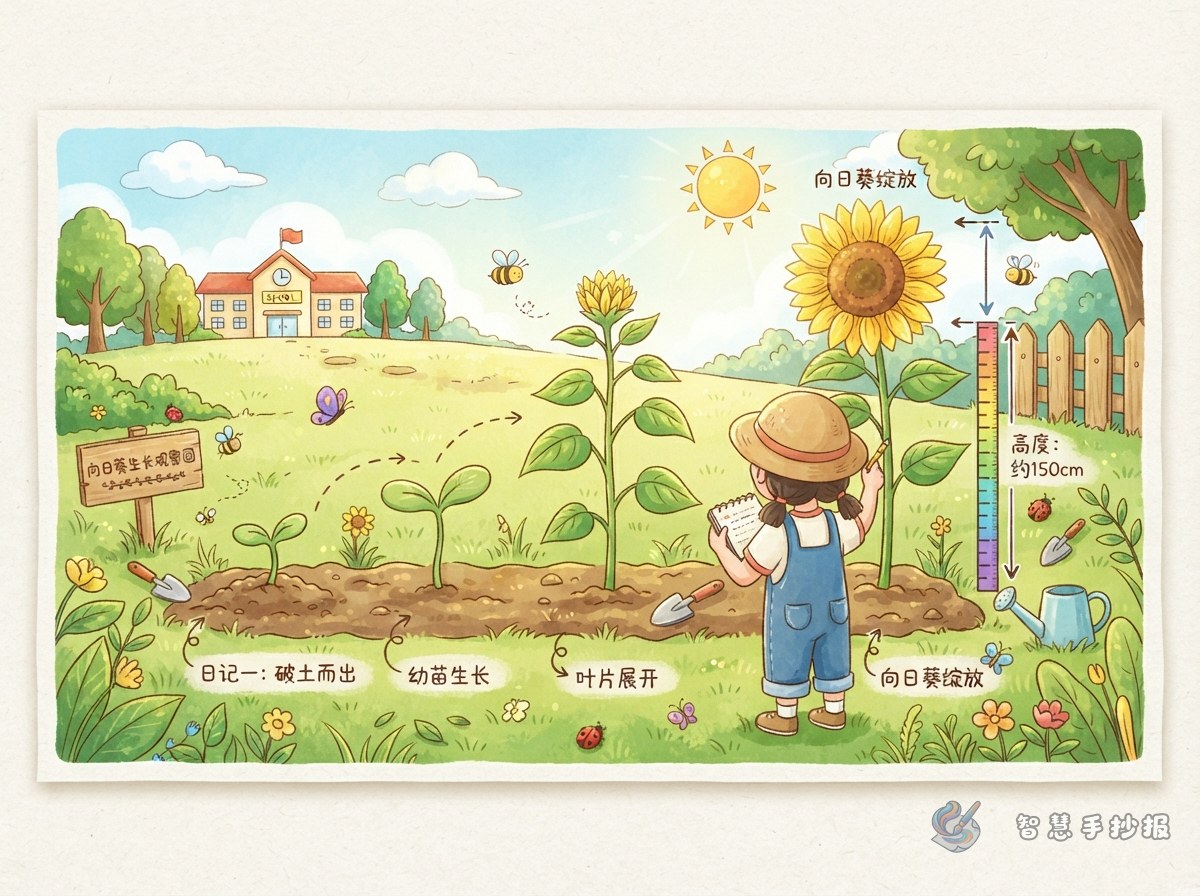
Why Sunflowers Work Well for a Planting and Labor Poster
Sunflowers grow tall and change quickly, so there is something new to notice almost every week from sowing to seed harvest. The care tasks are clear too: thinning, loosening soil, watering, staking, removing dry leaves, and drying the seeds. When students place “what I saw” next to “what I did,” the poster reads like a real record instead of a plant report.
Set Up Columns That Separate Observation from Labor
A single long paragraph about growth often turns into a description. Dividing the page into four or five columns keeps each part focused.
- Planting profile: crop name, sowing date, growing place, and the recorder’s name in a small box.
- Growth timeline: dates with height, leaf number, or flower head direction.
- Labor task list: what was done, which tools were used, and how long it took.
- My discoveries: leaves facing one direction, insects visiting, or changes in the soil after watering.
- One-sentence reflection: a short thought placed at the bottom to close the page.
Keep column names short, such as “Profile,” “Timeline,” and “Tasks,” so the headings do not crowd the writing space.
Write Each Growth Stage as “What I Saw” and “What I Did”
Three stages are enough to fill the poster without repeating yourself.
Sowing to sprouting
Describe how deep the seeds were planted, the shape of the first leaves, and which weak seedlings were removed during thinning. For labor, mention watering, covering the seeds with soil, and moving pots into the sun.
Leaves to flower buds
This is the fastest-changing stage. Record plant height and leaf count, whether the stem became thicker, and when the bud appeared at the top. Labor notes can include loosening soil, adding fertilizer, staking, and straightening plants bent by wind.
Flowering to seeds
Note when the flower head opened, how the petals unfolded from the outer ring inward, whether the head turned, and which insects visited. Labor notes can include removing lower dry leaves, covering the head with a net, and cutting and drying the head when the seeds mature.
Use the Sunflower Itself as Your Layout Guide
- Draw a large circle for the title and write “Sunflower Planting Observation” inside it. Use narrow petals around the circle, with a column name on each petal.
- Turn the stem into a vertical timeline, mark dates at the nodes, and place small note boxes beside them.
- Limit the poster to three main colors, such as yellow, green, and light brown, and leave the background mostly white.
- Put text-heavy columns in the lower half and small drawings or the planting profile in the upper half so the eye moves downward.
- Keep each column to five or six lines. If the text does not fit, shorten the sentences instead of using tiny handwriting.
Sentence Frames and Short Lines to Copy
Observation notes do not need fancy wording. Time, change, and action are enough. These frames can be adapted to your own records.
- “Today I measured the plant. It was taller than last time, and the newest leaf had just opened.”
- “After the bud appeared, I added a bamboo stake and tied the stem loosely with soft string.”
- “I noticed the topsoil dried quickly, so I moved watering time to the evening.”
- “The flower head faced the light, so I observed it at the same time for several days.”
- “Before harvesting, I covered the flower head with a net to keep birds away.”
To make the notes feel more like labor records, add one honest detail after each line, such as “My hands shook a little while tying the stake because I did not want to break the stem.”
A Quick Check Before You Start Writing
- Does each entry include a date and a specific change, rather than just “it grew well”?
- Does the labor column name tools and actions clearly enough for someone else to follow?
- Are the title, column names, and body text noticeably different in size?
- Is there white space around the edges, and do borders avoid covering the words?
- Did you sign your name and date at the bottom to complete the record?
If you want a different border or column combination, open the Smart Handwritten Poster WeChat mini program and choose a layout to continue filling in your observations.